Learning how to wear ihram is one of the first practical skills every male pilgrim needs. Two plain white sheets look simple on the hanger, yet many men arrive at the Miqat unsure how to tie the lower cloth so it stays up, or how the upper cloth should sit. This guide walks you through it calmly, step by step, so you can focus on your worship rather than your knots.
We cover what ihram is, how to prepare, how to wear ihram correctly, what you may wear with it and the mistakes that catch out first-timers. Practise before you travel and the real morning will feel easy.
What ihram means for men
Ihram is first of all a sacred state that begins when you make the intention for Umrah or Hajj. The clothing is the outward sign of that state. Before you think about how to wear ihram, remember that wearing the sheets alone does not put you in ihram; the intention and the Talbiyah do. Equally, if you have made the intention, you are in ihram even if your cloth slips.
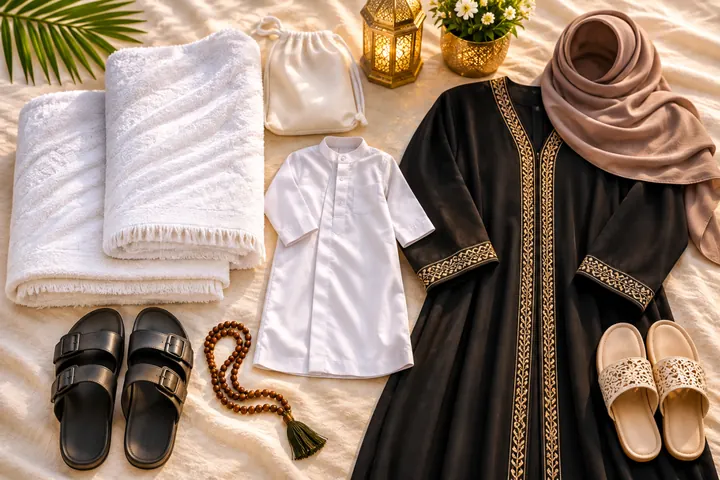
For men, the clothing consists of two pieces of plain, unstitched fabric, usually white towelling or cotton:
- The izar – the larger sheet wrapped around the waist, covering from the navel to below the knees.
- The rida – the upper sheet draped over the shoulders and back, rather like a shawl.
The basis is the well-known hadith reported by al-Bukhari and Muslim from Ibn ‘Umar, in which the Prophet ﷺ was asked what a pilgrim in ihram should wear. He said not to wear shirts, turbans, trousers, hooded cloaks or leather socks, unless someone cannot find sandals, and nothing touched by saffron or wars (a scented dye). White is recommended by scholars, though the colour is not a strict condition. For the complete list of rulings, read our ihram rules guide.
Choosing the right ihram cloth
Buying well is half of knowing how to wear ihram comfortably. Look for a lower sheet that is long enough to wrap around your waist one and a half times. Towelling is warm and absorbent, which suits winter and air-conditioned flights; thinner cotton is cooler in the warmer months. Many men pack two sets so one can be washed. Our Umrah packing list covers the rest of what to bring.
Before you put it on
Preparation is part of how to wear ihram well, and doing it at home saves stress at the airport. Most pilgrims put on the cloth before leaving for the airport and make the intention later, when they reach the Miqat.
- Trim and clean. Clip your nails, trim the moustache and remove underarm and pubic hair. Once in ihram these become prohibited, so do them now.
- Take a bath (ghusl). A full bath before ihram is a well-established Sunnah. If you cannot, wudu is sufficient.
- Apply perfume to the body only. Men may wear perfume on the head and beard before the intention, but not on the ihram cloths. If perfume gets on the cloth, scholars generally advise changing or washing it before ihram.
- Use the toilet. It sounds obvious, but it is far easier before the izar is tied.
Find out exactly where your route crosses the Miqat. If you are flying directly to Jeddah, it will almost certainly be in the air, so you need to be dressed before boarding or change on the plane. Our Miqat guide explains the five boundaries and the Miqat finder shows which applies to your route.
Free toolWhere is your Miqat?Find the Miqat for your route and when to be in ihram before you board.Find my Miqat →How to wear ihram step by step
Here is how to wear ihram in seven simple steps. Practise in front of a mirror with the belt you will use until you can do it in a couple of minutes.
Lay out both cloths
Unfold the izar and the rida and check which is larger. The bigger, heavier sheet is usually the izar. Keep an ihram belt or a few safety pins within reach.
Hold the izar behind you
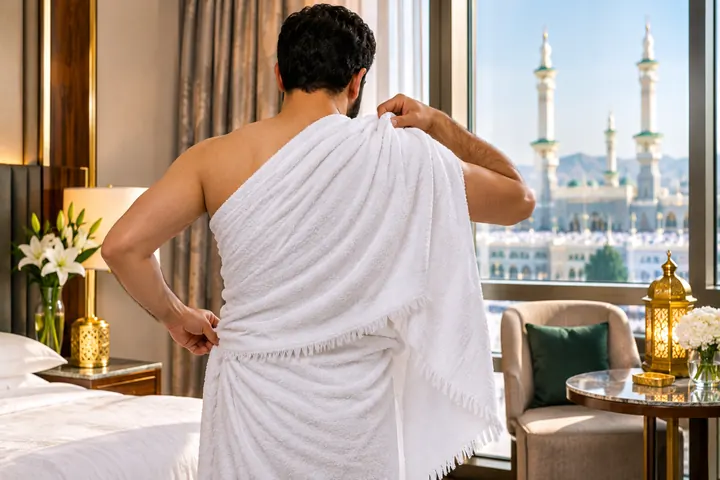
Hold the izar horizontally behind your back at waist height, with the top edge at or just above the navel and the bottom edge below the knees.
Wrap the right side across
Bring the right-hand side across the front of your body and tuck it against your left hip. Hold it in place with your left hand.
Wrap the left side over
Now bring the left-hand side over the top so it overlaps towards your right hip. Pull it snug, but not so tight that walking becomes difficult.
Roll and secure the waist
Roll the top edge outwards two or three times to lock it, then fasten an ihram belt over the roll. This is the secret to an izar that stays up through tawaf and sa‘i.
Drape the rida
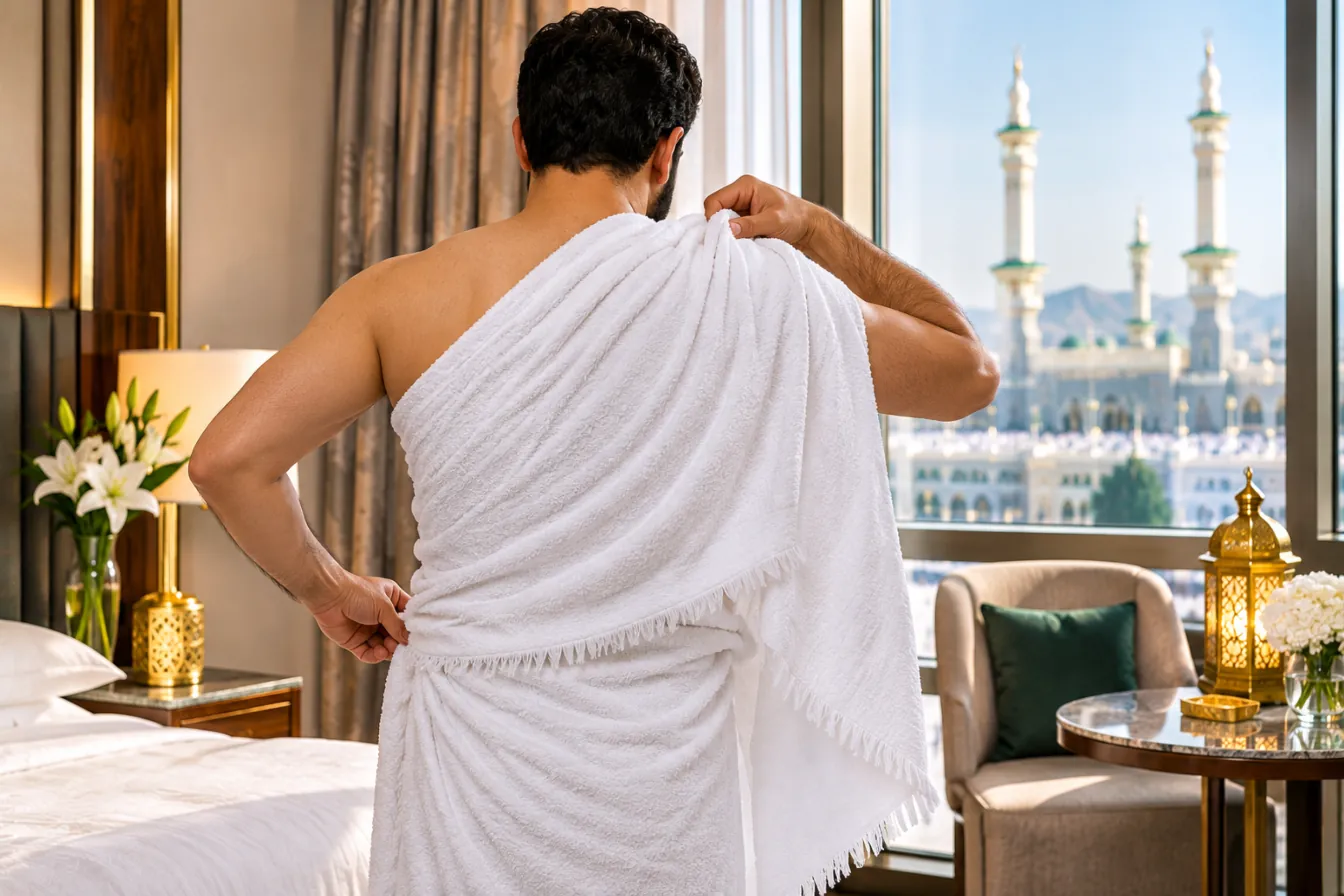
Place the rida over your back and bring both ends over your shoulders, so both shoulders are covered. Let the ends fall in front or cross them loosely.
Check the fit and footwear
Walk a few steps, sit down and stand up again. Check your knees stay covered and that your sandals leave the top of the foot exposed.
How to wear ihram so it stays secure
The most common complaint is an izar that loosens after an hour. When men ask how to wear ihram so it stays up, the answer is rolling the waistband, followed by a belt. A purpose-made ihram belt with pockets and a clip is permitted by the majority of scholars and is useful for your phone, hotel card and documents. Avoid knotting the corners of the izar together over the stomach, as this tends to slip and some scholars dislike it.
Some men add one or two safety pins to the rolled edge. Scholars differ on whether pins are disliked, but most permit them. A belt alone avoids the question.
Making the intention
Once you know how to wear ihram and are dressed, the next step is the intention. When you reach the Miqat, or shortly before it on a flight, intend Umrah in your heart and say the words of intention, then begin the Talbiyah. Men recite it aloud, and it continues until you begin tawaf.
لَبَّيْكَ اللَّهُمَّ عُمْرَةً
Labbayk Allahumma ‘umrah.
Here I am, O Allah, for Umrah.
Source: Muslimلَبَّيْكَ اللَّهُمَّ لَبَّيْكَ، لَبَّيْكَ لَا شَرِيكَ لَكَ لَبَّيْكَ، إِنَّ الْحَمْدَ وَالنِّعْمَةَ لَكَ وَالْمُلْكَ، لَا شَرِيكَ لَكَ
Labbayk Allahumma labbayk, labbayka la sharika laka labbayk, inna-l-hamda wa-n-ni‘mata laka wa-l-mulk, la sharika lak.
Here I am, O Allah, here I am. Here I am, You have no partner, here I am. All praise, blessings and sovereignty belong to You. You have no partner.
Source: al-Bukhari and MuslimIdtiba: the right shoulder in tawaf
Many men think how to wear ihram means keeping the right shoulder bare throughout, and that is one of the most frequent mistakes. Idtiba means passing the rida under the right armpit and placing its end over the left shoulder, leaving the right shoulder uncovered. It is a Sunnah only during the tawaf that begins your Umrah.
Before you start your first round, adjust the rida into idtiba. When the seven rounds end, cover both shoulders again before praying the two rak‘ahs behind Maqam Ibrahim or elsewhere in the masjid. During sa‘i and everywhere else, both shoulders stay covered.
Both shoulders covered, the rida draped evenly over the back. This is how to wear ihram from the Miqat to the start of tawaf, during sa‘i, while praying and while resting in your hotel.
Pass the rida under your right arm and throw the end over your left shoulder. The right shoulder is bare. Use this only for the seven rounds of the arrival or Umrah tawaf.
Cover both shoulders for every prayer, including the two rak‘ahs after tawaf. Praying with a bare shoulder is disliked, so re-adjust the rida as soon as tawaf ends.
Men also walk briskly (raml) in the first three rounds of this tawaf if they can do so without harming anyone. To understand how all the rites fit together, see our guide to how to perform Umrah.
What men may and may not wear in ihram
Knowing how to wear ihram also means knowing what else can go on your body. The general principle is that men avoid garments sewn or shaped to fit a part of the body, such as shirts, trousers, underwear, socks and caps. Items that are not worn as clothing are usually fine.
| Item | In ihram (men) | Notes |
|---|---|---|
| Underwear or shorts | Not allowed | Fitted, sewn garments are prohibited for men. |
| Cap, hat or turban | Not allowed | Men must keep the head uncovered by anything touching it. |
| Umbrella or shade | Allowed | Shade that does not rest on the head is permitted. |
| Ihram belt or money pouch | Allowed | Permitted by the majority of scholars. |
| Watch, glasses, ring | Allowed | These are not considered clothing. |
| Sandals or flip-flops | Allowed | Should leave the top of the foot and ankle exposed; see below. |
| Socks or closed shoes | Not allowed | Unless there is a genuine need; seek scholarly advice. |
| Scented soap or deodorant | Not allowed | Use unscented products after the intention. |
| Blanket while sleeping | Allowed | Keep the head uncovered. |
| Covering the face | Scholars differ | Some schools prohibit it for men; others permit it. Avoid it if you can. |
How to wear ihram with the right footwear
The hadith permits sandals and mentions cutting leather socks below the ankles for those who have no sandals. Scholars differ on the exact detail: the Hanafis require the raised bone on the top of the foot to be exposed, while others focus on the ankles. Simple open sandals or flip-flops satisfy every opinion, so they are the safest choice. Break them in at home first.
Still unsure about a specific item? Our ihram checker lets you test common items in seconds, and you can use it right here.
Ihram: allowed or not?
Check common actions against the rules of ihram.
Wearing perfume or scented soap
Not allowed after entering ihram. Use unscented products; perfume applied to the body before ihram may remain.
Cutting hair or nails
Not allowed until you exit ihram with halq or taqsir.
Men covering the head with a cap or turban
Men must leave the head uncovered. Shade from an umbrella or tent is fine.
Men wearing stitched, fitted clothing
Men wear two unstitched sheets. A belt, watch, glasses and sandals are fine.
Women wearing a niqab or gloves
Women may not wear a face veil tied to the face or gloves in ihram; they may lower a cloth over the face in front of non-mahram men.
Showering with unscented soap
Allowed. Avoid scented products and do not deliberately pull out hair.
Changing into a clean ihram sheet
Allowed whenever needed.
Using an umbrella or sitting in shade
Allowed for everyone.
Hunting land animals
Prohibited in ihram.
Marriage contract or proposing marriage
Not allowed while in ihram.
Marital relations
Strictly prohibited until fully out of ihram; it has serious consequences for the rites.
Taking medication
Allowed, including unscented creams.
If you break a rule of ihram by mistake or out of need, ask a qualified scholar about any expiation (fidyah).
Practical tips for wearing ihram comfortably
Once you know how to wear ihram correctly, comfort is the next challenge. These points come up again and again from pilgrims learning how to wear ihram for the first time.
Prevent chafing
Inner-thigh chafing is the most common discomfort. An unscented barrier balm or petroleum jelly, applied before the intention, helps a great deal.
Dress before the flight
Change at home, at the airport or in the plane’s toilet before the Miqat. Wear a jumper over your bag rather than over your ihram.
Stay warm in winter
Desert nights can be cool in winter. A second rida or an unstitched shawl over the shoulders is fine, as long as the head stays uncovered.
Carry a spare
Keep a spare izar in your hotel. If one gets dirty or torn, simply change it; changing ihram cloth does not break ihram.
Keep valuables close
Use the belt pouch for your hotel card, phone and Nusuk permit. Avoid carrying large bags into the Haram.
Practise at home
Showing teenagers how to wear ihram before travelling saves time at the airport.
If you are travelling with your wife or daughters, note that the rules for sisters are quite different; they wear ordinary modest clothing. Our companion article on ihram for women explains what is allowed for them, and what to wear for Umrah covers the whole family.
Common mistakes when wearing ihram
Most errors around how to wear ihram come from following the crowd or rushing. A quick revision of how to wear ihram the night before prevents nearly all of them. Here are the ones we see most often, with what to do instead.
- Crossing the Miqat without intention. Wearing the cloth is not enough; make the intention before the boundary. If you pass it without ihram, scholars generally say you should return to it or offer an expiation, so ask a scholar.
- Uncovering the right shoulder from the start. Idtiba is for tawaf only.
- Wearing underwear “just in case”. This is not permitted for men in ihram. A well-rolled izar and belt make it unnecessary.
- Spraying perfume on the cloth. Perfume goes on the body before intention, never on the sheets.
- Covering the head while sleeping. Pull the blanket up to the neck only.
- Using scented wipes or soap. Pack unscented versions before you travel.
How to wear ihram with children and older men
Teach boys how to wear ihram too: those who have not reached puberty may enter ihram, and their Umrah is valid and rewarded, though it does not replace the obligatory Umrah later in life according to many scholars. Tie their izar tightly with a belt, and consider bringing a smaller size. Older men who struggle with balance can sit down to tie the izar. If a medical need, such as a dressing or support garment, conflicts with the rules, seek scholarly advice in advance; many such cases are permitted with an expiation.
After you have finished sa‘i, you shave or shorten your hair and leave ihram. You may then change into normal clothes. Until then, keep the rules in mind and the Talbiyah on your tongue.
When you are ready to plan your trip, our Umrah packages include clear pre-departure briefings on how to wear ihram and where your Miqat falls, and our team can prepare a tailored proposal through the quote form. For the latest rules on permits, always check the official Nusuk platform.
Tailored quoteTell us your dates, city and hotel preferencesOne short form, a personalised Umrah or Hajj proposal from our travel team — no obligation.Request my quote →How to wear ihram: frequently asked questions
Can I put on ihram at home before going to the airport?
Yes. Many men put on the ihram cloths at home or at the airport, then make the intention and begin the Talbiyah when the plane approaches the Miqat. The prohibitions only begin once you make the intention.
Is it allowed to use a belt with ihram?
Yes. The majority of scholars permit a belt or money pouch to keep the izar secure and carry valuables. It is one of the easiest ways to learn how to wear ihram without it slipping.
Do I have to keep my right shoulder uncovered all the time?
No. Uncovering the right shoulder (idtiba) is a Sunnah only during the tawaf of Umrah. Cover both shoulders at all other times, including the two rak‘ahs after tawaf.
Can men wear underwear under ihram?
No. Men should not wear underwear, shorts or any sewn, fitted garment once in ihram. If there is a medical need, consult a scholar about the ruling and any expiation.
Does the ihram cloth have to be white?
White is recommended and is what nearly all men wear, but scholars do not consider the colour a condition. Avoid fabrics dyed with perfume or scented materials.
Can I change my ihram cloth if it gets dirty?
Yes. Changing or washing the ihram sheets does not affect your state of ihram. Many pilgrims bring a spare set for this reason.
What shoes can I wear in ihram?
Open sandals or flip-flops that leave the top of the foot exposed are the safest choice, as they satisfy all the main scholarly opinions.
Travel with confidence in ihram
Our Umrah trips include a pre-departure briefing on ihram, the Miqat and the rites. Tell us your dates and we will tailor the rest.