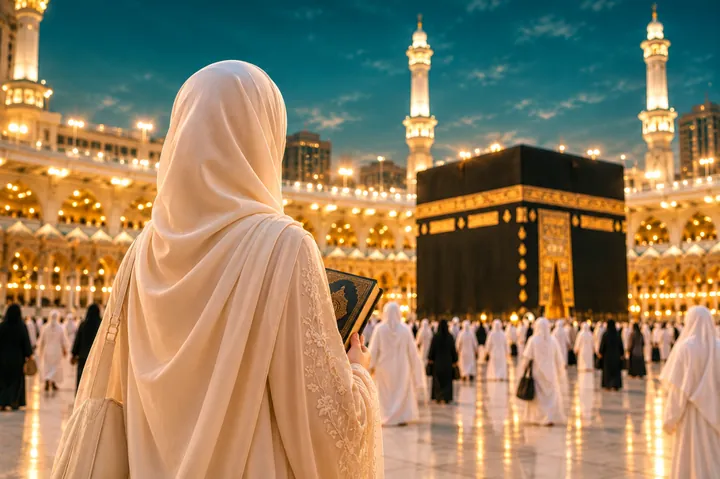
This guide to Umrah for women covers everything sisters ask before they travel: the current Saudi rules on travelling without a mahram and what the scholars say, what to wear in ihram, what to do about menstruation, how the rites differ slightly from men’s, how to cut the hair, and practical tips for Makkah and Madinah. It follows mainstream Sunni practice and notes where the four schools differ.
The rites of Umrah are the same for men and women, and the essentials of Umrah for women fit on a single page. The differences are few, and most of them make things simpler for women: there is no special ihram garment, no brisk walking in tawaf and no jogging in sa‘i.
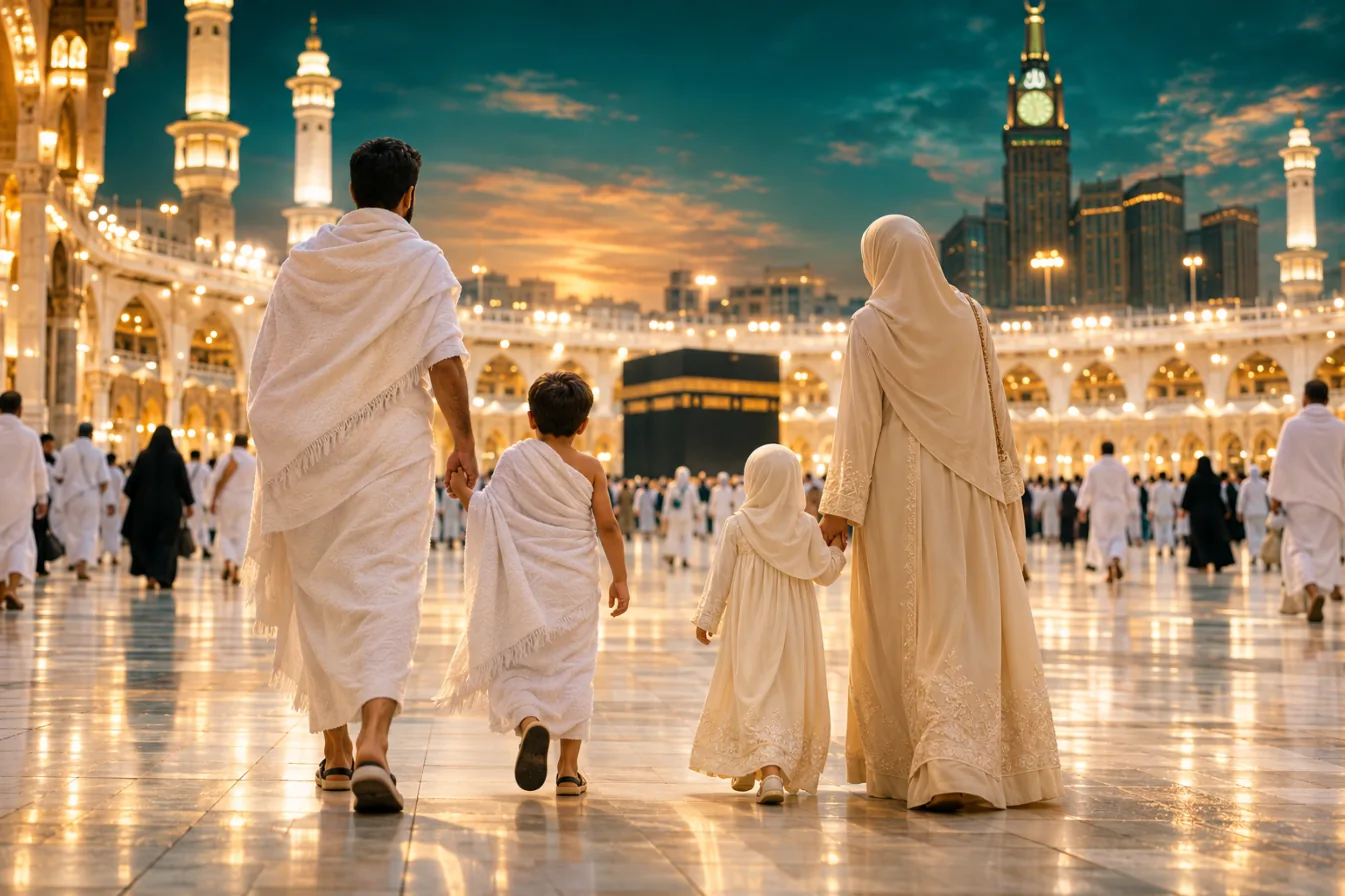
Umrah for women: the mahram question
A mahram is a husband or a male relative a woman can never marry, such as her father, son, brother or uncle. Whether a woman needs one to travel for Umrah is a question with two parts: the visa rules, and the fiqh.
What the Saudi authorities allow
The Saudi Ministry of Hajj and Umrah now allows women over 18 to travel for Umrah without a mahram, typically as part of an organised group or with a licensed provider. Visa conditions can change, so confirm the current rules for your nationality on Nusuk or with your provider before you book.
What the scholars say
Permission to enter the country does not settle the religious question, and sincere scholars differ on it. The Prophet ﷺ said, “A woman should not travel except with a mahram” (al-Bukhari and Muslim).
- The Hanafi and Hanbali schools generally require a woman to travel with a mahram or her husband for a journey of this distance, including for Hajj and Umrah.
- The Maliki and Shafi‘i schools allow a woman to travel for an obligatory Hajj, and for the Shafi‘is the obligatory first Umrah, in trustworthy company, such as a group of reliable women, when the route is safe.
- For voluntary trips, most classical scholars keep the mahram requirement, while some contemporary scholars permit travel in a safe, organised group.
Ihram for women
Clothing is the simplest part of Umrah for women. There is no special ihram garment for women. A woman enters ihram in her normal clothing, which should be loose, modest and cover the whole body except the face and hands. It can be any colour; white is not required. Stitched clothing, socks and shoes are all fine.
Two things are not worn in ihram: a niqab (a face veil fastened to the face) and gloves. The Prophet ﷺ said that a woman in ihram should not wear a niqab or gloves (al-Bukhari). If a woman usually covers her face, she may lower a scarf or the edge of her hijab over her face in front of non-mahram men, as the wives of the Prophet ﷺ did.
The other rules of ihram apply to women just as to men: no perfume, no cutting hair or nails, and no marital relations. Unscented toiletries are essential. See the full ihram rules or test an action in the ihram checker.
Umrah for women: menstruation and post-natal bleeding
This is the question most often asked about Umrah for women, and the Sunnah gives a clear answer. When ‘A’ishah’s period began on the way to Makkah, the Prophet ﷺ told her to do everything a pilgrim does except tawaf of the House until she was pure (al-Bukhari and Muslim).
If your period comes before the miqat
You still enter ihram at the miqat. Take a ghusl for ihram, as the Prophet ﷺ instructed Asma’ bint ‘Umays after she gave birth (Muslim), make the intention and say the Talbiyah. You remain in ihram and observe its rules.
Waiting until you are pure
Because sa‘i must follow tawaf, this is where planning Umrah for women needs a little flexibility: you wait until your period ends, take a ghusl, and then perform tawaf, sa‘i and taqsir. Until then, according to the majority of scholars, you do not stay in the masjid, but you can make dhikr, dua and Talbiyah freely.
If your period starts during the rites
If it begins during tawaf, stop and wait until you are pure. If it begins after tawaf and before or during sa‘i, you may complete sa‘i, because purity is not a condition for sa‘i according to the majority.
How the rites of Umrah for women differ
The steps are the same as in our how to perform Umrah guide, with these differences:
- Talbiyah: women say it so that they and those beside them can hear, without raising their voices as men do.
- No idtiba’: uncovering the right shoulder is for men only.
- No raml: women walk at a normal pace in all seven rounds of tawaf.
- No jogging in sa‘i: women walk normally between the green lights.
- The Black Stone: women should not push into crowds of men to touch it; pointing from a distance is the Sunnah when it is crowded.
- Cutting the hair: women never shave. Gather the hair and cut about a fingertip’s length from the ends, in private.
Women pray the two rak‘ahs after tawaf in the women’s areas if the space near Maqam Ibrahim is crowded with men. Every other element of Umrah for women, including the duas, is exactly the same. Our Umrah duas page has them all.
Madinah and the Rawdah for women
Most itineraries for Umrah for women include Madinah. Masjid an-Nabawi has dedicated women’s entrances, prayer halls and facilities. Women can visit the Rawdah with a free permit booked in the Nusuk app, in separate time slots for women shown in the app. Book early, especially in Ramadan and school holidays.
Women’s areas do not pass the Prophet’s ﷺ grave. You can send salam and blessings on him from wherever you are. Read more in our Madinah ziyarat guide.
Practical tips for Umrah for women
A little preparation makes Umrah for women far more comfortable. These are the tips our travellers share most often.
Pack light, breathable layers
Loose cotton abayas, a few hijabs that stay in place, and comfortable socks or shoes for long walks on marble floors.
Unscented everything
Unscented soap, shampoo, deodorant, sunscreen and wipes for the days in ihram.
Stay together
Agree a meeting point at a numbered gate. Crowds can separate groups quickly, and phone signal can drop inside.
Choose quieter times
Late night and mid-morning are often calmer for tawaf. The upper floors are less crowded.
Keep documents safe
Carry a copy of your passport, visa and Nusuk permits on your phone and keep your hotel card with you.
Look after your health
Drink water and Zamzam often, rest between rites and bring any medication you need with prescriptions.
Finally, remember that Umrah for women is the same act of worship with the same reward. Take your time, be patient in the crowds and keep a list of duas for your family. Use our Umrah checklist to pack, and if you are travelling with children, ask us about family-friendly hotels close to the Haram.
Free toolInteractive Umrah packing checklistTick items off as you pack; your progress is saved on this device.Open checklist →Umrah for women: frequently asked questions
Can a woman perform Umrah without a mahram?
The Saudi authorities now allow women over 18 to travel for Umrah without a mahram, usually in an organised group. The scholars differ on the religious ruling: the Hanafi and Hanbali schools generally require a mahram, while the Maliki and Shafi‘i schools allow obligatory pilgrimage in safe, trustworthy company. Ask a scholar you trust.
What should a woman wear for Umrah?
Normal loose, modest clothing in any colour that covers the whole body except the face and hands. Do not wear a niqab or gloves while in ihram.
Can I perform Umrah during my period?
You can enter ihram and do everything except tawaf. Wait until you are pure, take a ghusl, then perform tawaf, sa‘i and taqsir.
How much hair should a woman cut after Umrah?
About a fingertip’s length from the ends of the hair. Women do not shave the head.
Can women say the Talbiyah aloud?
Women say it so that they and those next to them can hear, without raising their voices as men do.
Can I take tablets to delay my period for Umrah?
Many scholars permit it if it causes no harm to your health. Speak to your doctor before you travel.
Plan a comfortable Umrah
Tell us who is travelling, your dates and hotel preferences, and we will send a tailored Umrah proposal.