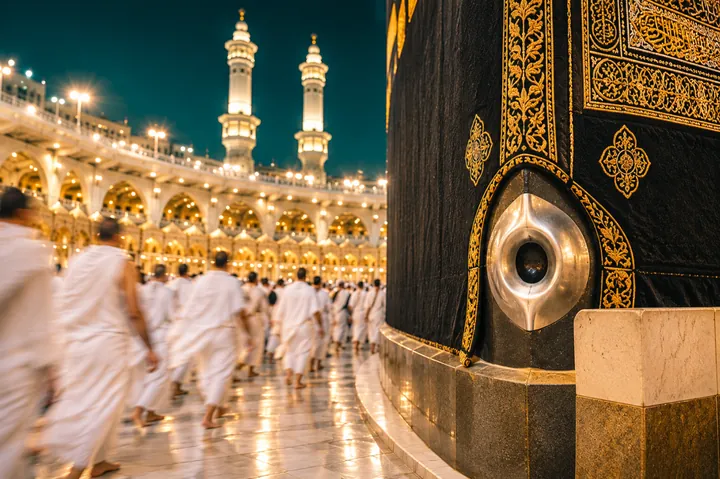
This guide explains how to perform Umrah from beginning to end: preparing at home, entering ihram at the miqat, the seven rounds of tawaf, the two rak‘ahs and Zamzam, the seven laps of sa‘i, and shaving or trimming the hair. At every step you will find what to read, what is obligatory and what is sunnah, following mainstream Sunni practice and noting briefly where the four schools differ.
Umrah is sometimes called the lesser pilgrimage. It can be performed at any time of year, and for most people the rites take only a few hours. Knowing how to perform Umrah correctly before you travel lets you spend those hours in calm, focused worship.
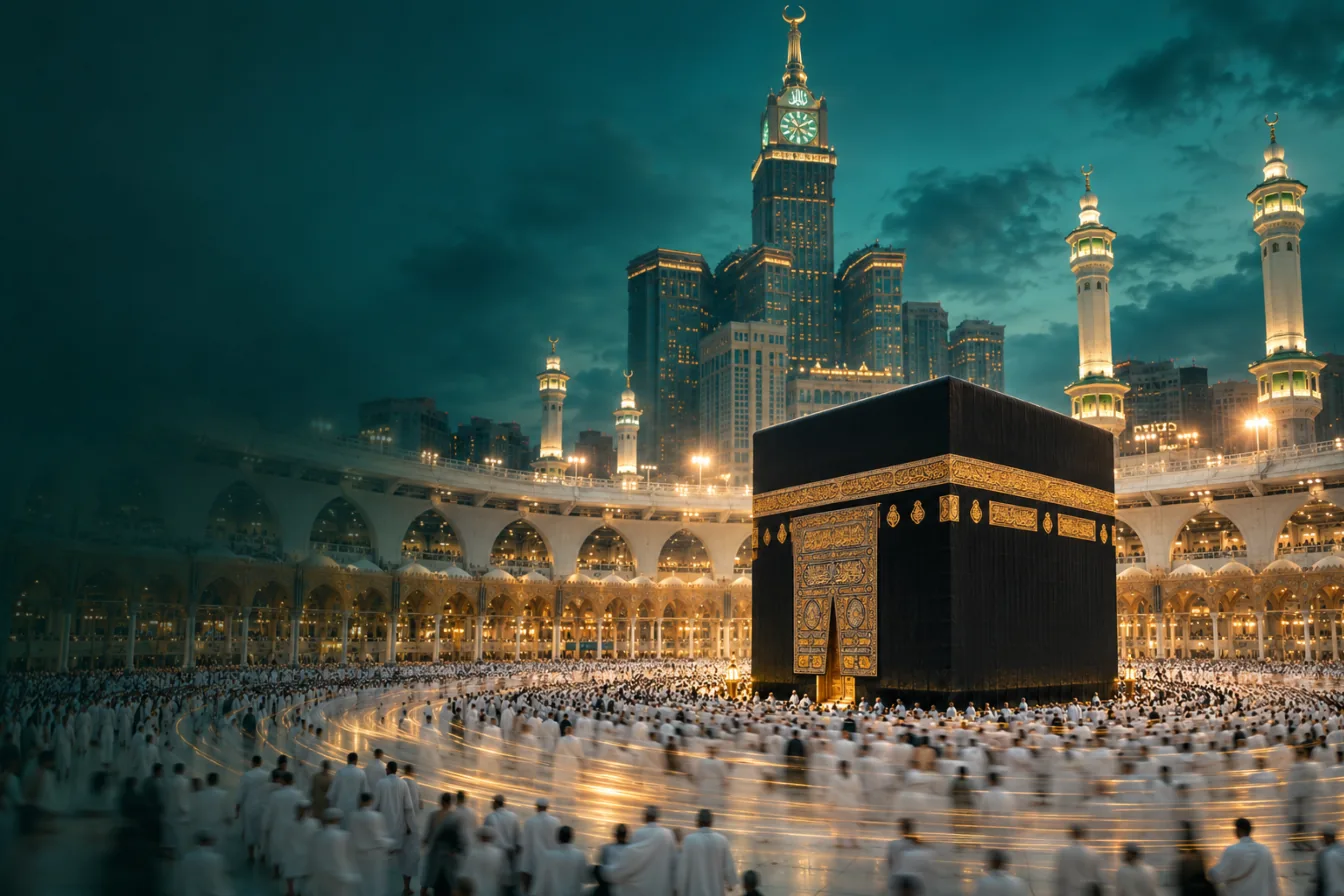
How to perform Umrah at a glance
The rites of Umrah are few. According to the majority of scholars its pillars are ihram, tawaf and sa‘i; the Shafi‘i school also counts shaving or trimming as a pillar, while the other schools treat it as obligatory (wajib). Entering ihram from the miqat is also obligatory. Everything else described below is sunnah: rewarded and beloved, but not something that invalidates your Umrah if missed.
Use the tabs below as a quick reference for how to perform Umrah, then read the detailed steps. If you are combining Umrah with Madinah, see our Madinah ziyarat guide.
Ghusl, unscented ihram clothing, intention at the miqat, then the Talbiyah until you begin tawaf.
Seven anticlockwise rounds starting and ending at the Black Stone, with the Kaaba on your left. Men uncover the right shoulder throughout and walk briskly in the first three rounds.
Two rak‘ahs behind Maqam Ibrahim if possible, or anywhere in the masjid, then drink Zamzam.
Seven laps beginning at Safa and ending at Marwah. Safa to Marwah counts as one lap.
Men shave the head (preferred) or trim it all over; women cut a fingertip’s length from the ends. Umrah is complete.
How to perform Umrah, steps 1–3: preparation, ihram and intention
Step 1: Prepare your body
Learning how to perform Umrah begins at home, before you put on ihram. It is sunnah to take a full bath (ghusl), even for a woman who is menstruating. Trim the nails, the moustache and underarm and pubic hair, so you will not need to during ihram. Men may apply perfume to the head and beard before ihram, as the Prophet ﷺ did, but not to the ihram garments; once in ihram, no new perfume may be used.
Pack unscented soap, shampoo and deodorant for the days ahead. Our Umrah checklist lists everything you need.
What to read at this step: nothing specific is prescribed. Many pilgrims read the dua for leaving home and the dua for travel as they set out.
Step 2: Put on the ihram clothing
The clothing is the first visible change in how to perform Umrah. Men wear two plain, unstitched sheets: the izar wrapped around the waist and the rida’ over the shoulders. White is preferred. Wear sandals that leave the top of the foot uncovered, and keep the head uncovered. A belt, watch, glasses and a bag are fine.
Women wear their normal, loose and modest clothing in any colour, covering the whole body except the face and hands. There is no special ihram garment for women. In ihram a woman does not wear a niqab or gloves, though she may lower a cloth over her face in front of non-mahram men.
Most scholars consider it sunnah to pray two rak‘ahs before entering ihram, outside the times when voluntary prayer is disliked. If an obligatory prayer is due, enter ihram after it; some scholars, such as Ibn Taymiyyah, held that there is no prayer specific to ihram and that entering ihram after an obligatory prayer is best. Either way, this prayer is not a condition of ihram. On a plane, you simply make the intention when the crew announce the miqat.
Step 3: Make the intention at the miqat
Every account of how to perform Umrah starts at the same point: the miqat. Ihram begins with the intention in your heart to start Umrah, made at or before the miqat. It is sunnah to say it aloud with the words reported from the Prophet ﷺ. If you fear illness or another obstacle may prevent you completing Umrah, you may add the condition. Use the miqat finder or read our miqat guide to know where yours is.
What to read at this step:
لَبَّيْكَ اللَّهُمَّ عُمْرَةً
Labbayk Allahumma ‘umrah.
Here I am, O Allah, for Umrah.
Source: Muslimفَإِنْ حَبَسَنِي حَابِسٌ فَمَحِلِّي حَيْثُ حَبَسْتَنِي
Fa in habasani habis, fa mahilli haythu habastani.
If I am prevented by an obstacle, then my place of leaving ihram is wherever You prevent me.
Source: al-Bukhari and Muslim (hadith of Duba‘ah)From this moment you are in ihram. Begin the Talbiyah straight away and repeat it often: on the road, when climbing or descending, after prayers and when meeting others. Men say it aloud; women say it so that they and those beside them can hear.
لَبَّيْكَ اللَّهُمَّ لَبَّيْكَ، لَبَّيْكَ لَا شَرِيكَ لَكَ لَبَّيْكَ، إِنَّ الْحَمْدَ وَالنِّعْمَةَ لَكَ وَالْمُلْكَ، لَا شَرِيكَ لَكَ
Labbayk Allahumma labbayk, labbayka la sharika laka labbayk, inna-l-hamda wa-n-ni‘mata laka wa-l-mulk, la sharika lak.
Here I am, O Allah, here I am. Here I am, You have no partner, here I am. All praise, blessings and sovereignty belong to You. You have no partner.
Source: al-Bukhari and MuslimFor Umrah, the majority of scholars hold that the Talbiyah stops when you begin tawaf. In the Maliki school it stops earlier, on reaching the boundary of the Haram.
Free toolInteractive Umrah packing checklistTick items off as you pack; your progress is saved on this device.Open checklist →How to perform Umrah, step 4: entering Masjid al-Haram
Knowing how to perform Umrah also means pacing yourself. When you reach Makkah, settle into your hotel, rest if you need to, and make wudu. Then go to Masjid al-Haram. Enter with your right foot first.
What to read at this step:
بِسْمِ اللهِ، وَالصَّلَاةُ وَالسَّلَامُ عَلَى رَسُولِ اللهِ، اللَّهُمَّ افْتَحْ لِي أَبْوَابَ رَحْمَتِكَ
Bismillah, wa-s-salatu wa-s-salamu ‘ala rasulillah. Allahumma-ftah li abwaba rahmatik.
In the name of Allah, and peace and blessings be upon the Messenger of Allah. O Allah, open for me the doors of Your mercy.
Source: Muslim; Ibn MajahWhen you first see the Kaaba, there is no specific authentic dua established from the Prophet ﷺ for that moment. It is a time of great emotion, so ask Allah for whatever you wish, in any language, and send blessings on the Prophet ﷺ. If a congregational prayer is about to start, join it first, then begin tawaf.
How to perform Umrah, step 5: tawaf around the Kaaba
Tawaf is the part of the rites most people picture when they think of how to perform Umrah. It is seven anticlockwise rounds of the Kaaba. Before you start, check that you have wudu: the majority of scholars hold that purity is a condition for tawaf, while the Hanafi school treats it as obligatory, so a tawaf done without wudu is still counted but requires an expiation. If your wudu breaks during tawaf, renew it and, according to many scholars, continue from where you stopped.
Idtiba’ for men
Before starting the tawaf of Umrah, men uncover the right shoulder by passing the middle of the upper sheet under the right arm and throwing its end over the left shoulder. This is called idtiba’. It is sunnah for all seven rounds of this tawaf only, not at other times.
Start at the Black Stone
Begin each round in line with the Black Stone (al-Hajar al-Aswad), marked by a green light on the wall opposite. If you can, kiss it or touch it with your right hand; if not, face it, raise your right hand towards it and say the words below. Do not push or harm anyone to reach it.
What to read at this step:
بِسْمِ اللهِ، وَاللهُ أَكْبَرُ
Bismillah, wallahu akbar.
In the name of Allah, and Allah is the Greatest.
Source: al-Bukhari (takbir); al-Bayhaqi from Ibn ‘Umar (with Bismillah)Raml, and keeping the Kaaba on your left
Men walk briskly with short steps (raml) in the first three rounds of this tawaf and walk normally for the last four, if the crowd allows. Keep the Kaaba on your left for the whole tawaf and walk outside the curved low wall called the Hijr or Hatim, which is part of the Kaaba.
What to say during the rounds
No fixed dua for each round is prescribed in the Sunnah. Booklets with a separate dua for each round are a later practice, not a requirement. Make any dhikr, dua or Qur’an recitation you like, in Arabic or your own language, and ask for good in this life and the next.
When you reach the Yemeni Corner, the corner before the Black Stone, touch it with your right hand if you can do so easily, without kissing it. If you cannot reach it, simply pass by: do not point or say takbir towards it. Between the Yemeni Corner and the Black Stone it is sunnah to read:
رَبَّنَا آتِنَا فِي الدُّنْيَا حَسَنَةً وَفِي الْآخِرَةِ حَسَنَةً وَقِنَا عَذَابَ النَّارِ
Rabbana atina fi-d-dunya hasanatan wa fi-l-akhirati hasanatan wa qina ‘adhaba-n-nar.
Our Lord, give us good in this world and good in the Hereafter, and protect us from the punishment of the Fire.
Source: Qur’an 2:201; Abu DawudEach time you pass the Black Stone, one round is complete. Counting accurately is a small but important part of how to perform Umrah properly. After the seventh round you have finished tawaf. Lose count? Build on the number you are sure of. The counter below is designed for one-handed use.
Tawaf and Sa‘i counter
Tap once at the end of each round. Your count is saved if the screen locks.
Tawaf rounds start and end at the Black Stone (green light on the wall opposite).
How to perform Umrah, step 6: Maqam Ibrahim, two rak‘ahs and Zamzam
After the seventh round, men cover the right shoulder again; a common gap in learning how to perform Umrah is forgetting this before prayer. Walk towards Maqam Ibrahim and, if it is easy, pray two rak‘ahs behind it; if it is crowded, pray anywhere in the masjid. In the first rak‘ah it is sunnah to recite Surah al-Kafirun after al-Fatihah, and in the second Surah al-Ikhlas. The majority of scholars regard these two rak‘ahs as a confirmed sunnah; the Hanafi school regards them as wajib.
What to read at this step:
وَاتَّخِذُوا مِنْ مَقَامِ إِبْرَاهِيمَ مُصَلًّى
Wattakhidhu min maqami Ibrahima musalla.
And take the standing place of Ibrahim as a place of prayer.
Source: Qur’an 2:125; Muslim (hadith of Jabir)Then drink Zamzam, which is available throughout the masjid, and make dua for whatever you need. If it is easy, return to touch the Black Stone before heading to Safa, as reported in the hadith of Jabir in Sahih Muslim.
اللَّهُمَّ إِنِّي أَسْأَلُكَ عِلْمًا نَافِعًا، وَرِزْقًا وَاسِعًا، وَشِفَاءً مِنْ كُلِّ دَاءٍ
Allahumma inni as’aluka ‘ilman nafi‘an, wa rizqan wasi‘an, wa shifa’an min kulli da’.
O Allah, I ask You for beneficial knowledge, abundant provision and healing from every illness.
Source: Hadith: Ibn Majah; the dua is reported from Ibn ‘Abbas (ad-Daraqutni)How to perform Umrah, step 7: sa‘i between Safa and Marwah
The next stage in how to perform Umrah is sa‘i. It commemorates Hajar’s search for water for her son Isma‘il. It is a pillar of Umrah for the Maliki, Shafi‘i and Hanbali schools and wajib for the Hanafi school. Allah says that Safa and Marwah are among His symbols (Qur’an 2:158).
Wudu is recommended for sa‘i but, according to the majority of scholars, not required. Sa‘i must come after a valid tawaf.
Begin at Safa
As you approach Safa at the very start of sa‘i, recite the verse and the words below. They are said only once, at the start of the first lap, not on every lap.
إِنَّ الصَّفَا وَالْمَرْوَةَ مِنْ شَعَائِرِ اللهِ — أَبْدَأُ بِمَا بَدَأَ اللهُ بِهِ
Inna-s-Safa wa-l-Marwata min sha‘a’iri-llah. Abda’u bima bada’a-llahu bih.
Indeed Safa and Marwah are among the symbols of Allah. I begin with what Allah began with.
Source: Qur’an 2:158; Muslim (hadith of Jabir)Climb Safa a little, turn to face the Kaaba, raise your hands in supplication and read the dhikr below three times, making your own duas in between. Do the same each time you reach Safa or Marwah.
اللهُ أَكْبَرُ، اللهُ أَكْبَرُ، اللهُ أَكْبَرُ. لَا إِلَهَ إِلَّا اللهُ وَحْدَهُ لَا شَرِيكَ لَهُ، لَهُ الْمُلْكُ وَلَهُ الْحَمْدُ، وَهُوَ عَلَى كُلِّ شَيْءٍ قَدِيرٌ. لَا إِلَهَ إِلَّا اللهُ وَحْدَهُ، أَنْجَزَ وَعْدَهُ، وَنَصَرَ عَبْدَهُ، وَهَزَمَ الْأَحْزَابَ وَحْدَهُ
Allahu akbar, Allahu akbar, Allahu akbar. La ilaha illa-llahu wahdahu la sharika lah, lahu-l-mulku wa lahu-l-hamd, wa huwa ‘ala kulli shay’in qadir. La ilaha illa-llahu wahdah, anjaza wa‘dah, wa nasara ‘abdah, wa hazama-l-ahzaba wahdah.
Allah is the Greatest (three times). There is no god but Allah alone, without partner; His is the dominion and His is the praise, and He has power over all things. There is no god but Allah alone; He fulfilled His promise, gave victory to His servant and defeated the confederates alone.
Source: Muslim (hadith of Jabir)The green lights
Walk towards Marwah. Between the two sets of green lights, men walk briskly or jog lightly; women walk normally. The supplication below is reported from Companions such as Ibn Mas‘ud and Ibn ‘Umar, not from the Prophet ﷺ himself, so you may read it or any other dua.
رَبِّ اغْفِرْ وَارْحَمْ، إِنَّكَ أَنْتَ الْأَعَزُّ الْأَكْرَمُ
Rabbi-ghfir warham, innaka anta-l-a‘azzu-l-akram.
My Lord, forgive and have mercy; You are the Most Mighty, the Most Generous.
Source: Reported from Ibn Mas‘ud and Ibn ‘Umar (Ibn Abi Shaybah)Counting the seven laps
Safa to Marwah is one lap; Marwah back to Safa is the second. You therefore finish the seventh lap at Marwah. As with tawaf, no fixed dua for each lap is prescribed, so make your own dhikr and dua. Switch the counter above to sa‘i mode to keep track.
How to perform Umrah, step 8: halq or taqsir
The final step in how to perform Umrah is cutting the hair. After sa‘i, men either shave the whole head (halq) or trim the hair from all over the head (taqsir). Shaving is better: the Prophet ﷺ prayed three times for those who shaved and once for those who trimmed, as reported by al-Bukhari and Muslim. The schools differ on the minimum: the Hanbali and Maliki schools require trimming from the whole head, the Hanafi school at least a quarter and the Shafi‘i school at least three hairs. Trimming the whole head is the safest choice. If Hajj follows shortly, many scholars advise trimming now so there is hair to shave on the Day of Sacrifice.
Women gather their hair and cut about a fingertip’s length from the ends. Women do not shave. Do this in private, away from non-mahram men.
That is how to perform Umrah from start to finish. Your Umrah is now complete, and all the restrictions of ihram are lifted. Praise Allah, thank Him and ask Him to accept it from you.
Tailored quoteTell us your dates, city and hotel preferencesOne short form, a personalised Umrah or Hajj proposal from our travel team — no obligation.Request my quote →Practise how to perform Umrah before you fly
Many first-time pilgrims find it helpful to rehearse how to perform Umrah at home. Walk through the steps with your family, read the duas aloud and practise the Talbiyah until it comes naturally. Men can practise wrapping the two ihram sheets and arranging idtiba’ so it is not a struggle on the day.
Watch for the times of the obligatory prayers in Makkah, because tawaf and sa‘i pause for the congregation. Plan to start after a prayer rather than just before one. Children, elderly parents and wheelchair users may find the upper floors easier, and electric carts are available for sa‘i and tawaf in designated areas.
Finally, remember that how to perform Umrah well is not only about the outward steps. Keep your tongue from argument, be patient with the crowds and help those around you. The reward is with Allah, and He knows the effort behind every step.
How to perform Umrah as a woman: key notes
How to perform Umrah is the same for men and women in almost every respect, with a few differences. Women do not do idtiba’ or raml, do not jog between the green lights, keep their voice low in the Talbiyah, and cut only a fingertip’s length of hair.
A woman who is menstruating or has post-natal bleeding may enter ihram at the miqat and do everything a pilgrim does except tawaf, as the Prophet ﷺ told ‘A’ishah (al-Bukhari and Muslim). Because sa‘i follows tawaf, she stays in ihram and waits until she is pure, takes a ghusl, then performs tawaf, sa‘i and taqsir. If her period begins after tawaf, she may complete sa‘i according to the majority. Our Umrah for women guide covers mahram rules and practical tips.
How to perform Umrah without common mistakes
Most of these come from learning how to perform Umrah from habit rather than from the Sunnah. If you are unsure whether a mistake affects your Umrah, ask a qualified scholar. Many issues have simple remedies, and the scholars in the Haram are available to answer questions.
How to perform Umrah: frequently asked questions
How long does it take to perform Umrah?
Tawaf and sa‘i usually take between two and four hours together, depending on crowds, the floor you use and your pace. Late at night and mid-morning are often quieter.
Is there a special dua for each round of tawaf?
No. The Sunnah does not prescribe a fixed dua for each round of tawaf or each lap of sa‘i. Make any dhikr, dua or Qur’an recitation. The reported duas are at the Black Stone, between the Yemeni Corner and the Black Stone, and on Safa and Marwah.
Do I need wudu for sa‘i?
According to the majority of scholars, wudu is recommended for sa‘i but not required. It is required for tawaf.
Can I do tawaf on the upper floors?
Yes. Tawaf on the upper floors and roof of Masjid al-Haram is valid. The rounds are longer, but they are often less crowded and suit elderly pilgrims and wheelchair users.
What if I lose count of my rounds?
Build on the number you are certain of. If you are unsure whether you did five or six, count it as five and continue.
Can I perform Umrah for someone else?
Yes, you may perform Umrah on behalf of a deceased person or someone unable to travel, provided you have already performed your own Umrah. Make the intention on their behalf at the miqat.
Can I perform more than one Umrah on a trip?
Scholars differ on repeating Umrah from Tan‘im in the same trip. Many encourage spending the time in extra tawaf and worship instead. If you do another Umrah, enter ihram from outside the Haram boundary, such as Masjid ‘A’ishah at Tan‘im.
Do I have to visit Madinah?
No. Madinah is not part of Umrah, but visiting Masjid an-Nabawi is highly recommended and most pilgrims include it.
Plan your Umrah with confidence
Share your dates, departure city and hotel preferences. Our team will send a tailored Umrah proposal.