This guide explains Hajj step by step, day by day, from the 8th to the 13th of Dhul Hijjah. You will learn the three types of Hajj, what happens at Mina, Arafah and Muzdalifah, how to stone the Jamarat, when the restrictions of ihram are lifted and how to finish with the farewell tawaf. Each day includes what to read and notes where the four Sunni schools differ.
Hajj is the fifth pillar of Islam, obligatory once in a lifetime for every adult Muslim who is physically and financially able. Hajj 2027 (1448 AH) is expected in mid-May 2027, subject to the sighting of the moon. Going through Hajj step by step before you travel is the best way to keep your heart free for worship during the days themselves.
Hajj step by step: choosing the type of Hajj
Before you can follow Hajj step by step, you need to know which type of Hajj you are performing, because it decides your intention at the miqat, whether you must offer a sacrifice and how many times you do sa‘i. All three are valid, as shown by the hadith of ‘A’ishah in al-Bukhari and Muslim.
| Type | What you do | Sacrifice (hady) | Typical pilgrim |
|---|---|---|---|
| Tamattu‘ | Umrah in the months of Hajj, leave ihram, then a new ihram for Hajj on the 8th | Required | Most international pilgrims |
| Qiran | Umrah and Hajj together in one ihram, kept until the 10th | Required | Pilgrims willing to stay in ihram from arrival until the 10th |
| Ifrad | Hajj only, in one ihram, kept until the 10th | Not required | Many residents of Makkah and those near it |
The sacrifice for Tamattu‘ and Qiran is set out in Qur’an 2:196: whoever cannot find one fasts three days during Hajj and seven on returning home. A pilgrim on Qiran or Ifrad who did sa‘i after the tawaf of arrival (Tawaf al-Qudum) does not repeat it after Tawaf al-Ifadah, according to the majority; the Hanafi school requires a qarin to perform two tawafs and two sa‘is.
Hajj step by step at a glance
Seen as a whole, Hajj step by step is simpler than many expect. The rites take place over five or six days in and around Makkah: Mina, the plain of Arafah, Muzdalifah, and back to Mina and the Haram. The infographic below shows Hajj step by step in a single view.
Before the days of Hajj, a Tamattu‘ pilgrim performs a complete Umrah and leaves ihram. If you need a refresher, follow our how to perform Umrah guide, and review the ihram rules, since you will enter ihram a second time.
Hajj step by step: before the 8th of Dhul Hijjah
Most international pilgrims arrive in Makkah or Madinah several days before the 8th. If you are performing Tamattu‘, you enter ihram for Umrah at the miqat, complete your Umrah and then leave ihram, living normally until the morning of the 8th. If you are on Qiran or Ifrad, you remain in ihram from the miqat until the 10th and perform the tawaf of arrival (Tawaf al-Qudum) when you reach Makkah.
Use these days to rest, pray in the Haram and go through Hajj step by step with your group leader. Find out where your camp is in Mina and Arafah, how your group will move between the sites, and the time slot you have been given for the Jamarat. Write down your group’s emergency number and keep it with your permit.
The first ten days of Dhul Hijjah are among the most virtuous days of the year, so increase your dhikr, takbir and good deeds. Prepare a written dua list for Arafah now, while your mind is calm. It is one of the simplest ways to take Hajj step by step with a clear heart.
What to pack for the days of Hajj
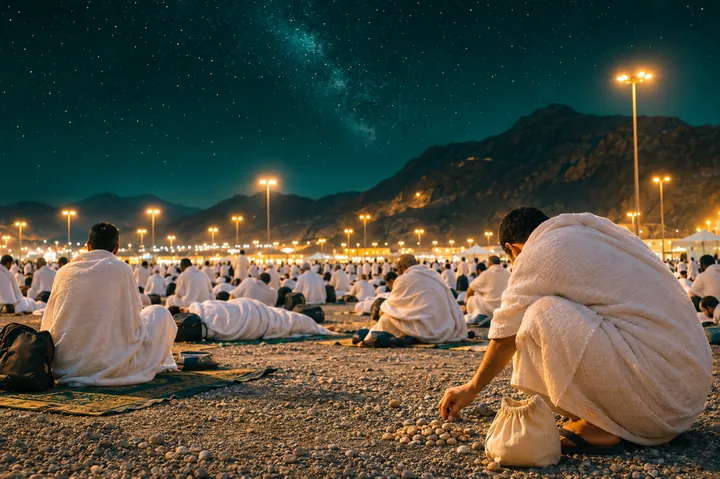
Your main luggage usually stays at the hotel while you move between Mina, Arafah and Muzdalifah. Pack a small bag with a spare ihram, unscented toiletries, medication, a light mat or blanket for Muzdalifah, a pouch for the pebbles, a power bank and a pocket guide to Hajj step by step with the duas for each day.
Hajj step by step, day by day
Select a day to follow Hajj step by step and see what to do and what to read. On each day, continue the Talbiyah until you begin stoning on the 10th, and from the dawn of Arafah say the takbir often, especially after prayers.
8 Dhul Hijjah: the Day of Tarwiyah
On the morning of the 8th, a Tamattu‘ pilgrim takes a ghusl, applies perfume to the body if he wishes, puts on ihram from wherever he is staying in Makkah and makes the intention for Hajj. Pilgrims on Qiran or Ifrad are already in ihram.
What to read:
لَبَّيْكَ اللَّهُمَّ حَجًّا
Labbayk Allahumma hajjan.
Here I am, O Allah, for Hajj.
Source: Muslimلَبَّيْكَ اللَّهُمَّ لَبَّيْكَ، لَبَّيْكَ لَا شَرِيكَ لَكَ لَبَّيْكَ، إِنَّ الْحَمْدَ وَالنِّعْمَةَ لَكَ وَالْمُلْكَ، لَا شَرِيكَ لَكَ
Labbayk Allahumma labbayk, labbayka la sharika laka labbayk, inna-l-hamda wa-n-ni‘mata laka wa-l-mulk, la sharika lak.
Here I am, O Allah, here I am. Here I am, You have no partner, here I am. All praise, blessings and sovereignty belong to You. You have no partner.
Source: al-Bukhari and MuslimGo to Mina and pray Dhuhr, Asr, Maghrib, Isha and the next Fajr there, shortening the four-rak‘ah prayers to two but praying each in its own time. Spending this day and night in Mina is sunnah. Fill the time with Talbiyah, dhikr, Qur’an and dua, and rest for the long day ahead.
9 Dhul Hijjah: the Day of Arafah
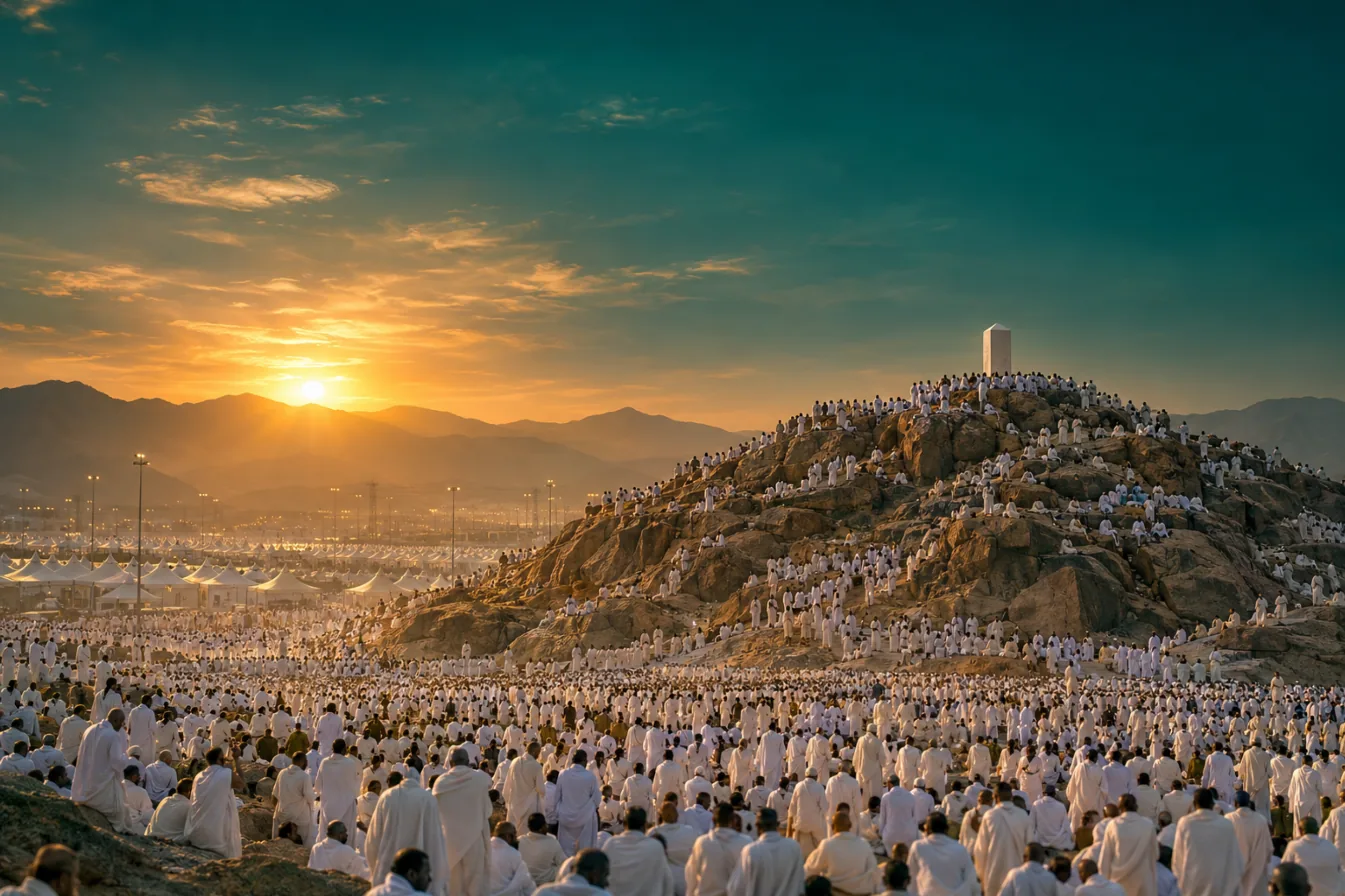
Standing at Arafah (wuquf) is the greatest pillar of Hajj. The Prophet ﷺ said, “Hajj is Arafah” (Abu Dawud, at-Tirmidhi, an-Nasa’i and Ibn Majah). Whoever misses it has missed Hajj.
After sunrise, move from Mina to Arafah. Make sure you are inside the boundaries of Arafah, which are clearly signposted; the area of Masjid Namirah closest to ‘Uranah lies partly outside them. After the sun passes its zenith (zawal), pray Dhuhr and Asr combined and shortened at the time of Dhuhr, with one adhan and two iqamahs.
Then devote the afternoon to dua, facing the qiblah with raised hands, until sunset. You do not need to climb Jabal ar-Rahmah or see it; all of Arafah is a place of standing. The Prophet ﷺ described the best dhikr of this day:
لَا إِلَهَ إِلَّا اللهُ وَحْدَهُ لَا شَرِيكَ لَهُ، لَهُ الْمُلْكُ وَلَهُ الْحَمْدُ، وَهُوَ عَلَى كُلِّ شَيْءٍ قَدِيرٌ
La ilaha illa-llahu wahdahu la sharika lah, lahu-l-mulku wa lahu-l-hamd, wa huwa ‘ala kulli shay’in qadir.
There is no god but Allah alone, without partner; His is the dominion and His is the praise, and He has power over all things.
Source: at-Tirmidhiاللهُ أَكْبَرُ اللهُ أَكْبَرُ، لَا إِلَهَ إِلَّا اللهُ، وَاللهُ أَكْبَرُ اللهُ أَكْبَرُ، وَلِلَّهِ الْحَمْدُ
Allahu akbar, Allahu akbar, la ilaha illa-llah, wallahu akbar, Allahu akbar, wa lillahi-l-hamd.
Allah is the Greatest, Allah is the Greatest; there is no god but Allah; Allah is the Greatest, Allah is the Greatest, and to Allah belongs all praise.
Source: Reported from Ibn Mas‘ud (Ibn Abi Shaybah)The night of the 10th: Muzdalifah
After sunset, leave Arafah calmly for Muzdalifah. Do not pray Maghrib at Arafah. On arrival, pray Maghrib and Isha combined, shortening Isha to two rak‘ahs. Spend the night there, resting as the Prophet ﷺ did.
Pray Fajr early, then make dua facing the qiblah until the sky is very bright, and leave for Mina before sunrise. Elderly, weak and women pilgrims, and those caring for them, may leave after the middle of the night, as the Prophet ﷺ permitted (al-Bukhari and Muslim). Collect pebbles for the next day, slightly larger than a chickpea; you may also collect them in Mina.
10 Dhul Hijjah: Yawm an-Nahr
This is the day of Eid al-Adha and the busiest day of Hajj. The sunnah order is: stone Jamrat al-Aqabah, offer the sacrifice, shave or trim, then perform Tawaf al-Ifadah and sa‘i.
1. Stone Jamrat al-Aqabah. Throw seven pebbles, one at a time, at the large Jamrah (al-Kubra), saying the takbir with each. The Talbiyah stops when you begin stoning. Only this Jamrah is stoned today.
اللهُ أَكْبَرُ
Allahu akbar.
Allah is the Greatest.
Source: al-Bukhari2. The sacrifice (hady). Pilgrims on Tamattu‘ and Qiran must offer a sacrifice. Most arrange it through the official sacrifice programme or their Hajj provider, who will confirm when it has been done.
3. Halq or taqsir. Men shave the head (preferred) or trim it; women cut a fingertip’s length. After stoning and shaving or trimming, you reach the first release from ihram (at-tahallul al-awwal): everything becomes permitted except marital relations. The schools differ on exactly which acts bring this release.
4. Tawaf al-Ifadah and sa‘i. Return to Makkah for Tawaf al-Ifadah, a pillar of Hajj, without idtiba’ or raml, then pray two rak‘ahs. A Tamattu‘ pilgrim then performs sa‘i for Hajj. Once these are done, the full release (at-tahallul ath-thani) follows and all restrictions end. Tawaf al-Ifadah may be delayed to the following days if needed.
When asked about doing these acts out of order on this day, the Prophet ﷺ said, “Do it, and there is no harm” (al-Bukhari and Muslim). The Hanafi school, however, requires a Tamattu‘ or Qiran pilgrim to keep the order of stoning, sacrifice and shaving.
11, 12 and 13 Dhul Hijjah: the days of Tashriq
Return to Mina and spend the nights there; the majority hold this is wajib, while the Hanafi school considers it sunnah. Each day, after zawal, stone all three Jamarat in order with seven pebbles each, saying the takbir with every throw:
1. The small Jamrah (as-Sughra), nearest Masjid al-Khayf. Then step aside, face the qiblah and make a long dua.
2. The middle Jamrah (al-Wusta). Again step aside, face the qiblah and make a long dua.
3. The large Jamrah (al-Aqabah). Stone it and leave without stopping for dua.
You may leave Mina on the 12th, after stoning, provided you depart before sunset: “whoever hastens in two days, there is no sin upon him” (Qur’an 2:203). If the sun sets while you are still in Mina, the majority say you should stay the night and stone on the 13th. Staying for the 13th is better if you are able. Those unable to stone because of illness or old age may appoint someone who is also performing Hajj to stone on their behalf, after first stoning for himself.
Hajj step by step: the farewell tawaf
The final rite of Hajj step by step is Tawaf al-Wada‘, the farewell tawaf, performed just before you leave Makkah. Ibn ‘Abbas reported that people were commanded to make their last act at the House, except that it was lightened for the menstruating woman (al-Bukhari and Muslim). It is wajib according to the majority and sunnah according to the Maliki school. There is no sa‘i after it.
Women follow Hajj step by step in the same way as men, without raml or idtiba’. A woman who is menstruating or has post-natal bleeding is excused from the farewell tawaf and owes nothing, provided she has already performed Tawaf al-Ifadah. If Tawaf al-Ifadah itself has not been done, she must wait until she is pure, or seek scholarly advice if her group cannot wait. Our guide for women covers this in more detail.
With the farewell tawaf, you have completed Hajj step by step. After it, leave without lingering for long in Makkah, though buying necessities or waiting for your transport is fine. Many pilgrims then travel to Madinah; see our Madinah ziyarat guide.
Hajj step by step: pillars, obligations and scholarly differences
Learning Hajj step by step also means knowing what matters most. Understanding which acts are pillars and which are obligations helps you prioritise if illness, crowds or delays disrupt your plans. A missed pillar invalidates Hajj; a missed obligation is compensated with a sacrifice; a missed sunnah lessens the reward but needs no compensation.
When you plan Hajj step by step with your group, note the core obligations. The obligations (wajibat) for most scholars include entering ihram from the miqat, staying at Arafah until sunset, the night at Muzdalifah, stoning the Jamarat, shaving or trimming, the nights in Mina and the farewell tawaf. Keep this list in mind as you work through Hajj step by step.
Practical tips for each day
Hajj is physically demanding, and following Hajj step by step is easier when you are rested. Wear broken-in sandals, carry an umbrella and a small refillable bottle, and keep a copy of your Nusuk card or permit and your camp details on you at all times. Follow the official schedule for the Jamarat, which assigns times to groups to keep the bridge safe.
Rest in the hours before Arafah so you can spend the afternoon in dua, and prepare a written list of what you want to ask for, including the requests of family and friends. Above all, be gentle with fellow pilgrims: “there is no obscenity, no wrongdoing and no quarrelling in Hajj” (Qur’an 2:197).
After Hajj
The scholars mention that a sign of an accepted Hajj is that a person returns better than they were. Having completed Hajj step by step, hold on to the habits you built: prayer on time, Qur’an, patience and generosity. The Prophet ﷺ said that an accepted Hajj (al-hajj al-mabrur) has no reward less than Paradise (al-Bukhari and Muslim).
Hajj step by step: registering and preparing
The first practical part of Hajj step by step is securing a place. How you book Hajj depends on your country of residence. Pilgrims from many countries, including the UK, Europe and the Americas, register through the official Nusuk Hajj platform, while others apply through a national Hajj system. Check the official announcements on the Saudi Ministry of Hajj and Umrah website and use the tool below to see the route from your country.
Hajj registration route finder
See the official route for booking Hajj from your country.
Once your place is confirmed, prepare as you would for Umrah: read this guide to Hajj step by step more than once, learn the duas, and pack with the Umrah checklist. For upcoming departures, see Hajj 2027.
Hajj step by step: frequently asked questions
What are the steps of Hajj in order?
Ihram and Mina on the 8th; Arafah on the 9th, then the night at Muzdalifah; on the 10th, stoning Jamrat al-Aqabah, the sacrifice, shaving or trimming and Tawaf al-Ifadah with sa‘i; stoning all three Jamarat on the 11th, 12th and optionally the 13th; and finally the farewell tawaf.
What is the most important day of Hajj?
The Day of Arafah, the 9th of Dhul Hijjah. Standing at Arafah is the greatest pillar; the Prophet ﷺ said, “Hajj is Arafah.”
When does the Talbiyah stop during Hajj?
It stops when you begin stoning Jamrat al-Aqabah on the 10th of Dhul Hijjah.
Do I have to offer a sacrifice?
Yes, if you perform Tamattu‘ or Qiran. If you cannot, you fast three days during Hajj and seven on returning home (Qur’an 2:196). There is no obligatory hady for Ifrad.
How many pebbles do I need?
Seven on the 10th and twenty-one on each of the 11th and 12th, making 49. If you stay for the 13th, you need another 21, making 70.
Can I leave Mina on the 12th?
Yes. After stoning on the 12th you may leave, provided you leave Mina before sunset (Qur’an 2:203). Otherwise, according to the majority, you stay the night and stone on the 13th.
What if a woman’s period starts during Hajj?
She may do all the rites except tawaf. She performs Tawaf al-Ifadah once pure, and is excused from the farewell tawaf if her period continues when she must leave.
Can someone stone on my behalf?
Yes, if you are unable because of illness, old age or similar. The deputy must be performing Hajj that year and should stone for himself first at each Jamrah.
Preparing for Hajj?
Tell us your country of residence and preferred dates, and our team will guide you through the official route and your options.