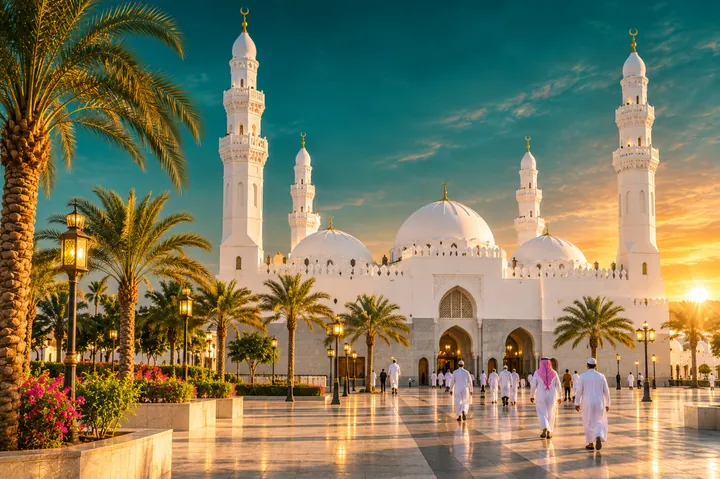
This Madinah ziyarat guide explains how to visit Masjid an-Nabawi, the Prophet’s ﷺ mosque, with the right etiquette: how to greet the Prophet ﷺ, how to book a visit to the Rawdah through the Nusuk app, and which historic sites to see, including Masjid Quba, Mount Uhud, Masjid al-Qiblatayn and al-Baqi‘. It follows mainstream Sunni practice and cites only well-known hadith.
Visiting Madinah is not part of Umrah or Hajj, and your Umrah is complete without it. Yet almost every pilgrim includes it, and for good reason: the city of the Prophet ﷺ is calm, welcoming and full of history, and praying in his mosque carries a great reward.
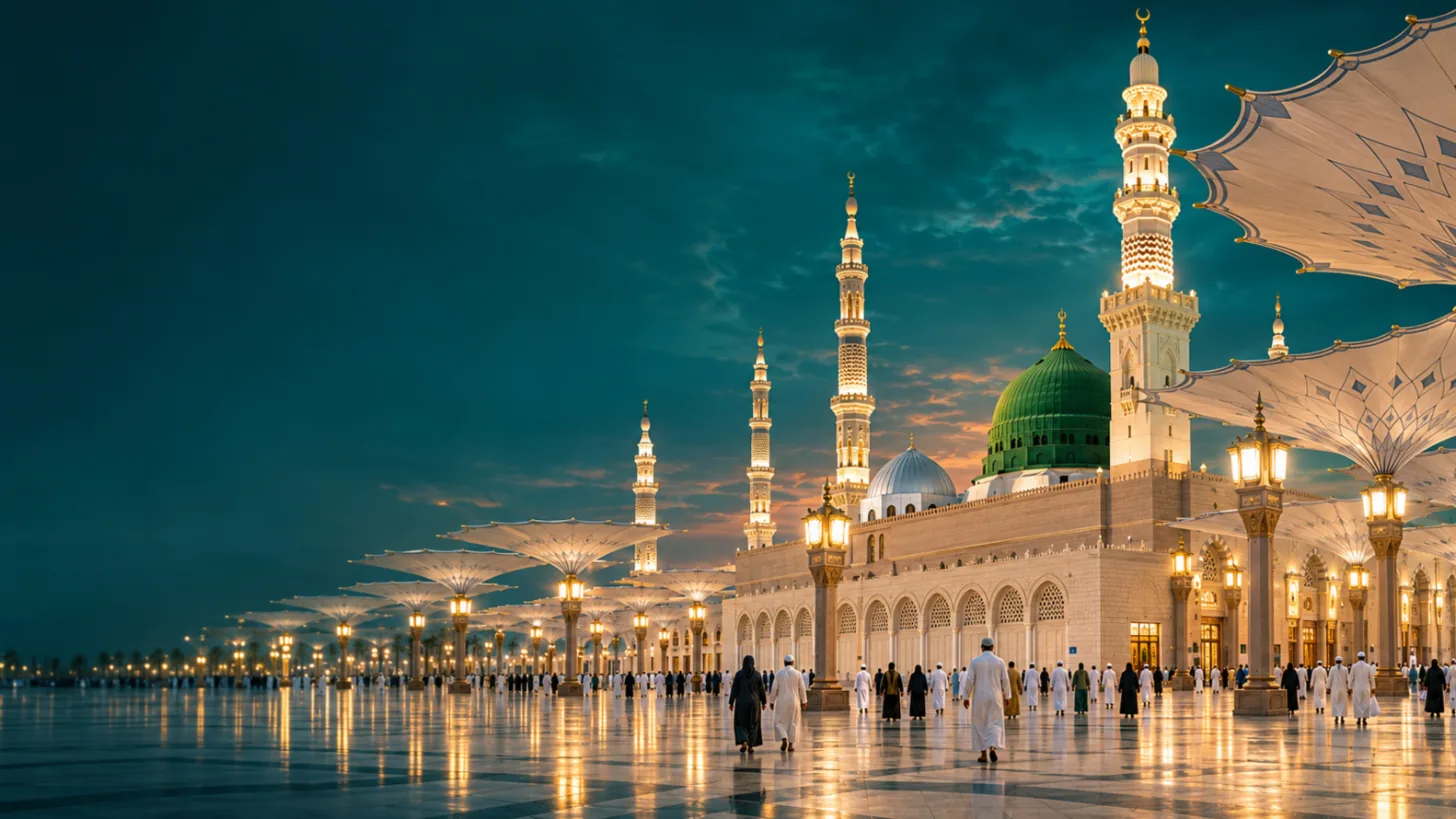
Madinah ziyarat begins at Masjid an-Nabawi
The heart of any Madinah ziyarat is the Prophet’s ﷺ mosque. The Prophet ﷺ said, “A prayer in this mosque of mine is better than a thousand prayers in any other mosque, except al-Masjid al-Haram” (al-Bukhari and Muslim). He also said that journeys of worship are undertaken to only three mosques: al-Masjid al-Haram, his own mosque and al-Masjid al-Aqsa (al-Bukhari and Muslim).
For this reason, the scholars say the intention of a Madinah ziyarat journey should be to visit and pray in the mosque. Once there, visiting the Prophet’s ﷺ grave and greeting him is part of the visit to the mosque.
Etiquette in the mosque
Enter with your right foot and the dua for entering any masjid, then pray two rak‘ahs of greeting. Keep your voice low, as Allah commanded the Companions not to raise their voices above the Prophet’s ﷺ (Qur’an 49:2), and the scholars apply this to his mosque. Pray as many of the five daily prayers in congregation as you can, and spend time with the Qur’an.
Good manners are the essence of Madinah ziyarat. Respect the place by not pushing, not wiping walls or railings for blessing, and not crowding the areas around the grave. Women have dedicated entrances and prayer halls, and staff will direct you.
Greeting the Prophet ﷺ during your Madinah ziyarat
Men pass the Prophet’s ﷺ grave along a corridor from the Bab as-Salam side, moving slowly with the flow of visitors. As you reach the grave, greet him calmly and with a lowered voice:
السَّلَامُ عَلَيْكَ يَا رَسُولَ اللهِ
As-salamu ‘alayka ya Rasulallah.
Peace be upon you, O Messenger of Allah.
Source: The practice of Ibn ‘Umar (Malik’s Muwatta’; al-Bayhaqi)Move a little further and greet Abu Bakr as-Siddiq, saying “As-salamu ‘alayka ya Aba Bakr,” then ‘Umar ibn al-Khattab, saying “As-salamu ‘alayka ya ‘Umar.” Ibn ‘Umar used to greet the Prophet ﷺ, Abu Bakr and ‘Umar in this way, keeping it brief.
This greeting is the most personal moment of a Madinah ziyarat, but supplication is directed to Allah alone. When you wish to make dua, move away from the grave and face the qiblah. Women, whose prayer areas do not pass the grave, can send salam and blessings on the Prophet ﷺ from wherever they are; the Prophet ﷺ said that Allah has angels who convey to him the greetings of his Ummah (an-Nasa’i).
The Rawdah: permits through the Nusuk app
The Rawdah is the area between the Prophet’s ﷺ house, where his grave is, and his minbar. He said, “Between my house and my minbar is a garden from the gardens of Paradise” (al-Bukhari and Muslim). It is marked by green carpet and white pillars.
Entry to the Rawdah now requires a free permit booked in the Nusuk app. Men and women have separate time slots, which are shown in the app. The rules on how often you can book change from time to time, so check the app before you travel and book as soon as your dates are fixed. Bring your permit on your phone and arrive early for your slot.
MadinahAdd Madinah to your UmrahNights near Masjid an-Nabawi, Rawdah permits and ziyarat — we include it in your proposal.Madinah guide →Madinah ziyarat sites: where to go
Beyond the mosque, a Madinah ziyarat usually includes a handful of historic places connected with the life of the Prophet ﷺ and his Companions. Most hotels and tour providers offer a half-day Madinah ziyarat tour by coach or car.
| Site | What it is | Tip |
|---|---|---|
| Masjid Quba | The first mosque built in Islam | Make wudu before leaving your hotel and pray two rak‘ahs |
| Mount Uhud | Site of the Battle of Uhud and the graves of its martyrs | Visit early morning; give salam to the martyrs |
| Masjid al-Qiblatayn | The “mosque of the two qiblahs” | Often combined with Quba on the same tour |
| Al-Baqi‘ | The main cemetery of Madinah, beside Masjid an-Nabawi | Opening times are limited; check locally on arrival |
| The Seven Mosques area | Near the site of the Battle of the Trench | A place of history; no special prayer is prescribed there |
| Date farms | Orchards and markets selling ‘Ajwa and other dates | Buy dates to take home as gifts |
Masjid Quba
Masjid Quba is the one site on a Madinah ziyarat tour with a specific reward. It was founded when the Prophet ﷺ arrived at Madinah on the Hijrah. He used to visit it every Saturday, walking or riding, and pray two rak‘ahs there (al-Bukhari and Muslim). He said that whoever purifies himself at home, then comes to Masjid Quba and prays in it, has a reward like that of an Umrah (Ibn Majah; a similar hadith is in at-Tirmidhi). It is about 3 km from Masjid an-Nabawi, and a pedestrian route links the two.
Mount Uhud and the martyrs
The Prophet ﷺ said, “Uhud is a mountain that loves us and we love it” (al-Bukhari and Muslim). The Battle of Uhud took place at its foot in the third year after the Hijrah, and seventy Companions were martyred, including the Prophet’s ﷺ uncle Hamzah ibn ‘Abd al-Muttalib. Visitors greet the martyrs at the cemetery and can see the small hill where the archers were stationed, a reminder of the cost of disobeying the Prophet’s ﷺ instruction.
Masjid al-Qiblatayn
This mosque is associated by historical reports with the change of the qiblah from Jerusalem to the Kaaba, revealed in Qur’an 2:144, which reached worshippers there during a prayer. Praying in it is like praying in any mosque; no special virtue is established, but it is a meaningful place to reflect on the history of the qiblah.
Al-Baqi‘
No Madinah ziyarat feels complete without remembering those buried here. Al-Baqi‘ is the resting place of thousands of Companions, many members of the Prophet’s ﷺ family and the third caliph, ‘Uthman ibn ‘Affan. The Prophet ﷺ visited it and taught the greeting for the graves, which you can find in our Umrah duas page. Entry is generally limited to men at set times; scholars also differ on women visiting graves. Make dua for the deceased, and avoid acts not taught in the Sunnah.
The Seven Mosques and the date farms
The Seven Mosques are small mosques near the site of the Battle of the Trench (al-Khandaq), where the Muslims dug a trench to defend Madinah. They are worth seeing for their history, but no special prayer or virtue is established for visiting them. Many tours end at a date farm. The Prophet ﷺ said that whoever eats seven ‘Ajwa dates in the morning will not be harmed that day by poison or magic (al-Bukhari and Muslim).
Planning your Madinah ziyarat
Most pilgrims spend three to five nights in Madinah, which is enough for an unhurried Madinah ziyarat. A good pattern is to pray the five prayers in Masjid an-Nabawi, book the Rawdah early, visit Quba on a morning (ideally a Saturday, following the Sunnah), and take one half-day tour for Uhud, al-Qiblatayn and the date farms.
Your order of cities also matters for ihram. If you visit Madinah first, you will enter ihram at Dhul Hulayfah (Abyar ‘Ali) on your way to Makkah; see our miqat guide. If you visit Makkah first, your Umrah is already complete and no ihram is needed for Madinah. Our Umrah trip planner can help you balance your nights, and the how to perform Umrah guide covers the rites in Makkah.
Stay close
Hotels near the mosque’s gates make it easier to pray every prayer in congregation, especially for elderly travellers.
Book early
Rawdah slots open in the Nusuk app and fill quickly in Ramadan and school holidays.
Travel by train
The Haramain high-speed railway links Madinah, Jeddah and Makkah.
Madinah ziyarat: frequently asked questions
Is visiting Madinah part of Umrah or Hajj?
No. Umrah and Hajj are complete without it. Visiting Masjid an-Nabawi is a separate, highly recommended act of worship, and most pilgrims include it in the same trip.
Do I need ihram to visit Madinah?
No. There is no ihram for Madinah. If you go from Madinah to Makkah for Umrah, you enter ihram at Dhul Hulayfah on the way.
Must I pray forty prayers in Masjid an-Nabawi?
The hadith about praying forty consecutive prayers there is considered weak by many hadith scholars. Pray as many prayers as you can, but do not feel obliged to arrange your trip around it.
How do I get a Rawdah permit?
Book a free slot in the Nusuk app. Men and women have separate times. Check the app for the current rules and book early.
Can women greet the Prophet ﷺ at his grave?
Women’s prayer areas do not pass the grave. Women send salam and blessings on the Prophet ﷺ from where they are, and the greeting reaches him.
What is the reward of praying in Masjid Quba?
The Prophet ﷺ said that whoever purifies himself at home, then prays in Masjid Quba, has a reward like an Umrah (Ibn Majah; similar in at-Tirmidhi).
Add Madinah to your Umrah
Tell us how many nights you would like in Madinah and Makkah, and we will send a tailored proposal with hotels near both Harams.