
This Madinah guide is for pilgrims who want everything about the city of the Prophet ﷺ in one place. Below you will find the live Madinah time, today’s prayer times and the weather now, then the history and virtue of the city, a practical walk-through of Masjid an-Nabawi and the Rawdah, the best months to visit, every ziyarah in Madinah, the areas to stay in and the etiquette that makes a visit easier.
The live panel updates in your browser, so you can keep this Madinah guide open on your phone and check the next prayer or the forecast at any moment of your stay.
Prayer times today
- Fajr--:--
- Sunrise--:--
- Dhuhr--:--
- Asr--:--
- Maghrib--:--
- Isha--:--
Calculated with the Umm al-Qura method (Fajr 18.5°, Isha 90 minutes after Maghrib, 120 in Ramadan). The Masjid an-Nabawi adhan may differ by a minute or two.
7-day forecast
Madinah time, Madinah weather and Madinah prayer times explained
Madinah time is Arabia Standard Time (AST), three hours ahead of GMT all year, the same as Makkah. Saudi Arabia does not use daylight saving, so the gap to the UK is three hours in winter and two hours in summer. The panel above shows the current Madinah time, the Hijri date and the difference from where you are.
The Madinah prayer times shown are calculated with the Umm al-Qura method, the official method in Saudi Arabia. Fajr is set when the sun is 18.5° below the horizon, and Isha is fixed at 90 minutes after Maghrib, extended to 120 minutes in Ramadan. Madinah lies about 340 km north of Makkah, so its prayers usually fall a few minutes apart from those in Makkah, and the adhan in Masjid an-Nabawi can differ from any calculation by a minute or two.
Adhan and iqamah at Masjid an-Nabawi
As in Makkah, there is an early adhan some time before dawn and then the adhan for Fajr. The gap to the iqamah is usually around 10 to 25 minutes, shortest at Maghrib. A funeral prayer often follows the obligatory prayer; stay in your row after the salam and join it.
Jumu‘ah in Madinah
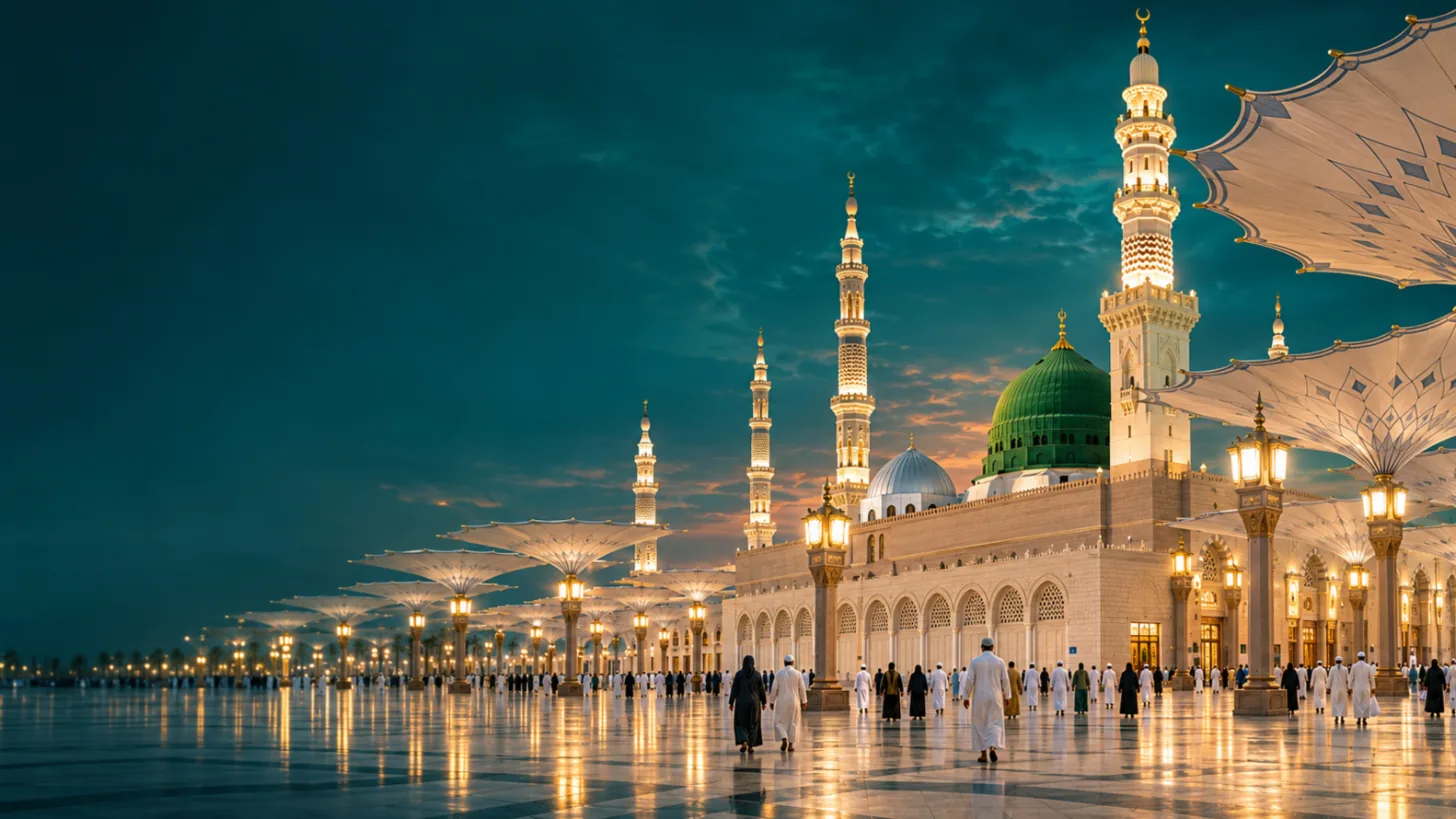
Friday is the busiest day of the week at the mosque. Arrive one to two hours before the adhan if you want a place inside, especially in Ramadan and the winter peak. Once the halls fill, people pray in the courtyards under the great umbrellas, and the roof opens at busy times.
The Madinah weather panel shows the temperature now and a seven-day forecast. Madinah is drier and has cooler winter nights than Makkah, so check it before you pack.
About Madinah: history and virtue
Every Madinah guide begins with the Hijrah. Madinah, once called Yathrib, lies on a high plain ringed by lava fields and mountains, including Uhud to the north. In 622 CE the Prophet ﷺ migrated here from Makkah, first stopping at Quba, and the city became the home of the first Muslim community. He built his mosque beside his house, lived here for the rest of his life and is buried in the room of ‘A’ishah, now within the mosque.
One of the three mosques
Abu Hurayrah reported that the Prophet ﷺ said: “Do not set out on a journey except to three mosques: al-Masjid al-Haram, this mosque of mine and al-Masjid al-Aqsa” (al-Bukhari and Muslim). He also said: “A prayer in this mosque of mine is better than a thousand prayers elsewhere, except al-Masjid al-Haram” (al-Bukhari and Muslim).
The sanctity of Madinah
The Prophet ﷺ declared Madinah a sanctuary: “Madinah is sacred from ‘Ayr to Thawr” (al-Bukhari and Muslim, from ‘Ali). In Muslim he said that Ibrahim made Makkah sacred and that he made sacred what lies between Madinah’s two lava fields, so its trees are not cut and its game is not hunted. He also said that faith will retreat to Madinah as a snake retreats to its hole (al-Bukhari and Muslim).
Masjid an-Nabawi: a practical Madinah guide to the Prophet’s ﷺ Mosque
Masjid an-Nabawi is open day and night, and this section of our Madinah guide answers what first-time visitors ask most. Read our full Masjid an-Nabawi guide for its history and expansions, and our Madinah ziyarat guide for a suggested order of visits.
Gates and landmarks
The mosque has dozens of numbered gates on every side. Bab al-Salam on the west is the traditional entrance for greeting the Prophet ﷺ; the line then moves past the graves of the Prophet ﷺ, Abu Bakr and ‘Umar and leaves towards Bab al-Baqi‘ on the east. King Fahd Gate on the north side opens onto the northern hotels. Choose a gate number, not “by the umbrellas”, as your meeting point.
Women’s areas
Women have their own entrances and prayer halls, clearly signed, mainly on the north and east sides of the mosque, with separate ablution blocks in the courtyards. Women visit the Rawdah and greet the Prophet ﷺ at set times that differ from the men’s; check the latest in Nusuk.
Visiting the Rawdah
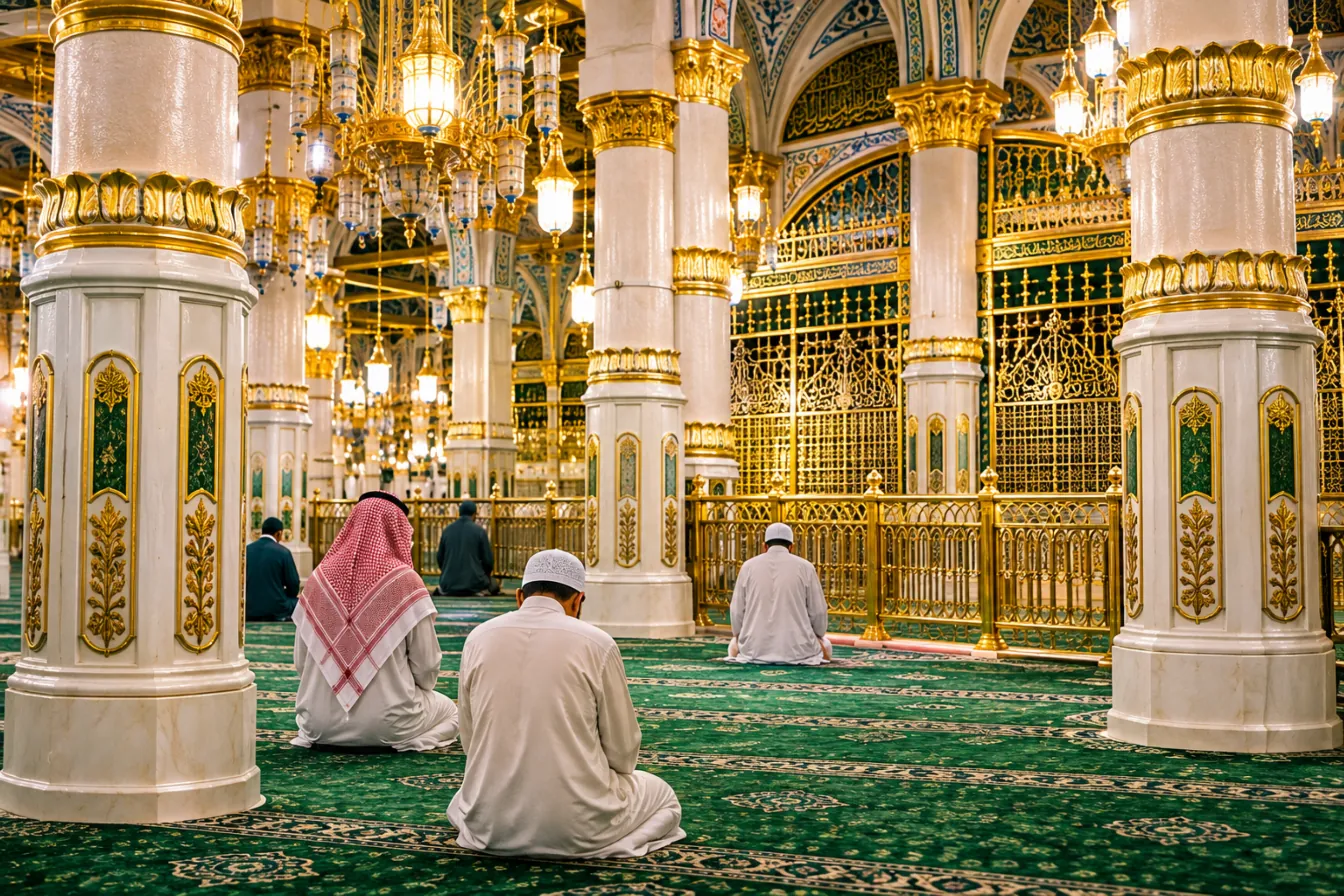
The Rawdah is the area between the Prophet’s ﷺ house and his minbar, of which he said, “What is between my house and my minbar is a garden from the gardens of Paradise” (al-Bukhari and Muslim). Access now runs through timed permits booked in the Nusuk app. Slots, frequency limits and queuing gates change, so check the latest in Nusuk and see our Rawdah booking guide.
Madinah weather by month and the best time to visit
Madinah has a desert climate: very hot summers and pleasant winters, when nights can turn chilly. From December to February, days are mild and comfortable for walking between ziyarat, and a light jacket is useful after Isha. Summer highs often pass 43°C. Compare both cities in our Makkah and Madinah weather guide.
| Month | Average high | Average low | Comfort for a visit |
|---|---|---|---|
| January | about 24°C | about 12°C | Very good, cool nights |
| February | about 27°C | about 14°C | Very good |
| March | about 31°C | about 17°C | Good |
| April | about 35°C | about 21°C | Warm |
| May | about 40°C | about 26°C | Hot |
| June | about 43°C | about 29°C | Very hot |
| July | about 43°C | about 30°C | Very hot |
| August | about 44°C | about 30°C | Very hot |
| September | about 42°C | about 28°C | Hot |
| October | about 37°C | about 23°C | Warm |
| November | about 30°C | about 18°C | Good |
| December | about 26°C | about 14°C | Very good, cool nights |
Crowds matter as much as the Madinah weather. Ramadan, the school holidays and the weeks just after Hajj, when many Hajj pilgrims come to Madinah, are the busiest periods. Quieter weeks tend to fall away from those peaks.
Madinah ziyarat: every site in the city
Madinah ziyarat brings the Seerah to life. Some visits have a clear basis in the Sunnah: praying in Masjid an-Nabawi, greeting the Prophet ﷺ, praying in Masjid Quba, which carries a reward like an Umrah, visiting Jannat al-Baqi‘ and the martyrs of Mount Uhud, and entering ihram at Dhul Hulayfah when heading to Makkah.
Other sites, such as Masjid al-Qiblatayn, the Seven Mosques and Masjid al-Jumu‘ah, are historic. You may pray where prayer is held, but there is no special reward tied to visiting them. Each card below is tagged Sunnah or Historic, and this Madinah guide lists all 21 Madinah ziyarat sites with distances and visit times.
The Prophet’s ﷺ Mosque — one of the three mosques worth travelling to.
The heart of MadinahThe Rawdah (Riyad al-Jannah)The area between the Prophet’s ﷺ house and minbar — a garden of Paradise.
Inside Masjid an-NabawiMasjid al-GhamamahOttoman-era mosque on the Prophet’s ﷺ Eid prayer ground.
About 500 m south-west of Masjid an-NabawiMasjid Abu BakrHistoric mosque on the Eid prayer ground of the Prophet ﷺ, named after Abu Bakr.
About 400 m south-west of Masjid an-NabawiMasjid UmarOttoman-era mosque on the old Eid prayer ground, named after ‘Umar ibn al-Khattab.
Beside Masjid al-GhamamahMasjid AliSmall historic mosque on the Musalla, linked by tradition to ‘Ali ibn Abi Talib.
North of Masjid al-GhamamahSaqifah Bani Sa‘idahGarden where the Companions gave the pledge to Abu Bakr as the first caliph.
About 300 m north-west of Masjid an-NabawiSeerah MuseumInteractive museum of the Prophet’s ﷺ life and the history of Madinah.
Beside Masjid an-NabawiJannat al-Baqi‘Madinah’s main cemetery, resting place of many Companions and members of the Prophet’s ﷺ family.
Adjacent to Masjid an-Nabawi (east)Dar al-Madinah MuseumMuseum of Madinah’s history with models of the city and the Prophet’s ﷺ mosque.
About 4–6 km from Masjid an-NabawiHejaz Railway MuseumRestored Ottoman-era station of the 1908 Damascus–Madinah railway.
About 1.5 km south-west of Masjid an-NabawiMasjid al-Jumu‘ahMarks where the Prophet ﷺ is reported to have led his first Friday prayer on the Hijrah.
About 2.5 km south of Masjid an-NabawiMasjid QubaThe first mosque in Islam; praying there brings a reward like an Umrah.
About 3.5 km south of Masjid an-NabawiThe Seven MosquesSmall historic mosques at the site of the Battle of the Trench (al-Khandaq).
About 3–4 km north-west of Masjid an-NabawiMasjid al-QiblataynMosque traditionally associated with the change of the qiblah to the Kaaba.
About 5 km north-west of Masjid an-NabawiBir Uthman (Bi’r Rumah)The well ‘Uthman ibn ‘Affan bought and gave freely to the Muslims.
About 5–7 km north-west of Masjid an-NabawiMasjid al-IjabahMosque where the Prophet ﷺ prayed and made three supplications, as reported by Muslim.
About 1 km north-east of Masjid an-NabawiKing Fahd Glorious Qur’an Printing ComplexWhere the Madinah Mushaf is reviewed, printed and bound; guided tours by arrangement.
About 10 km north-west of Masjid an-NabawiMount Uhud and the MartyrsSite of the Battle of Uhud and the graves of its martyrs, including Hamzah.
About 5 km north of Masjid an-NabawiJabal al-Rumat (Archers’ Hill)The small hill where the archers were stationed at the Battle of Uhud.
Facing Mount Uhud, 5 km northDhul Hulayfah (Abyar Ali)The Miqat of the people of Madinah, where the Prophet ﷺ entered ihram.
About 10 km south-west of Masjid an-NabawiMuseums and learning
Families and first-time visitors enjoy the Seerah Museum beside the mosque, the Dar al-Madinah Museum with its models of the old city, the Hejaz Railway Museum and the King Fahd Qur’an Printing Complex, where tours run by arrangement.
A typical Madinah ziyarat tour by car covers Quba, Qiblatayn, the Seven Mosques and Uhud in one morning. Use the planner below to put the sites in the best order with travel and visit times, or open the full ziyarat route planner.
Ziyarat route planner
Pick the sites you want to visit — we put them in the most efficient order with travel and visit times.
Madinah ziyarat at a glance
| Site | Why visit | Location | Visit |
|---|---|---|---|
| Masjid an-Nabawi | The Prophet’s ﷺ Mosque — one of the three mosques worth travelling to. | The heart of Madinah | 0 min |
| The Rawdah (Riyad al-Jannah) | The area between the Prophet’s ﷺ house and minbar — a garden of Paradise. | Inside Masjid an-Nabawi | 20 min |
| Masjid al-Ghamamah | Ottoman-era mosque on the Prophet’s ﷺ Eid prayer ground. | About 500 m south-west of Masjid an-Nabawi | 15 min |
| Masjid Abu Bakr | Historic mosque on the Eid prayer ground of the Prophet ﷺ, named after Abu Bakr. | About 400 m south-west of Masjid an-Nabawi | 10 min |
| Masjid Umar | Ottoman-era mosque on the old Eid prayer ground, named after ‘Umar ibn al-Khattab. | Beside Masjid al-Ghamamah | 10 min |
| Masjid Ali | Small historic mosque on the Musalla, linked by tradition to ‘Ali ibn Abi Talib. | North of Masjid al-Ghamamah | 10 min |
| Saqifah Bani Sa‘idah | Garden where the Companions gave the pledge to Abu Bakr as the first caliph. | About 300 m north-west of Masjid an-Nabawi | 15 min |
| Seerah Museum | Interactive museum of the Prophet’s ﷺ life and the history of Madinah. | Beside Masjid an-Nabawi | 60 min |
| Jannat al-Baqi‘ | Madinah’s main cemetery, resting place of many Companions and members of the Prophet’s ﷺ family. | Adjacent to Masjid an-Nabawi (east) | 25 min |
| Dar al-Madinah Museum | Museum of Madinah’s history with models of the city and the Prophet’s ﷺ mosque. | About 4–6 km from Masjid an-Nabawi | 75 min |
| Hejaz Railway Museum | Restored Ottoman-era station of the 1908 Damascus–Madinah railway. | About 1.5 km south-west of Masjid an-Nabawi | 45 min |
| Masjid al-Jumu‘ah | Marks where the Prophet ﷺ is reported to have led his first Friday prayer on the Hijrah. | About 2.5 km south of Masjid an-Nabawi | 20 min |
| Masjid Quba | The first mosque in Islam; praying there brings a reward like an Umrah. | About 3.5 km south of Masjid an-Nabawi | 40 min |
| The Seven Mosques | Small historic mosques at the site of the Battle of the Trench (al-Khandaq). | About 3–4 km north-west of Masjid an-Nabawi | 25 min |
| Masjid al-Qiblatayn | Mosque traditionally associated with the change of the qiblah to the Kaaba. | About 5 km north-west of Masjid an-Nabawi | 25 min |
| Bir Uthman (Bi’r Rumah) | The well ‘Uthman ibn ‘Affan bought and gave freely to the Muslims. | About 5–7 km north-west of Masjid an-Nabawi | 25 min |
| Masjid al-Ijabah | Mosque where the Prophet ﷺ prayed and made three supplications, as reported by Muslim. | About 1 km north-east of Masjid an-Nabawi | 10 min |
| King Fahd Glorious Qur’an Printing Complex | Where the Madinah Mushaf is reviewed, printed and bound; guided tours by arrangement. | About 10 km north-west of Masjid an-Nabawi | 60 min |
| Mount Uhud and the Martyrs | Site of the Battle of Uhud and the graves of its martyrs, including Hamzah. | About 5 km north of Masjid an-Nabawi | 50 min |
| Jabal al-Rumat (Archers’ Hill) | The small hill where the archers were stationed at the Battle of Uhud. | Facing Mount Uhud, 5 km north | 20 min |
| Dhul Hulayfah (Abyar Ali) | The Miqat of the people of Madinah, where the Prophet ﷺ entered ihram. | About 10 km south-west of Masjid an-Nabawi | 30 min |
Getting around: our Madinah guide to transport
The Haramain High Speed Railway links Madinah with Makkah, Jeddah and King Abdulaziz International Airport. Madinah station is in the Knowledge Economic City, several kilometres from the mosque, so plan a taxi or bus for the last leg. Book on the official Haramain train website and read our Haramain train guide.
City buses and dedicated shuttle services link outer districts and Quba with the central area, and sightseeing buses run ziyarat loops. Routes change in Ramadan and after Hajj, so check with your hotel.
Licensed taxis and ride-hailing apps are easy to find. Prince Mohammad bin Abdulaziz International Airport is a short drive from the centre. Cars are often stopped at the edge of the central area at prayer times.
The central area around Masjid an-Nabawi is compact and largely pedestrian. A shaded avenue leads south to Quba, about 3.5 km, a pleasant walk after Fajr in the cooler months.
Where to stay: Madinah guide to the best areas
In Madinah most hotels sit in the Markaziya, the central zone that rings the mosque. Our guide to Madinah hotels near the Haram compares them in detail.
Central North (Markaziya Shamaliya)
Large hotels facing the north courtyards and King Fahd Gate, close to many women’s entrances.
Learn moreCentral South
Near Bab al-Salam and the front of the mosque, convenient for greeting the Prophet ﷺ and for Quba Road.
Central West
Hotels near Masjid al-Ghamamah and the old Musalla, with easy access to shops.
East, near al-Baqi‘
Quieter side beside Jannat al-Baqi‘, good for visiting the cemetery after Fajr.
Quba and the south
Calmer residential area near Masjid Quba; you will need transport for every prayer at Masjid an-Nabawi.
Outer districts
Further hotels rely on shuttles, often used by large groups in the busiest weeks.
Etiquette and rules in Madinah
No Madinah guide is complete without the adab of the city. Madinah is a haram: its trees are not cut and its game is not hunted. Unlike Makkah, entering Madinah requires no ihram, and you are free to wear normal clothes.
Access, dress and photography
The central area around Masjid an-Nabawi is reserved for Muslims, and signs mark the approach roads; the rules for the wider city can change, so check the latest official guidance. Dress modestly and loosely. Keep photos discreet, never block a walkway or the Rawdah queue for a picture, and avoid filming other worshippers. Speak softly in the mosque, as Allah says: “Do not raise your voices above the voice of the Prophet” (Qur’an 49:2).
Madinah guide: practical tips for your stay
SIM and data
Buy a Saudi SIM or eSIM at the airport or in the city with your passport. You need data for Nusuk and Rawdah permits.
Money
The Saudi riyal is the currency. Cards and mobile payments are accepted almost everywhere; keep some cash for small purchases.
Heat and cold
Check the Madinah weather daily: summer heat is fierce, but winter nights can be cool, so pack a light layer.
Zamzam
Zamzam is brought from Makkah and served in coolers across the mosque. See our Zamzam water guide.
Shoes
Carry a small shoe bag; gates change and racks fill quickly.
Dates
Madinah is famous for its dates, including ‘Ajwah, sold in the markets around the mosque.
Most pilgrims combine Madinah with Makkah; our Makkah guide has the same live prayer times, weather and ziyarat for the Haram. Browse our Umrah packages or request a tailored quote. If you travel from Madinah to Makkah for Umrah, you enter ihram at Dhul Hulayfah; check your Miqat below.
Miqat finder
Find the Miqat on your route and when to be ready in ihram.
Madinah guide: frequently asked questions
What time is it in Madinah now?
Madinah uses Arabia Standard Time, GMT+3, with no daylight saving. The live clock at the top of this page shows the current Madinah time and the Hijri date.
What are the prayer times in Madinah today?
Today’s Madinah prayer times appear in the live panel above, calculated with the Umm al-Qura method. Tap Tomorrow for the next day. The mosque’s adhan may vary by a minute or two.
Is Madinah cold in winter?
Days are mild, around 24 to 27°C, but nights from December to February can drop to around 12°C. A light jacket or shawl is useful after Isha and before Fajr.
How do I book the Rawdah?
Rawdah visits are booked as timed permits in the Nusuk app, with separate times for men and women. Rules on how often you can book change, so check the latest in Nusuk.
Do I need ihram to enter Madinah?
No. Ihram is only for Umrah or Hajj. If you go on from Madinah to Makkah for Umrah, you enter ihram at Dhul Hulayfah.
Which Madinah ziyarat sites are Sunnah?
Praying in Masjid an-Nabawi, greeting the Prophet ﷺ, praying in Masjid Quba and visiting al-Baqi‘ and the martyrs of Uhud have a basis in the Sunnah. Sites such as Qiblatayn and the Seven Mosques are historic.
How far is Madinah from Makkah?
About 450 km by road. The Haramain train is the fastest option, while coaches and private cars take several hours.
Can non-Muslims visit Madinah?
The central area around Masjid an-Nabawi is reserved for Muslims. Rules for the wider city have changed over time, so check the latest official guidance before travelling.
How many days should I spend in Madinah?
Four to five nights suits most pilgrims: enough for many prayers in the mosque, a Rawdah visit and a morning of ziyarat without rushing.
Plan your nights in Madinah
Tell us your dates and preferred area, and we will send a tailored proposal with hotels close to Masjid an-Nabawi.