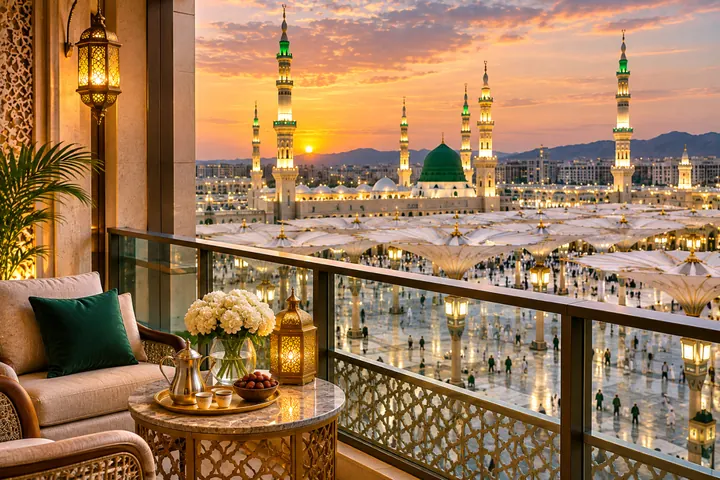
Masjid Umar is a small historic mosque just beside Masjid al-Ghamamah, a short walk south-west of Masjid an-Nabawi. It stands on the old musalla, the open ground where the Prophet ﷺ prayed the Eid prayers, and it carries the name of ‘Umar ibn al-Khattab, the second caliph of Islam.
The link with ‘Umar is an attribution of later tradition, which says that he led the Eid prayer here during his caliphate. There is no special act of worship tied to the site, but it makes a peaceful stop on a morning walk, and a reminder of one of the greatest figures in the history of Madinah.
The history of Masjid Umar
In the Prophet’s ﷺ time, the Eid prayers were not held inside his mosque but on an open prayer ground outside it. Abu Sa‘id al-Khudri reports that he would go out to the musalla on Eid al-Fitr and Eid al-Adha, start with the prayer and then address the people (al-Bukhari and Muslim). Historians of Madinah place this ground in the area where Masjid al-Ghamamah now stands.
In later centuries several small mosques were built across the musalla and named after the Prophet’s ﷺ Companions. Masjid Umar is one of them. The tradition is that ‘Umar, who was caliph from 13 to 23 AH, led the Eid prayer at this spot.
What we know, and what is tradition
It is well established that the caliphs continued the Prophet’s ﷺ practice of praying Eid in the open. Abu ‘Ubayd, a freed slave of Ibn Azhar, said that he attended Eid with ‘Umar, who prayed before the sermon and then said, “These are two days on which the Messenger of Allah ﷺ forbade fasting: the day you break your fast and the day you eat from your sacrifices” (al-Bukhari and Muslim).
However, no authentic report identifies this particular spot as ‘Umar’s, and the attribution does not appear in the earliest histories of Madinah. It is best described as a later local tradition. Treat the name as a way of honouring ‘Umar rather than as a confirmed historical marker.
The building
The present Masjid Umar is a modest stone building from the Ottoman period with a dome, a small courtyard and a short minaret. Its dark basalt and white plaster echo the style of Masjid al-Ghamamah next door. It was restored in the Saudi era and now sits among the open plazas of central Madinah.
Who was ‘Umar ibn al-Khattab?
‘Umar accepted Islam in Makkah, and his conversion gave strength to the small Muslim community. The Prophet ﷺ said to him, “Never does Shaytan meet you on a path except that he takes a path other than yours” (al-Bukhari and Muslim). At-Tirmidhi reports the hadith, “If there were to be a prophet after me, it would be ‘Umar,” which he graded hasan.
As caliph, ‘Umar expanded Masjid an-Nabawi, began dating events from the Hijrah, and governed a state that stretched from Egypt to Persia. When Madinah suffered drought, he asked al-‘Abbas, the Prophet’s ﷺ uncle, to pray for rain on behalf of the people (al-Bukhari). He used to pray, “O Allah, grant me martyrdom in Your cause, and let my death be in the city of Your Messenger” (al-Bukhari). Both were granted: he was killed while leading the Fajr prayer and is buried beside the Prophet ﷺ and Abu Bakr.
What is from the Sunnah at Masjid Umar (and what is not)
There is no established reward for visiting Masjid Umar, and no Sunnah of travelling to it. If it is open when you pass, it is simply a mosque: you may pray two rak‘ahs of greeting the mosque outside the times when voluntary prayer is disliked. That is all.
The Sunnah visits in Madinah are Masjid an-Nabawi, where a prayer is better than a thousand elsewhere apart from al-Masjid al-Haram (al-Bukhari and Muslim), Masjid Quba, where a prayer carries the reward of an Umrah (Ibn Majah and an-Nasa’i), and the graves of al-Baqi‘ and the martyrs of Uhud. Customary visits to other historic mosques are permissible as long as no special virtue is claimed for them.
Innovations to avoid
- Wiping or kissing the walls, doors or windows to seek blessing.
- Tying cloth or threads to the railings or windows.
- Collecting soil or stones from the mosque grounds.
- Making a ritual of praying a set number of rak‘ahs in each of the historic mosques.
- Calling upon ‘Umar or any Companion for help; supplication is for Allah alone.
What to do and what to read at Masjid Umar
Most pilgrims pause in the plaza outside Masjid Umar, look at the building and reflect. If the doors are open, enter with your right foot and the dua for entering a mosque, and pray if it is a permitted time.
بِسْمِ اللهِ، وَالصَّلَاةُ وَالسَّلَامُ عَلَى رَسُولِ اللهِ، اللَّهُمَّ افْتَحْ لِي أَبْوَابَ رَحْمَتِكَ
Bismillah, wa-s-salatu wa-s-salamu ‘ala rasulillah. Allahumma-ftah li abwaba rahmatik.
In the name of Allah, and peace and blessings be upon the Messenger of Allah. O Allah, open for me the doors of Your mercy.
Source: Muslim; Ibn MajahThere is no special dua for this site. You might ask Allah to be pleased with ‘Umar, reflect on his justice, humility and fear of Allah, and ask for the same qualities. The true place to send salam on ‘Umar is beside his grave in Masjid an-Nabawi, after greeting the Prophet ﷺ and Abu Bakr.
The site is also a good place to teach children the Sunnah of Eid: praying in the open, eating dates before Eid al-Fitr, and returning home by a different route from the one taken on the way (al-Bukhari).
How to get to Masjid Umar
From Masjid an-Nabawi
Leave by one of the south-western gates and walk towards Masjid al-Ghamamah, the larger mosque with several small domes. Masjid Umar stands beside it, roughly 500 metres from Masjid an-Nabawi, a walk of about ten minutes on flat paving. The route suits wheelchairs and pushchairs. Masjid Abu Bakr and Masjid ‘Ali are a minute or two away, so you can see all four in 30 to 45 minutes.
If you are staying further out, a taxi to Masjid al-Ghamamah is the simplest instruction for any driver.
From Masjid al-Haram in Makkah
Makkah to Madinah is roughly 450 km. The Haramain train takes around two and a quarter to two and a half hours, then a 15 to 20 minute taxi to the central area. By coach or private car allow four and a half to five hours.
Practical tips
Walk after Fajr
The plaza is cool, quiet and beautiful in the early light.
Use Ghamamah as a landmark
Masjid Umar is right beside it.
Interior may be closed
Opening varies; seeing the exterior is the usual visit.
Carry water
Shade is limited once the sun is up.
Frame it as tradition
Explain to children that the name honours ‘Umar by tradition.
Be back for prayer
Plan to reach Masjid an-Nabawi before the next adhan.
Masjid Umar quick facts
| City | Madinah |
|---|---|
| Location | Beside Masjid al-Ghamamah, about 500 m south-west of Masjid an-Nabawi |
| Time needed | 10 minutes; 30–45 minutes with the neighbouring mosques |
| Best time | After Fajr |
| Difficulty | Easy: flat, paved walk |
| Building | Ottoman period, restored in the Saudi era |
| Name | Attributed to ‘Umar ibn al-Khattab by later tradition |
| Open to visitors | Exterior always; interior opening varies, check locally |
Masjid Umar
Beside Masjid al-Ghamamah
Open in Google MapsNearby ziyarat- Masjid Abu Bakr0.1 km
- Masjid al-Ghamamah0.2 km
- Masjid Ali0.2 km
- Masjid an-Nabawi0.4 km
Continue to Masjid al-Ghamamah, Masjid Abu Bakr and Masjid ‘Ali nearby, and use the ziyarat route planner to add Quba or Uhud. Our Madinah city guide and the Madinah ziyarat guide cover the rest of the city, and the ziyarat hub lists every site. Rawdah permits are booked on Nusuk, and you can request a tailored quote for your stay.
Masjid Umar: frequently asked questions
Did ‘Umar pray in Masjid Umar?
Tradition says he led the Eid prayer at this spot as caliph. He certainly prayed Eid on the musalla, but the exact place is not confirmed by authentic reports.
Is there any reward for visiting Masjid Umar?
No special reward is established. If it is open, you may pray in it like any other mosque.
Is it the same as Masjid ‘Umar in Jerusalem?
No. This is a small mosque in Madinah. The mosques named after ‘Umar in Jerusalem and elsewhere are different buildings.
How long does the visit take?
About ten minutes on its own, or 30 to 45 minutes with the other mosques of the Eid ground.
Where is ‘Umar buried?
Beside the Prophet ﷺ and Abu Bakr, within Masjid an-Nabawi. Visitors greet him after greeting the Prophet ﷺ and Abu Bakr.
Is it suitable for wheelchair users?
Yes. The route from Masjid an-Nabawi is flat and paved.
Stay close, walk more
We can arrange hotels near Masjid an-Nabawi so the historic mosques of Madinah are an easy morning walk.