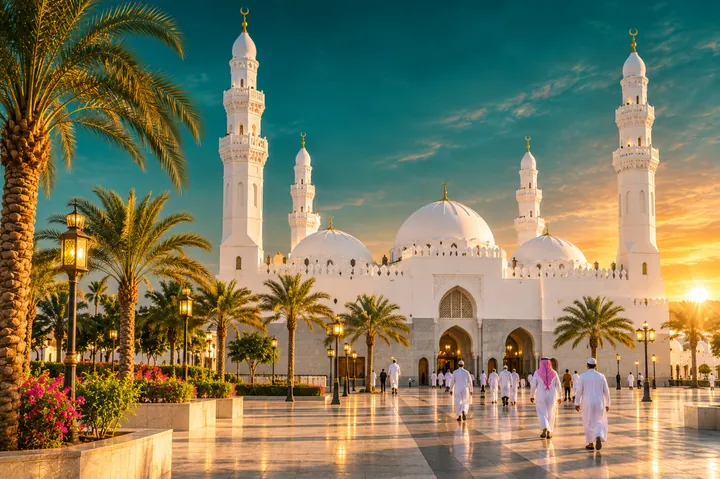
Ziyarat means “visits”. For pilgrims, it refers to visiting the places connected with the life of the Prophet ﷺ, his Companions and the early history of Islam in Makkah, Madinah and Taif. This guide brings together 44 sites, explains what each one is, and helps you plan visits that are meaningful, safe and true to the Sunnah.
It is written for Umrah and Hajj travellers who want to understand the history around them without confusing it with worship. Each site has its own detailed page, and our route planner can turn your choices into an efficient day.

What ziyarat is, and what it is not
Umrah consists of ihram, tawaf, sa‘i and shaving or trimming the hair. Hajj adds the days of Mina, Arafat and Muzdalifah. Neither includes visits to historical places, and both are complete without them. Ziyarat is therefore optional, a way of learning and reflecting, not a rite.
The greatest visits are to the two Harams themselves. The Prophet ﷺ said that journeys of worship are made to only three mosques: al-Masjid al-Haram, his own mosque and al-Masjid al-Aqsa (al-Bukhari and Muslim). He said a prayer in his mosque is better than a thousand elsewhere, except al-Masjid al-Haram (al-Bukhari and Muslim), and a hadith in Ibn Majah and Ahmad puts a prayer in al-Masjid al-Haram at a hundred thousand.
The few visits with an established Sunnah virtue
Beyond the two Harams, a small number of visits have a specific basis in the Sunnah:
- Masjid Quba: whoever purifies himself at home and prays there has a reward like an Umrah (Ibn Majah, an-Nasa’i; similar in at-Tirmidhi).
- Al-Baqi‘ and the martyrs of Uhud: the Prophet ﷺ visited them and taught the greeting “As-salamu ‘alaykum ahl ad-diyar min al-mu’minin wal-muslimin…”, reported in Sahih Muslim.
- Visiting graves in general, such as Jannat al-Mu‘alla in Makkah, which “reminds you of the Hereafter” (Muslim).
Every other site in this guide is valued for its history. That is worth a great deal, but it is not worship in itself, and no special prayer, dua or ritual is established for it.
Ziyarat etiquette: seven principles for every site
Two practical principles matter just as much. First, never let ziyarat make you miss a congregational prayer in the Haram, whose reward is far greater. Second, protect your energy for the rites: tawaf and sa‘i come before any climb or long drive. Our how to perform Umrah guide covers the rites themselves.
Ziyarat in Makkah
Makkah’s historical sites fall into three groups: the mountains of revelation and Hijrah, the holy sites of Hajj to the east, and places close to the Haram. Most hotels and operators offer a half-day Makkah ziyarat tour by coach.
Every Makkah site is listed below — tap any card for its full page. For live prayer times, weather and the city at a glance, see our Makkah city guide.
The Sacred Mosque around the Kaaba — one prayer here is worth 100,000 elsewhere.
The Haram itselfMakkah LibraryLibrary on the site traditionally identified as the Prophet’s ﷺ birthplace; the exact location is uncertain.
About 400 m east of Masjid al-HaramClock Tower MuseumScience-of-time and astronomy museum at the top of the Makkah Clock Tower.
Abraj Al Bait, beside the HaramJannat al-Mu‘allaMakkah’s historic cemetery, where Khadijah and members of the Prophet’s ﷺ family are buried.
About 1 km north of Masjid al-HaramMasjid al-JinnMosque traditionally linked with the jinn who listened to the Qur’an from the Prophet ﷺ.
About 1 km north of Masjid al-HaramJabal al-Nour (Cave Hira)The mountain of the Cave of Hira, where the first verses of the Qur’an were revealed.
About 4–5 km north-east of Masjid al-HaramMasjid al-Ji‘ranahMiqat mosque where the Prophet ﷺ entered ihram for Umrah after Hunayn.
About 25 km north-east of the HaramMinaThe valley of tents and the Jamarat, where pilgrims stay during the days of Hajj.
About 5–8 km east of Masjid al-HaramMasjid al-Bay‘ahSmall historic mosque marking the Pledges of al-‘Aqabah.
Near the Jamarat, Mina sideJamarat (Stoning Pillars)The three pillars of Mina stoned during Hajj, now in a multi-level complex.
Mina, about 5 km east of the HaramMasjid al-KhayfThe main mosque of Mina, near the smallest Jamarah, where the Prophet ﷺ prayed during Hajj.
About 7 km east of Masjid al-HaramWadi MuhassirThe valley where the army of the elephant was destroyed; pilgrims hasten through it.
Between Mina and MuzdalifahMuzdalifahThe open plain where Hajj pilgrims spend the night of the 10th of Dhul Hijjah.
About 10 km east of Masjid al-HaramArafat (Jabal al-Rahmah)The plain of the Day of Arafah, the heart of Hajj, with Jabal al-Rahmah at its centre.
About 20 km south-east of Masjid al-HaramJabal al-Rahmah (Mount of Mercy)The granite hill at the heart of Arafat, near where the Prophet ﷺ stood on the Day of Arafah.
Arafat, about 20 km east of the HaramMasjid NamirahThe mosque of the Arafah sermon, partly outside the boundary of Arafat.
About 19 km south-east of Masjid al-HaramJabal ThawrThe mountain whose cave sheltered the Prophet ﷺ and Abu Bakr for three nights on the Hijrah.
About 6 km south of Masjid al-HaramExhibition of the Two Holy Mosques ArchitectureMuseum of historic pieces of the Kaaba, the Haram and Masjid an-Nabawi at Umm al-Joud.
About 7 km north-west of Masjid al-HaramMasjid Aisha (Tan‘im)The nearest point outside the haram, where people in Makkah enter ihram for Umrah.
About 7.5 km north-west of Masjid al-HaramHudaybiyah (al-Shumaisi)Site of the Treaty of Hudaybiyah and the Pledge of Ridwan, on the old Jeddah road.
About 22–25 km west of Masjid al-HaramMakkah ziyarat plans
Half day (about 3–4 hours): leave after Fajr, drive to Jabal al-Nour for a view from the base, then continue east through Mina, Muzdalifah and Arafat, and return before Dhuhr. This is the classic coach tour.
Full day: add the climb to the Cave of Hira at first light, the holy sites mid-morning, the air-conditioned Two Holy Mosques Exhibition at midday, then Masjid Aisha and a walk to Jannat al-Mu‘alla and Masjid al-Jinn after ‘Asr. Keep the five prayers in the Haram where you can.
In the hotter months, swap the order: indoor visits at midday, mountains and open plains only in the first hours after sunrise. Families with young children usually prefer the half-day plan spread over two mornings.
Free toolBuild your Umrah itinerary in one minutePick your nights in Makkah and Madinah and get a day-by-day outline you can bring to us.Open planner →Ziyarat in Madinah
Madinah is compact, and many sites are close to Masjid an-Nabawi. Before anything else, read our Madinah ziyarat guide on visiting the Prophet’s ﷺ mosque, greeting him and booking the Rawdah through the Nusuk app.
Every Madinah site is listed below, each with its own page. Our Madinah city guide adds live prayer times, weather and practical tips for the city.
The Prophet’s ﷺ Mosque — one of the three mosques worth travelling to.
The heart of MadinahThe Rawdah (Riyad al-Jannah)The area between the Prophet’s ﷺ house and minbar — a garden of Paradise.
Inside Masjid an-NabawiMasjid al-GhamamahOttoman-era mosque on the Prophet’s ﷺ Eid prayer ground.
About 500 m south-west of Masjid an-NabawiMasjid Abu BakrHistoric mosque on the Eid prayer ground of the Prophet ﷺ, named after Abu Bakr.
About 400 m south-west of Masjid an-NabawiMasjid UmarOttoman-era mosque on the old Eid prayer ground, named after ‘Umar ibn al-Khattab.
Beside Masjid al-GhamamahMasjid AliSmall historic mosque on the Musalla, linked by tradition to ‘Ali ibn Abi Talib.
North of Masjid al-GhamamahSaqifah Bani Sa‘idahGarden where the Companions gave the pledge to Abu Bakr as the first caliph.
About 300 m north-west of Masjid an-NabawiSeerah MuseumInteractive museum of the Prophet’s ﷺ life and the history of Madinah.
Beside Masjid an-NabawiJannat al-Baqi‘Madinah’s main cemetery, resting place of many Companions and members of the Prophet’s ﷺ family.
Adjacent to Masjid an-Nabawi (east)Dar al-Madinah MuseumMuseum of Madinah’s history with models of the city and the Prophet’s ﷺ mosque.
About 4–6 km from Masjid an-NabawiHejaz Railway MuseumRestored Ottoman-era station of the 1908 Damascus–Madinah railway.
About 1.5 km south-west of Masjid an-NabawiMasjid al-Jumu‘ahMarks where the Prophet ﷺ is reported to have led his first Friday prayer on the Hijrah.
About 2.5 km south of Masjid an-NabawiMasjid QubaThe first mosque in Islam; praying there brings a reward like an Umrah.
About 3.5 km south of Masjid an-NabawiThe Seven MosquesSmall historic mosques at the site of the Battle of the Trench (al-Khandaq).
About 3–4 km north-west of Masjid an-NabawiMasjid al-QiblataynMosque traditionally associated with the change of the qiblah to the Kaaba.
About 5 km north-west of Masjid an-NabawiBir Uthman (Bi’r Rumah)The well ‘Uthman ibn ‘Affan bought and gave freely to the Muslims.
About 5–7 km north-west of Masjid an-NabawiMasjid al-IjabahMosque where the Prophet ﷺ prayed and made three supplications, as reported by Muslim.
About 1 km north-east of Masjid an-NabawiKing Fahd Glorious Qur’an Printing ComplexWhere the Madinah Mushaf is reviewed, printed and bound; guided tours by arrangement.
About 10 km north-west of Masjid an-NabawiMount Uhud and the MartyrsSite of the Battle of Uhud and the graves of its martyrs, including Hamzah.
About 5 km north of Masjid an-NabawiJabal al-Rumat (Archers’ Hill)The small hill where the archers were stationed at the Battle of Uhud.
Facing Mount Uhud, 5 km northDhul Hulayfah (Abyar Ali)The Miqat of the people of Madinah, where the Prophet ﷺ entered ihram.
About 10 km south-west of Masjid an-NabawiMadinah ziyarat plans
Half day: make wudu at your hotel, pray two rak‘ahs in Quba after sunrise, stop at Masjid al-Jumu‘ah, then continue to Masjid al-Qiblatayn, the Seven Mosques and Uhud, returning for Dhuhr. Greet the people of al-Baqi‘ after Fajr or ‘Asr on another day.
Full day: start with the Dar al-Madinah Museum or the Qur’an Printing Complex to understand the setting, follow the half-day loop, then walk to Masjid al-Ghamamah in the evening. Saturday mornings at Quba follow the Prophet’s ﷺ own practice.
MadinahAdd Madinah to your UmrahNights near Masjid an-Nabawi, Rawdah permits and ziyarat — we include it in your proposal.Madinah city guide →Ziyarat in Taif
Taif is a cool mountain city about 90 km from Makkah, where the Prophet ﷺ faced rejection with mercy. A full-day trip combines Masjid ‘Abdullah ibn ‘Abbas and Masjid ‘Addas with the Al-Hada road, Al-Shafa and, in spring, the rose farms. If you return to Makkah intending Umrah, you must enter ihram at Qarn al-Manazil; see our miqat guide.
Mountain city of the Prophet’s ﷺ visit, Masjid Ibn Abbas, Al-Hada, Al-Shafa and rose farms.
About 90 km from Masjid al-Haram by roadMasjid Abdullah ibn AbbasLarge historic mosque of Taif beside the grave of Ibn ‘Abbas.
Central TaifMasjid AddasSmall mosque recalling ‘Addas, who welcomed the Prophet ﷺ after the hardship of Taif.
South Taif, near the old gardensFull day plan: leave after Fajr, reach the city by mid-morning, visit the mosques before Dhuhr, enjoy lunch and the mountain viewpoints, and return before Maghrib.
Plan your ziyarat route
Choose the sites you want and the planner will order them into an efficient loop, with distances and suggested times. You can also open the full ziyarat route planner page.
Ziyarat route planner
Pick the sites you want to visit — we put them in the most efficient order with travel and visit times.
Ziyarat: frequently asked questions
Is ziyarat part of Umrah or Hajj?
No. Both are complete without visiting any historical site. Ziyarat is an optional, beneficial addition to your trip.
Which ziyarat sites have a reward in the Sunnah?
Beyond the two Harams, praying in Masjid Quba carries a reward like an Umrah, and visiting and greeting the believers at al-Baqi‘, the martyrs of Uhud and other cemeteries is a Sunnah.
Can I touch the walls or take soil for blessing?
No. These practices are not from the Sunnah. Respect the sites and follow the signs and staff.
How much time do I need for ziyarat?
A half day in each city covers the main sites. A full day allows a calmer pace or extra visits such as museums or Taif.
Can women and elderly pilgrims join ziyarat tours?
Yes. Most sites can be seen from a coach or with short walks. Avoid the mountain climbs if mobility is limited, and note that cemetery entry is generally for men.
Do I need a guide?
A knowledgeable guide helps a great deal, especially for history. Choose one who distinguishes authentic reports from popular stories.
Umrah with a well-planned ziyarat
Tell us your dates and the sites that matter to you, and we will send a proposal with hotels, transport and guided ziyarat in Makkah and Madinah.