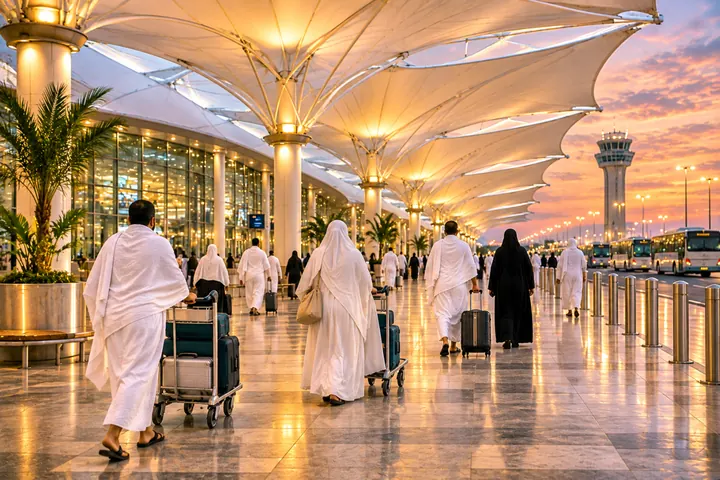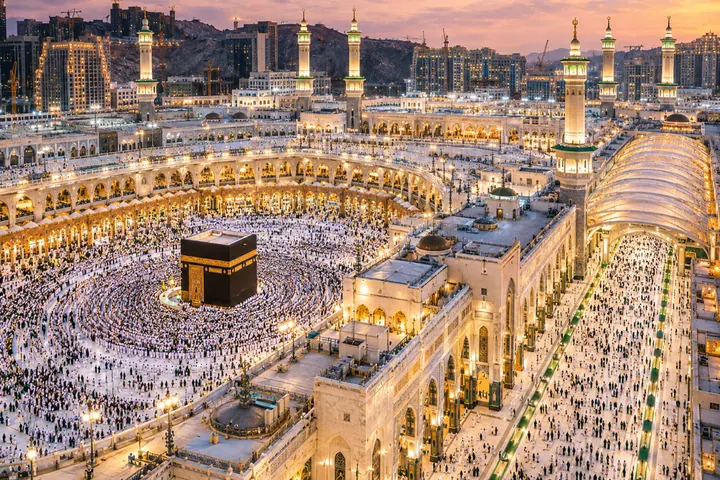
The Umrah steps are fewer and simpler than many people expect. At its heart, Umrah consists of four essential acts performed in order: entering ihram, circling the Kaaba in tawaf, walking between Safa and Marwah in sa‘i, and shaving or shortening the hair. This guide explains those four Umrah steps simply and clearly, with the duas, the Sunnah acts that beautify each stage and the common mistakes to avoid.
If you can remember the four steps, you can perform Umrah. Everything else in this article helps you perform them correctly, calmly and with a present heart.
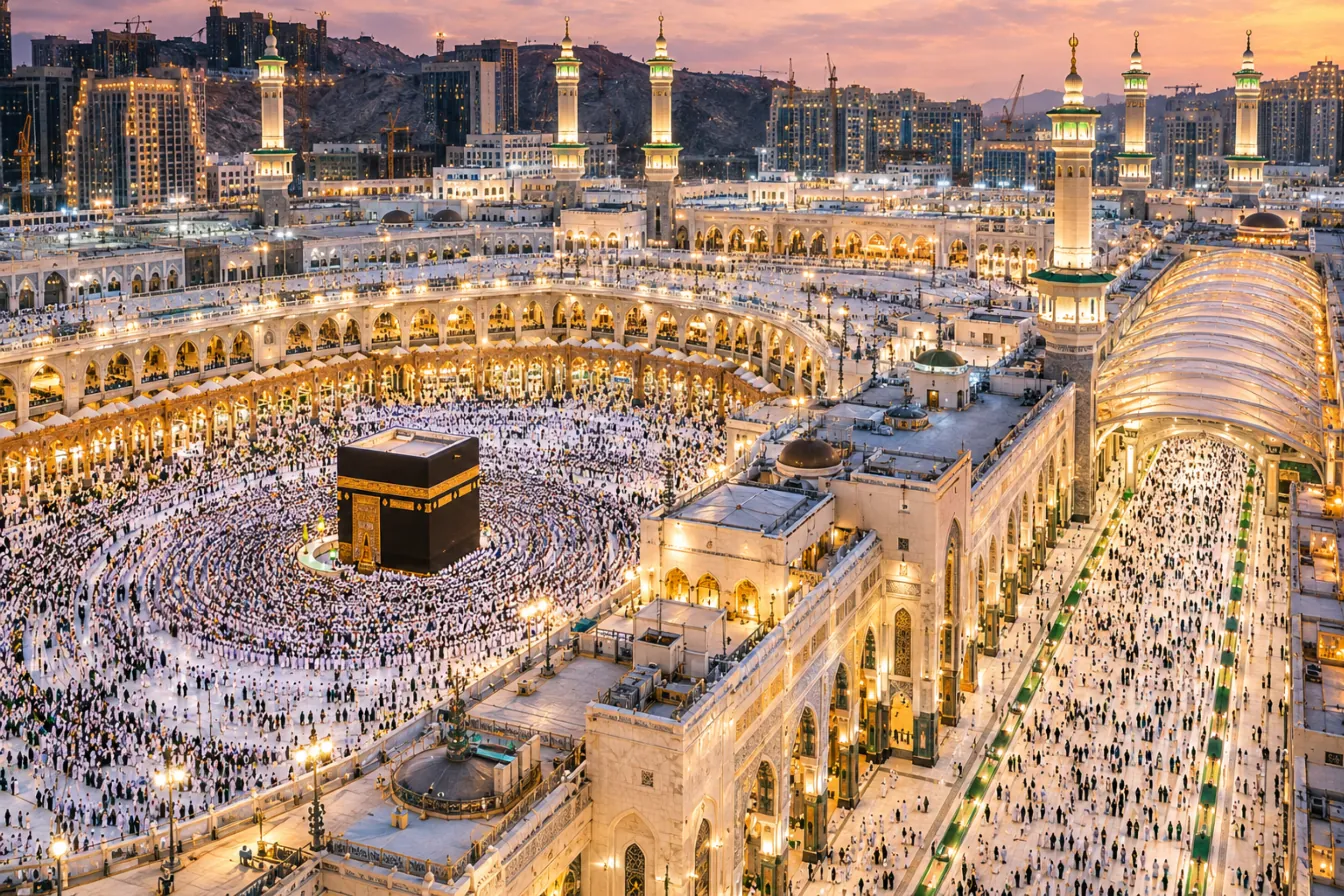
The four Umrah steps at a glance
Here is the whole journey in one picture. Each of the Umrah steps flows naturally into the next, and most pilgrims complete them in a few hours.
Umrah can be performed at any time of year, and its reward is great. The Prophet ﷺ said that one Umrah to the next is an expiation for what lies between them, a hadith recorded by al-Bukhari and Muslim. Understanding the Umrah steps before you travel lets you focus on that meaning rather than worrying about the order.
Pillars and obligations: how the madhhabs differ
You will often hear the four Umrah steps called “the pillars of Umrah”. That is a helpful way to teach them, but the four Sunni schools of law classify them slightly differently. A pillar (rukn) is an act without which Umrah is not valid; an obligation (wajib) is required, but missing it is usually made up with an expiation rather than invalidating the Umrah.
| Act | Hanafi | Maliki | Shafi‘i | Hanbali |
|---|---|---|---|---|
| Ihram | Condition (shart) | Pillar | Pillar | Pillar |
| Tawaf | Pillar | Pillar | Pillar | Pillar |
| Sa‘i | Obligation | Pillar | Pillar | Pillar |
| Halq or taqsir | Obligation | Obligation | Pillar | Obligation |
Step 1 of the Umrah steps: ihram
Ihram is the sacred state you enter with the intention of Umrah. It begins at or before the Miqat, the boundary you must not cross without being in ihram if you intend to perform Umrah. If you are flying, this is usually on the plane before landing in Jeddah. Our Miqat guide explains where each route crosses the boundary.
Preparing for ihram
Before making your intention, it is Sunnah to take a bath (ghusl), trim nails and remove unwanted hair. Men may apply perfume to the body, not the garments, before the intention. Men then wear two unstitched white sheets, one around the waist and one over the shoulders, with sandals that leave the ankles uncovered. Women wear ordinary modest clothing, without a niqab or gloves while in ihram.
Making the intention
At the Miqat, make the intention in your heart and say “Labbayka Allahumma ‘umrah”. If you fear illness or another obstacle may stop you, you may add the condition taught in the hadith of Duba‘ah bint al-Zubayr, recorded by al-Bukhari and Muslim. Then begin the Talbiyah, which men say aloud and women say quietly.
لَبَّيْكَ اللَّهُمَّ عُمْرَةً
Labbayk Allahumma ‘umrah.
Here I am, O Allah, for Umrah.
Source: Muslimلَبَّيْكَ اللَّهُمَّ لَبَّيْكَ، لَبَّيْكَ لَا شَرِيكَ لَكَ لَبَّيْكَ، إِنَّ الْحَمْدَ وَالنِّعْمَةَ لَكَ وَالْمُلْكَ، لَا شَرِيكَ لَكَ
Labbayk Allahumma labbayk, labbayka la sharika laka labbayk, inna-l-hamda wa-n-ni‘mata laka wa-l-mulk, la sharika lak.
Here I am, O Allah, here I am. Here I am, You have no partner, here I am. All praise, blessings and sovereignty belong to You. You have no partner.
Source: al-Bukhari and MuslimOnce in ihram, avoid its prohibitions: perfume, cutting hair or nails, sexual relations, hunting, and for men covering the head or wearing fitted, stitched clothing. Our ihram rules guide covers the details and what to do if you break one by mistake.
Step 2 of the Umrah steps: tawaf
When you reach Makkah, stop the Talbiyah as you begin tawaf. Enter Masjid al-Haram with your right foot, and the dua for entering the masjid. Make sure you have wudu, since the majority of scholars require purity for tawaf.
Prepare at the Black Stone line
Men uncover the right shoulder (idtiba). Stand in line with the Black Stone, marked by a green light on the wall opposite.
Begin the first round
Face the Black Stone, kiss or touch it if you can without harming anyone, or point to it with your right hand, saying Bismillah, Allahu akbar.
Walk seven rounds
Keep the Kaaba on your left and walk anticlockwise, outside the curved wall of Hijr Isma‘il. Men walk briskly (raml) in the first three rounds where possible.
Make your own duas
There is no fixed dua for each round. Between the Yemeni Corner and the Black Stone, recite “Rabbana atina fi-d-dunya hasanah…”.
Pray two rak‘ahs
Cover the shoulder again and pray two rak‘ahs behind Maqam Ibrahim if there is space, or anywhere in the masjid. Then drink Zamzam.
Tawaf is the most detailed of the Umrah steps, so we have written a full guide on how to do tawaf, including what to do if you lose count or the prayer starts in the middle of a round.
بِسْمِ اللهِ، وَاللهُ أَكْبَرُ
Bismillah, wallahu akbar.
In the name of Allah, and Allah is the Greatest.
Source: al-Bukhari (takbir); al-Bayhaqi from Ibn ‘Umar (with Bismillah)رَبَّنَا آتِنَا فِي الدُّنْيَا حَسَنَةً وَفِي الْآخِرَةِ حَسَنَةً وَقِنَا عَذَابَ النَّارِ
Rabbana atina fi-d-dunya hasanatan wa fi-l-akhirati hasanatan wa qina ‘adhaba-n-nar.
Our Lord, give us good in this world and good in the Hereafter, and protect us from the punishment of the Fire.
Source: Qur’an 2:201; Abu DawudAfter the seventh round, it is Sunnah to walk towards Maqam Ibrahim reciting “Wattakhidhu min maqami Ibrahima musalla” (al-Baqarah 2:125), then pray two rak‘ahs. In the description of the Prophet’s ﷺ Hajj recorded by Muslim, he recited Surah al-Kafirun and Surah al-Ikhlas in them. If the area behind the Maqam is crowded, pray anywhere in the masjid, then drink Zamzam and make dua before heading to Safa.
Counting seven rounds while surrounded by thousands of people is harder than it sounds. Our tawaf and sa‘i counter lets you tap once per round on your phone, so you can focus on your duas instead of your arithmetic.
Tawaf and Sa‘i counter
Tap once at the end of each round. Your count is saved if the screen locks.
Tawaf rounds start and end at the Black Stone (green light on the wall opposite).
Step 3 of the Umrah steps: sa‘i
Sa‘i commemorates Hajar, the mother of Isma‘il, who ran between the hills of Safa and Marwah searching for water until Allah caused Zamzam to flow. Allah says that Safa and Marwah are among His symbols (al-Baqarah 2:158).
- Go to Safa. As you approach, recite the verse “Inna as-Safa wal-Marwata min sha‘a’irillah”. Climb a little, face the Kaaba, raise your hands and praise Allah and make dua.
- Walk to Marwah. Men walk briskly between the two green lights; women walk at a normal pace throughout.
- At Marwah, repeat the dua. Face the direction of the Kaaba and make dua as at Safa. That is one lap.
- Complete seven laps. Safa to Marwah is one, Marwah to Safa is two, and so on, finishing at Marwah.
إِنَّ الصَّفَا وَالْمَرْوَةَ مِنْ شَعَائِرِ اللهِ — أَبْدَأُ بِمَا بَدَأَ اللهُ بِهِ
Inna-s-Safa wa-l-Marwata min sha‘a’iri-llah. Abda’u bima bada’a-llahu bih.
Indeed Safa and Marwah are among the symbols of Allah. I begin with what Allah began with.
Source: Qur’an 2:158; Muslim (hadith of Jabir)Wudu is recommended for sa‘i but not required according to most scholars. You may rest during sa‘i if you need to, and wheelchairs are widely used. For more detail, read our full guide to sa‘i between Safa and Marwah.
Step 4 of the Umrah steps: halq or taqsir
The final of the four Umrah steps is cutting the hair, which releases you from ihram. Men may shave the head (halq) or shorten the hair (taqsir); shaving is better, as the Prophet ﷺ made dua three times for those who shave and then for those who shorten, as recorded by al-Bukhari and Muslim. Women gather their hair and trim a fingertip’s length from the ends.
Once your hair is cut, your Umrah is complete and the restrictions of ihram are lifted. Take a moment to thank Allah, make dua for your family and those who asked you to remember them, and rest. Our complete guide to how to perform Umrah covers every stage in even more depth, and our collection of Umrah duas brings all the supplications together in one place.
Dua collectionThe duas to read at each stepTalbiyah, tawaf, Safa and Marwah, Arafah and more — with copy and audio-friendly text.Open duas →Umrah steps for women, children and the elderly
The four Umrah steps are the same for everyone, but some details differ. These tabs summarise the main points.
Women wear modest everyday clothing in ihram, without niqab or gloves, and say the Talbiyah quietly. They do not uncover a shoulder, walk briskly in tawaf or run between the green lights. A woman who is menstruating stays in ihram and waits until she is pure before tawaf, as the Prophet ﷺ instructed ‘A’ishah, according to al-Bukhari and Muslim. See our Umrah for women guide.
A child’s Umrah is valid, though scholars who hold Umrah to be obligatory say it does not count as the obligatory Umrah of adulthood. Parents make the intention on behalf of very young children and carry them through tawaf and sa‘i. Older children can perform the Umrah steps themselves with a little help.
Wheelchairs are widely used for tawaf and sa‘i, and the upper floors are often less crowded. Rest between the Umrah steps if you need to: there is no requirement to perform sa‘i immediately after tawaf, although it is the Sunnah to keep them close together.

After the Umrah steps: what comes next?
Many pilgrims feel a mix of relief and joy once the fourth step is done. Change into your normal clothes, eat, rest and thank Allah for allowing you to complete the Umrah steps. The rest of your time in Makkah is yours to fill with worship: the five daily prayers in congregation, voluntary tawaf, reading Qur’an and making dua for yourself and others.
Voluntary tawaf has no sa‘i and no hair cutting, and men do not uncover the shoulder or walk briskly in it. It is one of the most rewarding things you can do in Makkah, and many scholars prefer it to repeating Umrah on the same trip. Keep a little energy in reserve, too, for Madinah if it is part of your journey.
A simple checklist for the day
- Ihram garments or modest clothing ready, and your intention clear in your mind before the Miqat
- Wudu renewed before you enter Masjid al-Haram
- A counter or method for tracking seven rounds and seven laps
- A small bag for your shoes, a bottle for Zamzam and any medicines
- A meeting point agreed with your group, such as a numbered gate
- Scissors or a plan for a barber once sa‘i is complete
If you are still planning when to travel and where to stay, a hotel within walking distance of the Haram makes all four Umrah steps far easier, especially for families and older relatives. Our team can suggest suitable hotels and timings through the quote form.
Common mistakes in the Umrah steps
Most mistakes come from rushing or copying others. Here are the ones we see most often, and what to do instead.
Crossing the Miqat
Passing the Miqat without ihram when intending Umrah. Enter ihram before it, including on a plane.
Walking inside Hijr Isma‘il
The curved area is part of the Kaaba. Walk around the outside of its wall.
Idtiba all the time
Men uncover the right shoulder only during tawaf, not throughout ihram or during prayer.
Starting sa‘i at Marwah
Sa‘i always begins at Safa and ends at Marwah after seven laps.
Cutting a few hairs
Shave, or cut evenly from the whole head, to leave ihram with certainty.
Pushing at the Black Stone
Kissing it is Sunnah, but harming others is forbidden. Point from a distance.
Sincerity matters more than perfection. Learn the four Umrah steps, carry a short checklist of the duas, and you will find that the rites become a source of peace rather than anxiety. Official information on Umrah permits and services is available on the Nusuk platform, and rules change, so check it before you travel.
Tailored quoteTell us your dates, city and hotel preferencesOne short form, a personalised Umrah or Hajj proposal from our travel team — no obligation.Request my quote →Umrah steps: frequently asked questions
What are the four steps of Umrah?
Ihram with the intention at the Miqat, tawaf of seven rounds around the Kaaba, sa‘i of seven laps between Safa and Marwah, and shaving or shortening the hair.
How long do the Umrah steps take?
Usually around two to four hours from the start of tawaf to cutting the hair, depending on crowds, your pace and the floor you use.
Is the two rak‘ah prayer after tawaf one of the steps?
It is attached to tawaf rather than counted as a separate step. Scholars differ on its status: many regard it as a confirmed Sunnah, while others, including the Hanafis, regard it as wajib.
Can I rest between tawaf and sa‘i?
Yes. It is Sunnah to do sa‘i soon after tawaf, but a rest between them does not invalidate your Umrah.
Do I need wudu for all the Umrah steps?
The majority of scholars require wudu for tawaf. It is recommended, but not required, for sa‘i and the other steps.
Is there a special dua for each round of tawaf?
No fixed dua for each round is established in the Sunnah. Make sincere duas in any language, and recite the Qur’anic dua between the Yemeni Corner and the Black Stone.
Can I perform more than one Umrah on the same trip?
Scholars differ on repeating Umrah during one trip, especially by going out to Masjid ‘A’ishah for ihram. Many encourage extra tawaf instead. Ask a scholar you trust.
Ready to perform your Umrah?
Tell us your dates and who is travelling, and our team will plan a well-paced Umrah with hotels close to the Haram.