Ihram for women is simpler than many sisters expect, yet it is surrounded by more confusion than almost any other part of Umrah. There is no special uniform, no white sheet and no single “correct” outfit. Instead, a woman enters a sacred state in her ordinary modest clothing and observes a short list of restrictions until her Umrah is complete.
This guide sets out what is allowed and what is not, from the face and hands to perfume, jewellery, hair and periods. Where scholars differ, we say so, so you can follow the opinion of a scholar you trust with confidence.
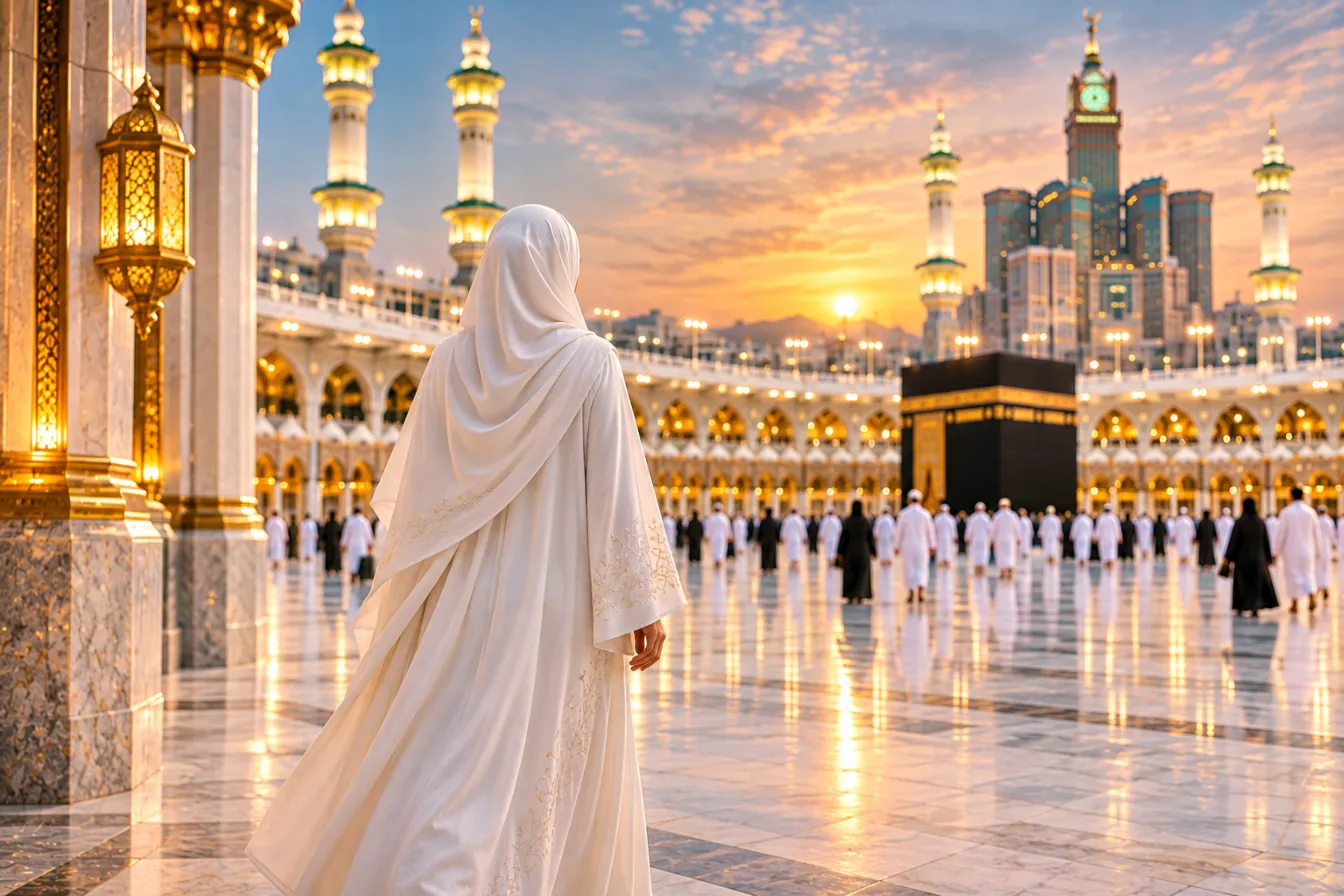
Ihram for women: the basics
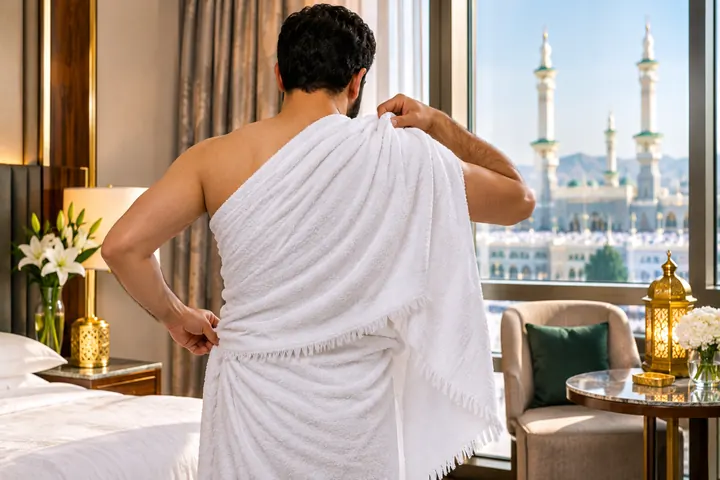
Ihram is a state of consecration that begins with the intention for Umrah or Hajj, made at or before the Miqat. For men it involves two unstitched cloths, but ihram for women involves no change of garment at all. A woman simply wears clean, modest, loose clothing that covers her body according to Islamic dress, makes her intention, and begins the Talbiyah quietly.
The restrictions that follow are fewer than many expect. Most are shared with men, such as avoiding perfume, not cutting hair or nails and refraining from marital relations. A few are specific to women, notably the rulings on the niqab and gloves. Our full Umrah for women guide covers the whole journey; this article focuses on the state of ihram itself.
Preparing at home
The same Sunnah preparations apply to women as to men. Take a bath (ghusl), trim nails and remove unwanted hair before the intention, because these are prohibited afterwards. A woman may take ghusl for ihram even while menstruating, as the Prophet ﷺ instructed Asma’ bint ‘Umays to do when she gave birth during Hajj, as reported by Muslim. Women avoid perfume that others can smell when going out, so most scholars advise a sister to skip it, or use only a little in private before the intention.
What to wear in ihram for women
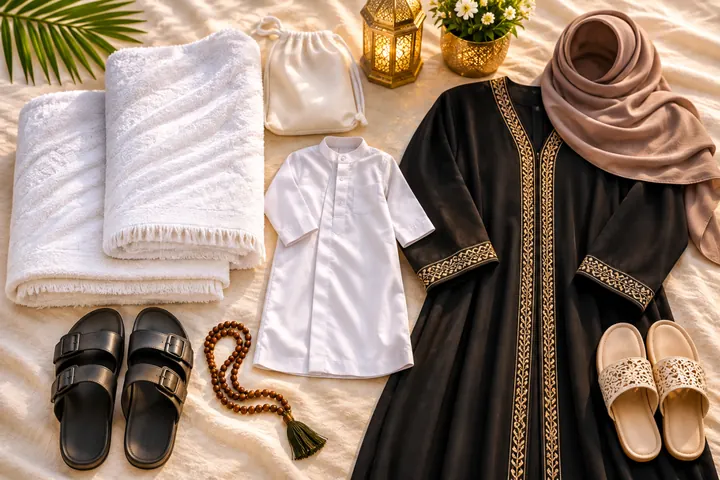
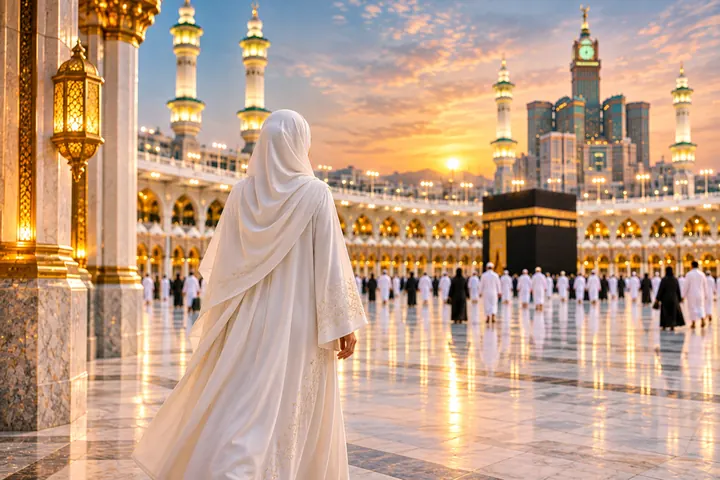
When it comes to clothing, ihram for women follows one rule: wear what you would normally wear for prayer and modest dress in public. Any colour is permitted. White is not required, and some scholars mention that black or plain dark colours are a common choice, but the key is modesty and avoiding clothes designed to attract attention.
Loose abaya or jilbab
A loose, opaque outer garment that covers the body. Lightweight, breathable fabric is easier in crowds and warm weather.
Secure hijab
A headscarf that covers the hair and neck and stays in place while walking. Under-scarves and pins are fine.
Comfortable shoes
Unlike men, women may wear socks and closed shoes. Choose soft, broken-in footwear for long walks.
Layers for winter
A cardigan or long-sleeved underlayer is permitted and helps with cool nights and air-conditioning.
Plain, not showy
Avoid heavy embellishment or perfume-infused fabric. Simple clothing keeps the focus on worship.
A spare set
Pack a second outfit. Changing clothes does not affect ihram, and you may need it after a long journey.
Our article on what to wear for Umrah has a full wardrobe list for the family, and the Umrah packing list covers everything else that goes in the case.
Free toolInteractive Umrah packing checklistTick items off as you pack; your progress is saved on this device.Open checklist →Face, niqab and gloves in ihram
This is the area of ihram for women that raises the most questions. In the hadith of Ibn ‘Umar recorded by al-Bukhari, the Prophet ﷺ said that a woman in ihram should not wear the niqab or gloves. Scholars agree on this point: once in ihram, a woman does not wear a fitted face veil tied over the face, nor gloves on her hands.
This does not mean she must be seen by everyone. There are reports from ‘A’ishah, recorded by Abu Dawud and others, that the women in ihram would lower a garment from the head over the face when men passed by, and lift it again afterwards. On this basis, many scholars permit a woman to let a cloth hang over her face in front of non-mahram men, provided it is not a tied niqab. Some prefer that the cloth does not touch the face; others are more relaxed. Hands can be covered by the sleeves or the abaya.
Sunglasses, masks and visors
Sunglasses are generally considered permissible, as they are not a face covering. Medical face masks are more debated: some scholars allow them where there is a need, such as illness or heavy crowds, while others see them as covering the face and suggest a drape instead. Peaked caps with a visor are not usually worn by women, as the hijab already covers the head.
What is not allowed in ihram for women
The prohibitions of ihram for women can be summarised in a short list. Keep it on your phone and read it once on the flight.
| Item or action | In ihram for women | Notes |
|---|---|---|
| Niqab tied over the face | Not allowed | Reported by al-Bukhari; a hanging drape is permitted by many scholars. |
| Gloves | Not allowed | Cover hands with sleeves or the abaya instead. |
| Perfume or scented products | Not allowed | Includes scented soap, shampoo, lotions and wipes. |
| Cutting hair or nails | Not allowed | Until the hair is trimmed at the end of Umrah. |
| Marital relations | Not allowed | Also avoid intimate touching with desire. |
| Hunting land animals | Not allowed | Rarely relevant today, but part of the rules. |
| Marriage contract | Not allowed | Neither for herself nor arranging one, according to the majority. |
| Arguing and bad speech | Avoid | The Qur’an forbids disputing during the pilgrimage (al-Baqarah 2:197). |
Henna is a point where scholars differ. Many advise avoiding it in ihram because it was regarded as a form of adornment with scent; it is simplest to apply it before you travel, if at all. Make-up is also best avoided, both because some products are scented and because of the spirit of humility that ihram represents.
Not sure about a particular product or accessory? Try our ihram checker below. It is built mainly around the rules for men, but most of its answers on perfume, hair and nails apply equally to ihram for women.
Ihram: allowed or not?
Check common actions against the rules of ihram.
Wearing perfume or scented soap
Not allowed after entering ihram. Use unscented products; perfume applied to the body before ihram may remain.
Cutting hair or nails
Not allowed until you exit ihram with halq or taqsir.
Men covering the head with a cap or turban
Men must leave the head uncovered. Shade from an umbrella or tent is fine.
Men wearing stitched, fitted clothing
Men wear two unstitched sheets. A belt, watch, glasses and sandals are fine.
Women wearing a niqab or gloves
Women may not wear a face veil tied to the face or gloves in ihram; they may lower a cloth over the face in front of non-mahram men.
Showering with unscented soap
Allowed. Avoid scented products and do not deliberately pull out hair.
Changing into a clean ihram sheet
Allowed whenever needed.
Using an umbrella or sitting in shade
Allowed for everyone.
Hunting land animals
Prohibited in ihram.
Marriage contract or proposing marriage
Not allowed while in ihram.
Marital relations
Strictly prohibited until fully out of ihram; it has serious consequences for the rites.
Taking medication
Allowed, including unscented creams.
If you break a rule of ihram by mistake or out of need, ask a qualified scholar about any expiation (fidyah).
What is allowed in ihram for women
The list of permitted things is reassuringly long. Many sisters worry unnecessarily about ordinary items, so here is what ihram for women does allow.
- Any modest clothing in any colour, including stitched and fitted garments.
- Socks and closed shoes, unlike men.
- Underwear and sanitary products, including pads and, according to most scholars, tampons.
- Hair clips, pins and under-scarves to keep the hijab in place.
- Jewellery already worn, such as a wedding ring or small earrings. Avoid showing adornment to non-mahram men.
- Changing and washing clothes as often as you need.
- Bathing with unscented soap, even if a few hairs fall naturally.
- An umbrella or shade for the sun.
- Medicines, including unscented creams and eye drops.
Periods, postnatal bleeding and ihram for women
A woman whose period begins before the Miqat should still enter ihram there. The clearest evidence is the hadith of ‘A’ishah in al-Bukhari and Muslim: when her period began during the Farewell Pilgrimage, the Prophet ﷺ told her to do everything a pilgrim does except the tawaf of the House until she was pure. The same applies to postnatal bleeding (nifas).
Take a bath for ihram if you wish, make the intention at the Miqat and recite the Talbiyah. You remain in ihram while you wait to become pure. You may make dhikr and dua, and many scholars permit reciting the Qur’an from memory or a device.
Stay in ihram and wait. Once your period ends, take a bath and perform tawaf, then sa‘i and the hair trim. Most scholars say sa‘i itself does not require purity, but sa‘i must come after a valid tawaf.
If your period begins after you complete tawaf, you may continue with sa‘i according to the majority of scholars, then trim your hair and leave ihram.
This is where scholars differ most. Some permit tawaf with protection in genuine necessity, others advise remaining in ihram or other solutions. Ask a qualified scholar before you travel so you have a plan.
Delaying a period with medication
Many scholars permit a woman to take medication to delay her period for Umrah, provided it is safe for her. This is a medical decision as much as a religious one, so speak to your GP or pharmacist well in advance. The NHS guidance on periods is a useful starting point for UK sisters planning ihram for women around their cycle, and leaving a few spare days in your itinerary is always wise.
How the rites differ for women in ihram
The rites of Umrah are the same for men and women, but there are a few practical differences that follow from ihram for women. If you are new to the rites, read our step-by-step guide to how to perform Umrah first.
Talbiyah quietly
Women recite the Talbiyah so that they can hear themselves and those beside them, rather than aloud as men do.
No idtiba or raml
Uncovering the shoulder and the brisk walk in the first three rounds of tawaf are for men only. Women walk at a normal pace.
Tawaf with care
Women are not required to reach the Black Stone. Pointing from a distance avoids crowding among men, and the outer rounds or upper floors are often calmer.
Walk normally in sa‘i
Women do not run between the green lights in sa‘i; they walk at a steady pace throughout.
Trim a fingertip's length
Women do not shave. Gather the hair and cut about a fingertip’s length from the ends, privately or with a mahram or another woman.
لَبَّيْكَ اللَّهُمَّ لَبَّيْكَ، لَبَّيْكَ لَا شَرِيكَ لَكَ لَبَّيْكَ، إِنَّ الْحَمْدَ وَالنِّعْمَةَ لَكَ وَالْمُلْكَ، لَا شَرِيكَ لَكَ
Labbayk Allahumma labbayk, labbayka la sharika laka labbayk, inna-l-hamda wa-n-ni‘mata laka wa-l-mulk, la sharika lak.
Here I am, O Allah, here I am. Here I am, You have no partner, here I am. All praise, blessings and sovereignty belong to You. You have no partner.
Source: al-Bukhari and MuslimTravelling with or without a mahram
Saudi regulations now allow many women to perform Umrah without a mahram, often as part of an organised group. The religious ruling is a separate matter on which scholars differ, so consult a scholar you trust. Visa rules change, so check the latest on the official Nusuk platform before booking. Our free Umrah tools include a trip planner and checklist that work for women travelling alone, with family or in a group.
Planning a women’s group or a family trip? Our team understands the practical side of ihram for women, from hotel proximity to quieter tawaf times, and can build an itinerary around your needs through the quote form.
FamiliesFamily Umrah, planned around your childrenConnecting rooms, buggies, school-holiday dates and a calmer pace — tell us who is travelling.Plan a family trip →Common mistakes with ihram for women
A few misunderstandings about ihram for women come up on almost every trip. Knowing them in advance saves worry and, sometimes, an unnecessary expiation.
- Thinking white clothes are required. They are not; modest clothing of any colour is fine.
- Delaying ihram because of a period. Enter ihram at the Miqat regardless, then wait to perform tawaf.
- Wearing gloves for modesty. Gloves are not worn in ihram; long sleeves do the same job.
- Using scented wipes and creams. Check labels, or buy fragrance-free products before you travel.
- Copying the men. Idtiba, raml, running between the green lights and shaving are for men only.
If you are travelling with your husband, father or sons, the men’s rules are quite different. Our companion guide on how men wear ihram explains them step by step, so the whole family can prepare together and keep ihram for women and men clear in everyone’s mind.
Ihram for women: frequently asked questions
Do women have to wear white in ihram?
No. Ihram for women has no special colour or garment. Any modest, loose clothing is permitted, in any colour, as long as it is not designed to attract attention.
Can I wear my niqab in ihram?
No. The niqab and gloves are not worn in ihram, as reported by al-Bukhari. Many scholars permit lowering a loose cloth over the face in front of non-mahram men.
Can women wear socks and shoes in ihram?
Yes. Unlike men, women may wear socks and closed shoes. Choose comfortable footwear you have already broken in.
Can I enter ihram while on my period?
Yes. You should still make the intention at the Miqat. You remain in ihram and wait until you are pure before performing tawaf.
Is jewellery allowed in ihram for women?
Jewellery you normally wear, such as a ring or small earrings, is generally permitted, but avoid displaying adornment to non-mahram men and avoid anything scented.
How much hair should a woman cut after Umrah?
A woman trims about a fingertip’s length from the ends of her hair. Women do not shave their heads.
Can a woman wear make-up in ihram?
It is best avoided. Many products are scented, which is prohibited, and ihram is a state of humility rather than adornment.
Can I use a medical face mask in ihram?
Scholars differ. Some permit a mask where there is a genuine need, such as illness, while others prefer a hanging cloth. Ask a scholar you trust.
Umrah planned around your needs
Whether you are travelling with family, a women's group or your mahram, tell us your dates and we will tailor hotels and timings to suit.