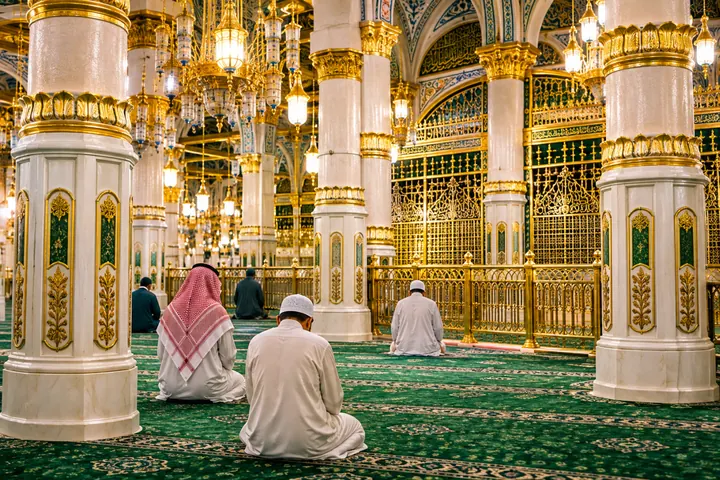
The Rawdah, or Riyad al-Jannah, is a small area inside Masjid an-Nabawi between the room where the Prophet ﷺ lived and is buried and the place of his minbar. He described it as “a garden from the gardens of Paradise”, and praying in the Rawdah is one of the most longed-for moments of any visit to Madinah.
Because the space is small and the demand enormous, entry is organised through permits booked in the Nusuk app. This page explains its history, what is and is not from the Sunnah, and how to plan a calm, focused visit.
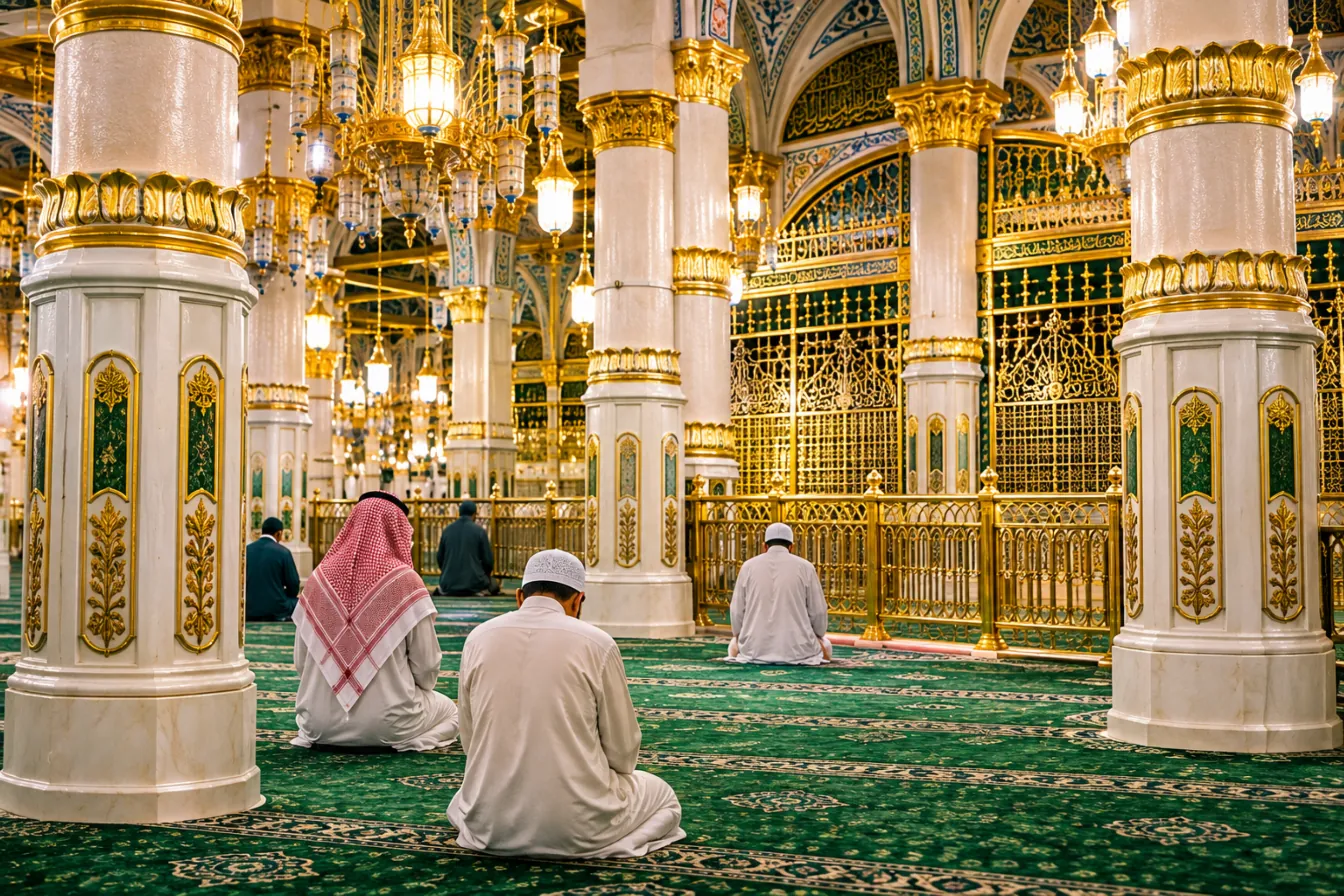
The history and significance of the Rawdah
The Prophet ﷺ said, “What is between my house and my minbar is a garden from the gardens of Paradise, and my minbar is upon my Hawd (Cistern)” (al-Bukhari and Muslim). The area this describes is roughly 22 metres long and 15 metres wide, in the south-eastern part of the original mosque.
Scholars differ on the meaning of the hadith. Some say this piece of ground will itself be moved into Paradise; others say that worship performed there is a means of reaching Paradise; and many say both meanings are possible. All agree that it is a place of great honour.
The minbar and the weeping palm trunk
Before the minbar was made, the Prophet ﷺ used to deliver the sermon leaning on the trunk of a date palm. When he moved to the new wooden minbar, the Companions heard the trunk cry out like a child until he came down and placed his hand on it (al-Bukhari, from Jabir ibn ‘Abdullah). The present marble minbar dates from the Ottoman period and stands close to the place of the original.
The pillars of the Rawdah
The white pillars in this area carry names recorded by the historians of Madinah, marking places linked with events in the Prophet’s ﷺ life. Among them are the Pillar of ‘A’ishah, the Pillar of Repentance (associated with Abu Lubabah), the Pillar of the Delegations, where tribes were received, and the Pillar of the Guard. Their exact positions are based on these historical reports rather than on hadith, and the pillars themselves are later rebuildings.
The mihrab here marks the place where the Prophet ﷺ stood to lead the prayer. Salamah ibn al-Akwa‘ used to seek out the pillar near the place where the mushaf was kept, and said he had seen the Prophet ﷺ seek to pray near it (al-Bukhari).
What is from the Sunnah in the Rawdah (and what is not)
The virtue of this place is established in authentic hadith, and scholars encourage praying voluntary prayers there when it is possible without harming others. There is, however, no fixed number of rak‘ahs, no special dua and no particular dhikr prescribed for it. Pray what you can, make dua for yourself and others, and leave room for the next person.
The Companions valued praying in the front rows of the mosque as well. During the obligatory prayers, the first rows, which lie in front of it in today’s mosque, carry their own great reward.
Innovations and mistakes to avoid
- Wiping or kissing the pillars, the minbar, the mihrab or the carpet for blessing.
- Pushing, shoving or stepping over people to get closer; harming others cancels the purpose of the visit.
- Taking threads from the carpet, or tying or rubbing cloth on pillars to take home.
- Believing a prayer there is more than a thousand times rewarded beyond the rest of Masjid an-Nabawi; no hadith specifies this.
- Spending your limited time filming instead of praying.
What to do and what to read in the Rawdah
Enter calmly with your right foot and the dua for entering the mosque. Once inside, pray two rak‘ahs, or more if staff allow time, as long as it is not a time when voluntary prayer is disliked. Then use the remaining minutes for dua: for forgiveness, for your family, for guidance, for those who asked you to pray for them, and for the Muslims in general.
Remember that the prayer and dua matter more than the exact spot. If the crowd is heavy, a place at the edge with a calm heart is better than a place at the front reached by pushing, and Allah hears your dua wherever you are in His Messenger’s ﷺ mosque.
Make your dua in your own words and language, facing the qiblah. Sending salawat on the Prophet ﷺ is always beloved. Prepare a short written list beforehand so the moment is not lost in nerves.
For men, the exit route usually leads past the Prophet’s ﷺ grave, where you can give the greeting briefly before moving on.
السَّلَامُ عَلَيْكَ يَا رَسُولَ اللهِ
As-salamu ‘alayka ya Rasulallah.
Peace be upon you, O Messenger of Allah.
Source: The practice of Ibn ‘Umar (Malik’s Muwatta’; al-Bayhaqi)How to get to the Rawdah and book a permit
Booking through Nusuk
A permit is required for entry. Book it in the Nusuk app: choose the Rawdah prayer service, select your preferred date and time slot, and the permit appears with a QR code. Men and women have separate slots and separate entrances. Each person, including children above the age set by the authorities, needs their own permit.
Booking rules change regularly, including how far ahead slots open and how often one person may book. Slots in the busy seasons go quickly, so check Nusuk as soon as your Madinah dates are fixed and look again in the days before; new or released slots sometimes appear.
Reaching the Rawdah on the day
Riyad al-Jannah lies inside Masjid an-Nabawi, so if your hotel is in the central area you can walk to the gate in a few minutes. Your permit and the staff will direct you to the gate and waiting area for your slot. Arrive in good time, already in wudu, and expect a queue in stages before you enter. Inside, the time allowed is short, often around ten to twenty minutes.
If you are coming from Makkah, the Haramain train takes around two and a quarter to two and a half hours to Madinah, and a taxi from the station to the mosque about 15 to 20 minutes. Allow a generous gap between arrival and your Rawdah slot.
Practical tips for the Rawdah
Book early, recheck often
Book as soon as your dates are known and check again for released slots.
Come in wudu
There is no time to leave and return once you are in the queue.
Keep the permit ready
Have the QR code on your phone and the screen brightness up.
Prepare your duas
A short list helps you use every minute well.
Help the elderly
Ask staff about assistance for wheelchair users and older pilgrims.
Be gentle
Patience and kindness in the crowd are part of the worship.
Rawdah quick facts
| City | Madinah |
|---|---|
| Location | Inside Masjid an-Nabawi, between the Prophet’s ﷺ house and minbar |
| Size | About 22 m by 15 m |
| Time inside | Usually around 10–20 minutes per permit |
| Best time | At your Nusuk-booked slot |
| Difficulty | Easy, though queues can be long |
| Permit | Required; booked through Nusuk, separate slots for men and women |
| Sunnah | Its virtue is established in authentic hadith |
The Rawdah (Riyad al-Jannah)
Inside Masjid an-Nabawi
Open in Google MapsNearby ziyarat- Masjid an-Nabawi0.0 km
- Seerah Museum0.2 km
- Masjid Ali0.2 km
- Masjid al-Ghamamah0.3 km
Learn more about the mosque itself on our Masjid an-Nabawi page, and plan the rest of your stay with our Madinah city guide and the Madinah ziyarat guide. Nearby sites include Jannat al-Baqi‘ and Masjid al-Ghamamah. The ziyarat route planner helps you build visits around your Rawdah slot, and the ziyarat hub lists every site. Book permits on Nusuk, or ask us for a tailored quote for your Madinah stay.
Rawdah: frequently asked questions
Do I need a permit to enter the Rawdah?
Yes. Entry is by a permit booked in the Nusuk app, with set time slots. Check Nusuk for the current rules before you travel.
How long can I stay in the Rawdah?
Usually around ten to twenty minutes, depending on crowds and staff instructions.
Is there a special prayer or dua for the Rawdah?
No. Pray voluntary prayers and make any dua you wish. Nothing specific is prescribed.
Can women visit the Rawdah?
Yes. Women have their own permit slots and entrance, at times set by the authorities.
What if I cannot get a permit?
Keep checking Nusuk for released slots. Every prayer in Masjid an-Nabawi still carries a reward a thousand times greater than elsewhere, apart from al-Masjid al-Haram (al-Bukhari and Muslim).
How do I know I am inside the Rawdah?
The area has a lighter green carpet than the surrounding mosque, and its pillars are white with inscribed names.
Plan your Madinah days around the Rawdah
We can arrange hotels a short walk from Masjid an-Nabawi and help you plan your time around your Rawdah permit.