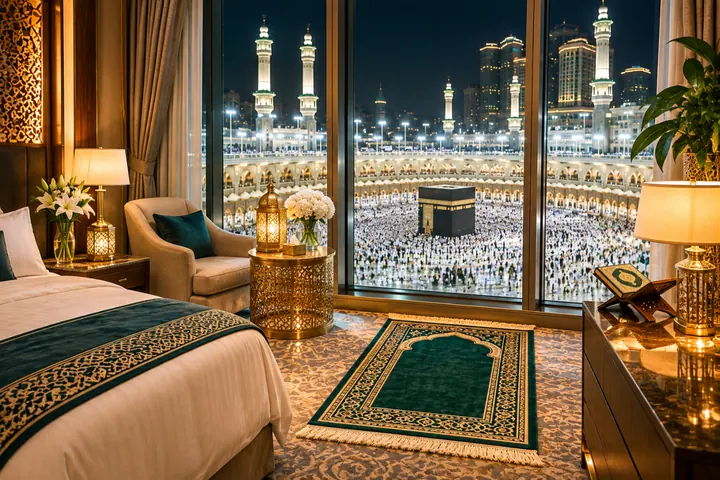
The Clock Tower Museum sits high in the Makkah Clock Royal Tower, the tallest building in the Abraj Al Bait complex directly beside Masjid al-Haram. Spread over several floors near the giant clock faces, it explains the science of time, the movements of the sun and moon, and how Muslims have used astronomy to set prayer times and the Hijri calendar.
It is a modern museum, not a historical or religious site, and visiting it is not part of Umrah. For many visitors, though, it is a rewarding hour that deepens their appreciation of the signs of Allah in the heavens, with views over the Haram that few other places can offer.

The Clock Tower Museum: history and significance
The Abraj Al Bait towers were built in the 2000s on the hill where the Ottoman-era Ajyad Fortress once stood, a decision that was controversial at the time. The central Makkah Clock Royal Tower was completed around 2012 and, at roughly 600 metres, is among the tallest buildings in the world.
Its four clock faces, each more than 40 metres across, can be seen from much of the city. Above them rises a spire crowned by a golden crescent. At prayer times, lights on the tower are used to mark the call to prayer, which helps people far from the mosque.
Why a museum of time in Makkah?
Time is woven into Islamic worship. The five prayers follow the position of the sun, the fast of Ramadan begins and ends with the sighting of the new moon, and the days of Hajj fall on fixed dates of the lunar month of Dhul Hijjah. The Qur’an says, “They ask you about the new moons. Say: they are measures of time for people and for Hajj” (Qur’an 2:189), and “The sun and the moon run on a fixed course” (Qur’an 55:5).
The Clock Tower Museum builds on this theme. Its galleries trace the history of astronomy, including the work of Muslim scholars who refined instruments such as the astrolabe and compiled astronomical tables, and they explain how the tower’s own clock and lights work. The museum opened in recent years, and its exhibits, layout and ticketing arrangements may change.
Clock Tower Museum: what is from the Sunnah (and what is not)
Be clear about the status of this visit. There is no Sunnah, reward or ritual attached to the tower or the museum. It is a permissible outing for learning and reflection, like visiting a science museum at home.
Ordinary Islamic etiquette applies inside the Clock Tower Museum. Dress modestly, lower your gaze, and keep your voice down. Prayer areas are usually available in the complex, but if you are in the tower when the adhan sounds, pray in congregation where you can rather than delaying the prayer.
What to avoid
Do not attach religious meaning to the clock, the crescent or the lights. They are modern architecture and engineering. Avoid photographing other worshippers without their permission, especially women, and avoid filming in a way that blocks walkways in the busy malls below.
What to see at the Clock Tower Museum
Exhibits vary, but visitors typically find the following sections, mostly with Arabic and English explanations.
- The universe and the solar system: models, projections and films about the planets, the moon’s phases and the movement of the earth around the sun.
- Measuring time: sundials, water clocks, astrolabes and mechanical clocks, with the contribution of Muslim astronomers to each.
- Prayer times and the Hijri calendar: how the times of Fajr, Dhuhr, ‘Asr, Maghrib and ‘Isha are calculated, and how the new crescent is sighted.
- The clock itself: the engineering of the four faces, the mechanism and the lights, with views close to the clock.
- The observation level: where open, a viewing area high above the city looks down on the mataf and the mountains of Makkah.
Most visitors to the Clock Tower Museum need 45 to 90 minutes. Children usually enjoy the interactive displays, and the visit can open a good conversation about the Qur’anic verses on the sun, moon and stars.
What to read
There is no special dua for the Clock Tower Museum. When you look out over the sky or the city, you might reflect on the verse, “Indeed, in the creation of the heavens and the earth and the alternation of night and day are signs for people of understanding” (Qur’an 3:190), which the Prophet ﷺ recited when he rose at night (al-Bukhari and Muslim).
How to get to the Clock Tower Museum from Masjid al-Haram
The Clock Tower Museum is part of Abraj Al Bait, immediately south of Masjid al-Haram across the King Abdulaziz Gate plaza.
Walking: from the southern gates of the Haram it is a 5 to 10 minute walk to the tower entrance. Inside the complex, follow the signs for the museum or ask hotel or mall staff for the correct lobby and lifts, because only certain lifts reach the upper floors.
Taxi or bus: if you are staying away from the centre, take a taxi, ride-hailing car or Makkah Bus to the Haram area and walk the last stretch. Roads close around prayer times, so allow extra time.
Clock Tower Museum opening hours, ticket sales and booking methods change. At the time of writing, tickets are usually arranged through official channels or at the complex itself, and some days or seasons may be closed. Check locally or with your hotel concierge before you go.
Practical tips for the Clock Tower Museum
Go between prayers
Late morning after Duha or the time after ‘Asr gives you a full hour without missing a prayer.
Confirm the entrance
Ask at the tower for the lifts that serve the museum; the complex is large and confusing.
Check opening times
Hours and ticketing change, and the museum may close in peak seasons. Check locally first.
Bring ID
Carry your passport or visa copy; it may be needed for entry or ticketing.
Plan for children
The interactive exhibits suit young visitors, but keep them close in the crowds.
Dress modestly
You are beside the Haram; dress as you would for the mosque.
Clock Tower Museum quick facts
| City | Makkah |
|---|---|
| Location | Makkah Clock Royal Tower, Abraj Al Bait, beside the Haram |
| Time needed | About 45–90 minutes |
| Best time | Late morning or after ‘Asr |
| Difficulty | Easy: lifts to all levels |
| Open to visitors | Yes, but hours and ticketing change; check locally |
| Sunnah | No: a modern museum, not part of Umrah |
Clock Tower Museum
Abraj Al Bait, beside the Haram
Open in Google MapsNearby ziyarat- Masjid al-Haram0.4 km
- Makkah Library0.7 km
- Masjid al-Jinn1.5 km
- Jannat al-Mu‘alla1.6 km
For more on the area around Abraj Al Bait, see our Makkah city guide. Our Masjid al-Haram guide covers the mosque itself, and if you enjoy museums, the Exhibition of the Two Holy Mosques Architecture and the Makkah Library are worth adding. Build your day with the ziyarat route planner, browse the ziyarat hub, read how to perform Umrah, or ask us for a tailored quote.
Clock Tower Museum: frequently asked questions
Where is the Clock Tower Museum?
On the upper floors of the Makkah Clock Royal Tower, the central tower of Abraj Al Bait, just south of Masjid al-Haram.
Do I need to book tickets in advance?
Arrangements change. Tickets have been sold through official channels and on site at different times, so check with your hotel or at the tower before you go.
Is visiting the museum part of Umrah or ziyarat?
No. It is a modern museum with no religious ritual or reward attached. It is simply a permissible and educational visit.
Can I see the Kaaba from the museum?
From the viewing areas, when open, you can look down on the Haram and the mataf. Views depend on which levels are accessible during your visit.
Is it suitable for children and older visitors?
Yes. Lifts serve the museum, and the interactive galleries appeal to children. Older visitors should avoid peak crowd times in the complex below.
How long should I allow?
Around an hour for the galleries, plus time to reach the correct lifts and return to the Haram before the next prayer.
Stay steps from the Haram
We can plan your Umrah with a hotel close to Abraj Al Bait and leave room in your days for a few well-chosen visits.