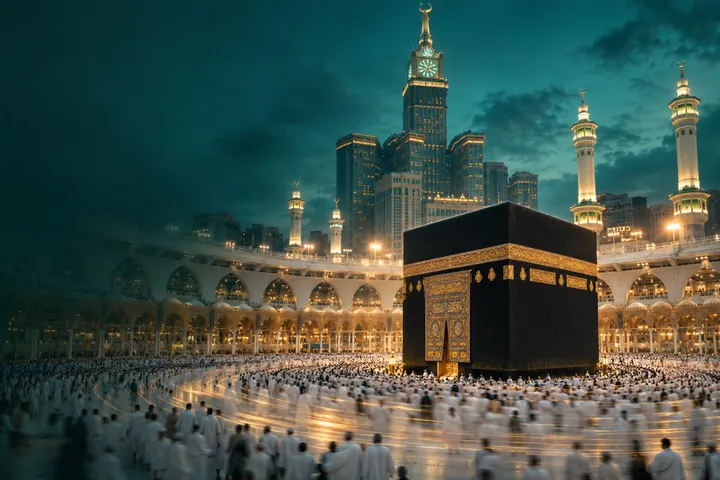
This Makkah guide is written for pilgrims who want everything about the holiest city in Islam on one page. Below you will find the live Makkah time, today’s prayer times and the weather now, followed by the history and virtue of the city, a walk-through of Masjid al-Haram, the best months to visit, every ziyarah in and around Makkah, the areas to stay in and the practical rules worth knowing before you land.
Everything in the live panel updates in your browser, so you can keep this Makkah guide open on your phone during your trip and check the next prayer or the forecast at a glance.
Prayer times today
- Fajr--:--
- Sunrise--:--
- Dhuhr--:--
- Asr--:--
- Maghrib--:--
- Isha--:--
Calculated with the Umm al-Qura method (Fajr 18.5°, Isha 90 minutes after Maghrib, 120 in Ramadan). The Masjid al-Haram adhan may differ by a minute or two.
7-day forecast
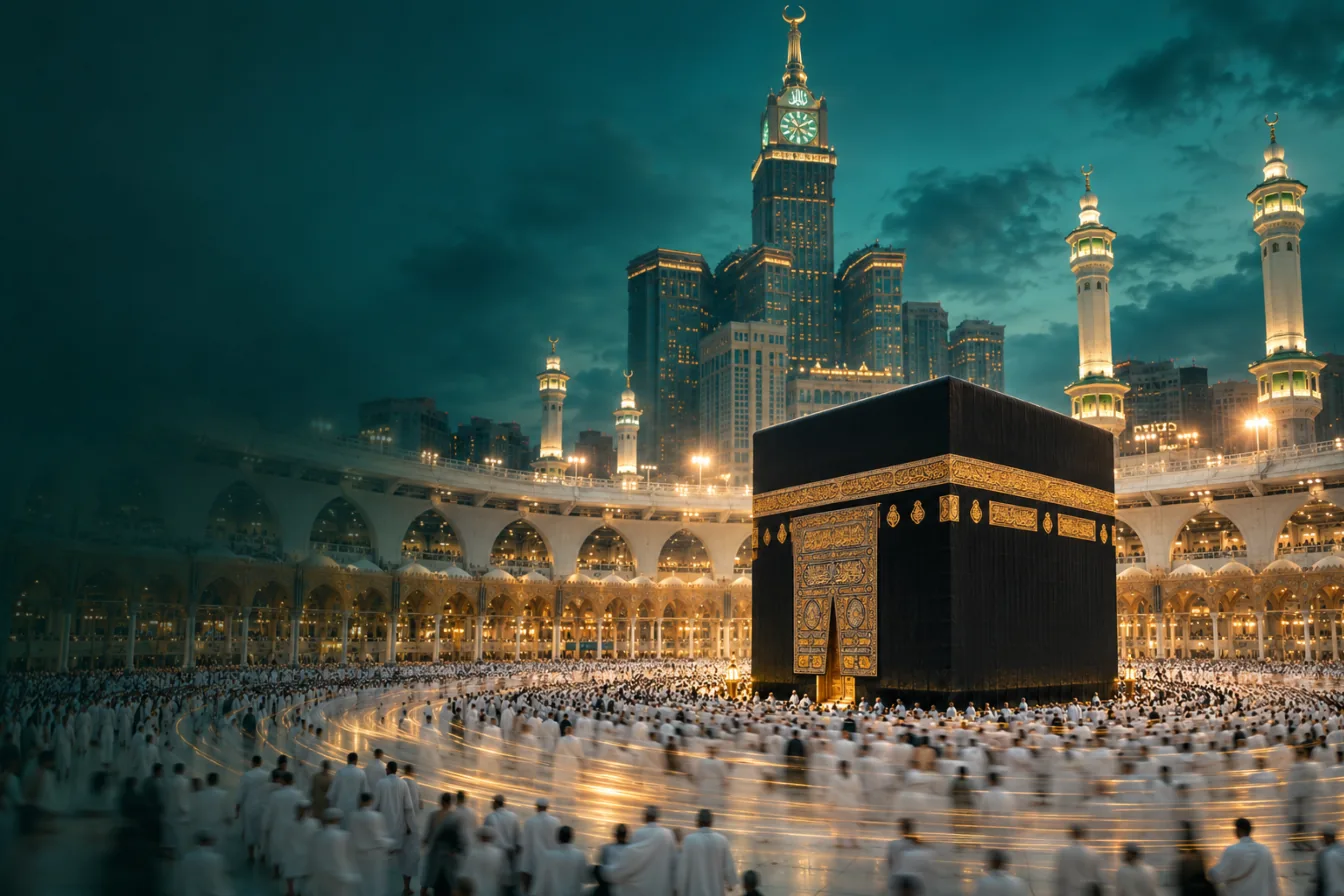
Makkah time, Makkah weather and Makkah prayer times explained
Makkah time is Arabia Standard Time (AST), three hours ahead of GMT all year round. Saudi Arabia does not use daylight saving, so the gap to the UK is three hours in winter and two hours in summer. The panel above shows the current Makkah time, the Hijri date and how far ahead of or behind you the city is.
The Makkah prayer times shown are calculated with the Umm al-Qura method, the official method in Saudi Arabia. Fajr is set when the sun is 18.5° below the horizon, and Isha is fixed at 90 minutes after Maghrib, extended to 120 minutes during Ramadan. The adhan in Masjid al-Haram can differ from any calculation by a minute or two, so treat the times as a close guide.
Adhan and iqamah at the Haram
There are two calls before Fajr in the Haram: an early adhan some time before dawn, then the adhan for Fajr itself. The gap between adhan and iqamah is usually around 10 to 25 minutes, shortest at Maghrib and longest at Fajr. A funeral prayer (salat al-janazah) often follows the obligatory prayer, so stay in your place after the salam and join it.
Jumu‘ah in Makkah
Friday prayer at the Haram is the busiest prayer of the week. Aim to be inside one to two hours before the adhan, especially in Ramadan and the winter peak. The streets and courtyards around the mosque fill completely, and gates close once areas are full. Bring water and agree a meeting point with your group.
Because the city sits near the Tropic of Cancer, Makkah prayer times shift less through the year than in Europe: Fajr moves between roughly 4:00 and 5:40 am and Maghrib between about 5:40 and 7:10 pm Makkah time. The Makkah weather panel shows the temperature now and a seven-day forecast. Midday heat is intense for most of the year, so plan tawaf and walking for the cooler hours after Fajr and after Isha.
About Makkah: history and virtue
Every Makkah guide begins with the Kaaba. Makkah lies in a dry valley of the Hijaz, among rocky mountains about 80 km inland from Jeddah on the Red Sea. Muslims believe that the Prophet Ibrahim and his son Isma‘il raised the foundations of the Kaaba here, and that the well of Zamzam sprang up for Hajar and the infant Isma‘il. Centuries later the Prophet Muhammad ﷺ was born in Makkah, received the first revelation in the Cave of Hira and returned to the city in triumph in 8 AH.
Allah says: “Indeed, the first House established for mankind was that at Bakkah, blessed and a guidance for the worlds. In it are clear signs, the standing place of Ibrahim; and whoever enters it shall be safe” (Qur’an 3:96–97). He also says: “And We made the House a place of return for people and a place of security. And take the standing place of Ibrahim as a place of prayer” (Qur’an 2:125).
The reward of prayer in Masjid al-Haram
Jabir ibn ‘Abdullah reported that the Prophet ﷺ said: “A prayer in my mosque is better than a thousand prayers elsewhere, except al-Masjid al-Haram, and a prayer in al-Masjid al-Haram is better than a hundred thousand prayers elsewhere” (Ibn Majah and Ahmad). Scholars differ on whether this multiplied reward covers the whole haram area or the mosque itself, and on whether it extends to voluntary prayers, but all agree on the immense virtue of praying there.
The Prophet ﷺ also said of Makkah as he left it: “By Allah, you are the best of Allah’s land and the most beloved of Allah’s land to Allah, and had I not been driven out of you, I would not have left” (at-Tirmidhi and Ibn Majah).
Masjid al-Haram: a practical Makkah guide to the Haram
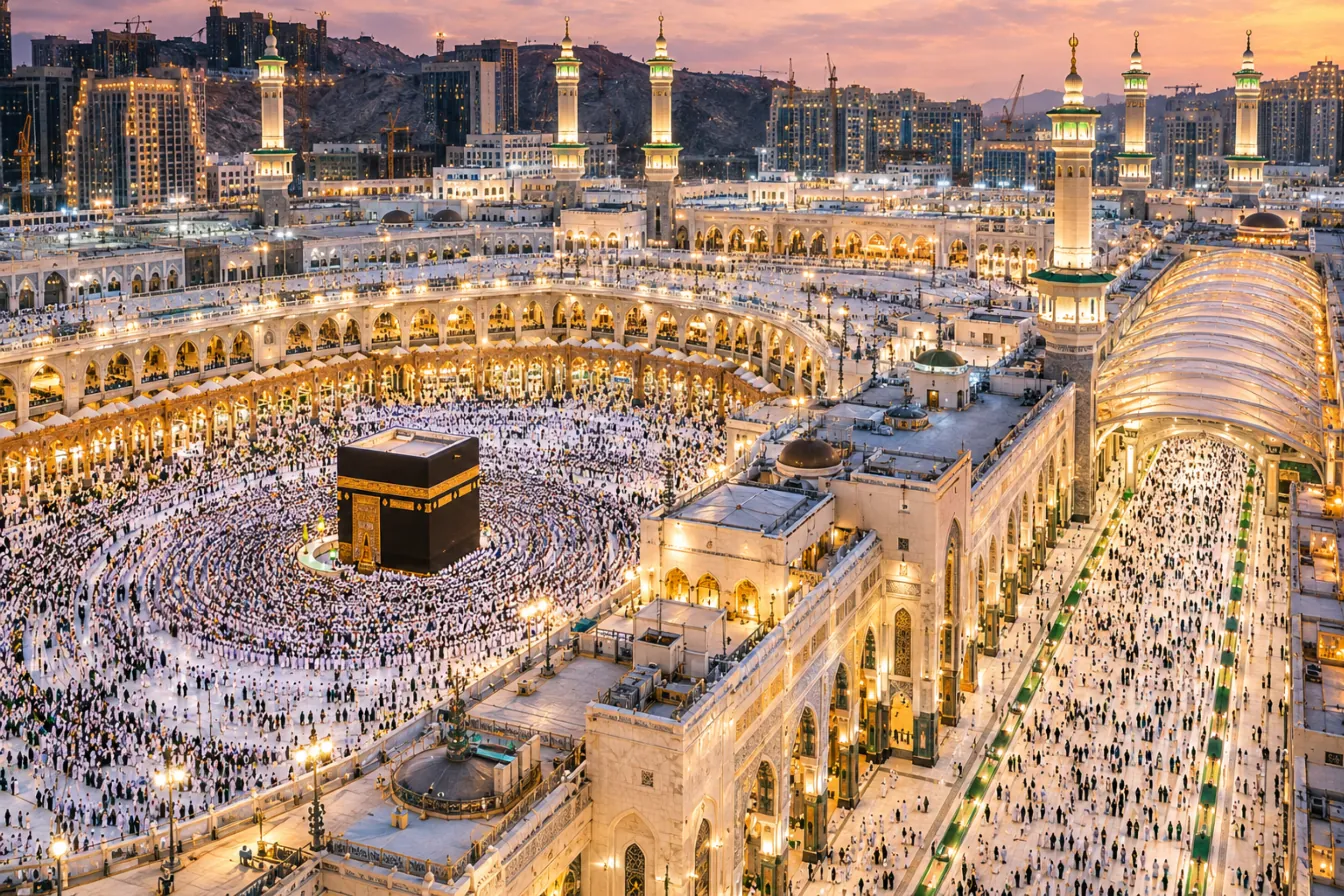
Masjid al-Haram surrounds the Kaaba and is the largest mosque in the world. It is open day and night, and this section of our Makkah guide covers what first-time visitors most often ask about. Read our full Masjid al-Haram guide for its history, and our step-by-step guide on how to perform Umrah for the rites themselves.
Gates and landmarks
The mosque has well over a hundred numbered gates. A few are used constantly as meeting points: King Abdulaziz Gate (Gate 1) faces the Clock Tower on the south side, Bab al-Umrah (Gate 62) is on the west, and King Fahd Gate (Gate 79) leads into the King Fahd expansion. The newer King Abdullah expansion on the north side adds many more entrances. Pick a numbered gate as your meeting point rather than “by the Clock Tower”, which can mean several places.
Levels, mataf and mas‘a
Tawaf is performed on the open ground-level mataf around the Kaaba and on the upper levels and roof of the mataf building. At busy times the ground level is often reserved for pilgrims in ihram performing Umrah. The upper levels are longer per circuit but calmer, and suit wheelchair users. The mas‘a between Safa and Marwah also runs over several floors, with lanes for wheelchairs.
Women’s areas and accessibility
Women pray in designated sections signposted throughout the mosque, and staff direct women to them as prayer approaches. Wheelchairs and electric carts are available inside the mosque; check the latest booking arrangements in the Nusuk app.
Makkah weather by month and the best time to visit
Makkah is hot for most of the year, with very little rain. Winter (December to February) brings warm days and mild nights, which is why it is the most comfortable and most popular season for Umrah. Summer highs regularly pass 43°C. For both cities side by side, see our Makkah and Madinah weather guide.
| Month | Average high | Average low | Comfort for Umrah |
|---|---|---|---|
| January | about 31°C | about 19°C | Very good |
| February | about 32°C | about 20°C | Very good |
| March | about 35°C | about 22°C | Good |
| April | about 39°C | about 25°C | Warm |
| May | about 42°C | about 28°C | Hot |
| June | about 44°C | about 30°C | Very hot |
| July | about 43°C | about 30°C | Very hot |
| August | about 43°C | about 30°C | Very hot |
| September | about 43°C | about 29°C | Hot |
| October | about 40°C | about 26°C | Warm |
| November | about 35°C | about 23°C | Good |
| December | about 32°C | about 21°C | Very good |
Weather is only one factor. Ramadan, especially the last ten nights, and school holidays bring the biggest crowds. Quieter windows tend to fall in the weeks after Hajj and in the months between the summer holidays and Rabi‘ al-Awwal, though the heat is higher then.
Ramadan, Hajj and Eid in Makkah
The Islamic calendar shapes life in Makkah more than any season. In Ramadan the Haram is full for Tarawih and Qiyam, and the last ten nights draw millions. During the Hajj season, from late Dhul Qa‘dah into Dhul Hijjah, entry to Makkah is restricted to those with Hajj permits and residents, and Umrah arrangements pause; check the latest in Nusuk. The countdowns below follow the Umm al-Qura calendar.
Loading…
Dates follow the Umm al-Qura calendar used in Saudi Arabia. Ramadan and the Eids are confirmed by moon sighting and may shift by a day. Times counted to midnight, Makkah time.
Makkah ziyarat: every site in and around the city
Makkah ziyarat means visiting the places linked with the Prophet ﷺ, the Hijrah and Hajj. It is important to separate what is Sunnah from what is simply history. The only acts of worship tied to Makkah are those of the Haram, Umrah and Hajj, and a few sites have a clear basis: Masjid Aisha at Tan‘im and Masjid al-Ji‘ranah are places to enter ihram, and visiting graves such as Jannat al-Mu‘alla to greet the dead and remember the Hereafter is a general Sunnah.
Other sites, such as Jabal al-Nour and the Cave of Hira or Jabal Thawr, are deeply moving to see but carry no special worship. Pray where prayer is allowed, reflect on the Seerah, and avoid seeking blessing from rocks, walls or soil. Sites marked Sunnah or Historic on each card reflect this distinction. This Makkah guide lists all 20 Makkah ziyarat sites, from the Haram itself to Hudaybiyah on the old Jeddah road, with their distance and the time you need.
The Sacred Mosque around the Kaaba — one prayer here is worth 100,000 elsewhere.
The Haram itselfMakkah LibraryLibrary on the site traditionally identified as the Prophet’s ﷺ birthplace; the exact location is uncertain.
About 400 m east of Masjid al-HaramClock Tower MuseumScience-of-time and astronomy museum at the top of the Makkah Clock Tower.
Abraj Al Bait, beside the HaramJannat al-Mu‘allaMakkah’s historic cemetery, where Khadijah and members of the Prophet’s ﷺ family are buried.
About 1 km north of Masjid al-HaramMasjid al-JinnMosque traditionally linked with the jinn who listened to the Qur’an from the Prophet ﷺ.
About 1 km north of Masjid al-HaramJabal al-Nour (Cave Hira)The mountain of the Cave of Hira, where the first verses of the Qur’an were revealed.
About 4–5 km north-east of Masjid al-HaramMasjid al-Ji‘ranahMiqat mosque where the Prophet ﷺ entered ihram for Umrah after Hunayn.
About 25 km north-east of the HaramMinaThe valley of tents and the Jamarat, where pilgrims stay during the days of Hajj.
About 5–8 km east of Masjid al-HaramMasjid al-Bay‘ahSmall historic mosque marking the Pledges of al-‘Aqabah.
Near the Jamarat, Mina sideJamarat (Stoning Pillars)The three pillars of Mina stoned during Hajj, now in a multi-level complex.
Mina, about 5 km east of the HaramMasjid al-KhayfThe main mosque of Mina, near the smallest Jamarah, where the Prophet ﷺ prayed during Hajj.
About 7 km east of Masjid al-HaramWadi MuhassirThe valley where the army of the elephant was destroyed; pilgrims hasten through it.
Between Mina and MuzdalifahMuzdalifahThe open plain where Hajj pilgrims spend the night of the 10th of Dhul Hijjah.
About 10 km east of Masjid al-HaramArafat (Jabal al-Rahmah)The plain of the Day of Arafah, the heart of Hajj, with Jabal al-Rahmah at its centre.
About 20 km south-east of Masjid al-HaramJabal al-Rahmah (Mount of Mercy)The granite hill at the heart of Arafat, near where the Prophet ﷺ stood on the Day of Arafah.
Arafat, about 20 km east of the HaramMasjid NamirahThe mosque of the Arafah sermon, partly outside the boundary of Arafat.
About 19 km south-east of Masjid al-HaramJabal ThawrThe mountain whose cave sheltered the Prophet ﷺ and Abu Bakr for three nights on the Hijrah.
About 6 km south of Masjid al-HaramExhibition of the Two Holy Mosques ArchitectureMuseum of historic pieces of the Kaaba, the Haram and Masjid an-Nabawi at Umm al-Joud.
About 7 km north-west of Masjid al-HaramMasjid Aisha (Tan‘im)The nearest point outside the haram, where people in Makkah enter ihram for Umrah.
About 7.5 km north-west of Masjid al-HaramHudaybiyah (al-Shumaisi)Site of the Treaty of Hudaybiyah and the Pledge of Ridwan, on the old Jeddah road.
About 22–25 km west of Masjid al-HaramHajj sites: Mina, Muzdalifah and Arafat
Outside Hajj, a guided drive around Mina, Muzdalifah and Arafat takes two to three hours and helps first-time pilgrims picture the rites. Museums such as the Exhibition of the Two Holy Mosques Architecture and the Clock Tower Museum are good choices for families.
Taif: a day trip from Makkah
Taif, about 90 km by road and high in the mountains, is cooler than Makkah and recalls the Prophet’s ﷺ visit to its people. See our Taif guide for the drive up the escarpment and its historic mosques.
Mountain city of the Prophet’s ﷺ visit, Masjid Ibn Abbas, Al-Hada, Al-Shafa and rose farms.
About 90 km from Masjid al-Haram by roadMasjid Abdullah ibn AbbasLarge historic mosque of Taif beside the grave of Ibn ‘Abbas.
Central TaifMasjid AddasSmall mosque recalling ‘Addas, who welcomed the Prophet ﷺ after the hardship of Taif.
South Taif, near the old gardensA typical Makkah ziyarat tour by car covers Jabal al-Nour, Jabal Thawr, Jannat al-Mu‘alla and the Hajj sites in a single morning. Use the planner below to put your chosen Makkah ziyarat in the most efficient order, with travel and visit times. You can also open the full ziyarat route planner.
Ziyarat route planner
Pick the sites you want to visit — we put them in the most efficient order with travel and visit times.
Makkah ziyarat at a glance
| Site | Why visit | Location | Visit |
|---|---|---|---|
| Masjid al-Haram | The Sacred Mosque around the Kaaba — one prayer here is worth 100,000 elsewhere. | The Haram itself | 0 min |
| Makkah Library | Library on the site traditionally identified as the Prophet’s ﷺ birthplace; the exact location is uncertain. | About 400 m east of Masjid al-Haram | 10 min |
| Clock Tower Museum | Science-of-time and astronomy museum at the top of the Makkah Clock Tower. | Abraj Al Bait, beside the Haram | 60 min |
| Jannat al-Mu‘alla | Makkah’s historic cemetery, where Khadijah and members of the Prophet’s ﷺ family are buried. | About 1 km north of Masjid al-Haram | 25 min |
| Masjid al-Jinn | Mosque traditionally linked with the jinn who listened to the Qur’an from the Prophet ﷺ. | About 1 km north of Masjid al-Haram | 15 min |
| Jabal al-Nour (Cave Hira) | The mountain of the Cave of Hira, where the first verses of the Qur’an were revealed. | About 4–5 km north-east of Masjid al-Haram | 150 min |
| Masjid al-Ji‘ranah | Miqat mosque where the Prophet ﷺ entered ihram for Umrah after Hunayn. | About 25 km north-east of the Haram | 45 min |
| Mina | The valley of tents and the Jamarat, where pilgrims stay during the days of Hajj. | About 5–8 km east of Masjid al-Haram | 30 min |
| Masjid al-Bay‘ah | Small historic mosque marking the Pledges of al-‘Aqabah. | Near the Jamarat, Mina side | 20 min |
| Jamarat (Stoning Pillars) | The three pillars of Mina stoned during Hajj, now in a multi-level complex. | Mina, about 5 km east of the Haram | 30 min |
| Masjid al-Khayf | The main mosque of Mina, near the smallest Jamarah, where the Prophet ﷺ prayed during Hajj. | About 7 km east of Masjid al-Haram | 15 min |
| Wadi Muhassir | The valley where the army of the elephant was destroyed; pilgrims hasten through it. | Between Mina and Muzdalifah | 10 min |
| Muzdalifah | The open plain where Hajj pilgrims spend the night of the 10th of Dhul Hijjah. | About 10 km east of Masjid al-Haram | 20 min |
| Arafat (Jabal al-Rahmah) | The plain of the Day of Arafah, the heart of Hajj, with Jabal al-Rahmah at its centre. | About 20 km south-east of Masjid al-Haram | 45 min |
| Jabal al-Rahmah (Mount of Mercy) | The granite hill at the heart of Arafat, near where the Prophet ﷺ stood on the Day of Arafah. | Arafat, about 20 km east of the Haram | 40 min |
| Masjid Namirah | The mosque of the Arafah sermon, partly outside the boundary of Arafat. | About 19 km south-east of Masjid al-Haram | 15 min |
| Jabal Thawr | The mountain whose cave sheltered the Prophet ﷺ and Abu Bakr for three nights on the Hijrah. | About 6 km south of Masjid al-Haram | 150 min |
| Exhibition of the Two Holy Mosques Architecture | Museum of historic pieces of the Kaaba, the Haram and Masjid an-Nabawi at Umm al-Joud. | About 7 km north-west of Masjid al-Haram | 50 min |
| Masjid Aisha (Tan‘im) | The nearest point outside the haram, where people in Makkah enter ihram for Umrah. | About 7.5 km north-west of Masjid al-Haram | 40 min |
| Hudaybiyah (al-Shumaisi) | Site of the Treaty of Hudaybiyah and the Pledge of Ridwan, on the old Jeddah road. | About 22–25 km west of Masjid al-Haram | 75 min |
Getting around: our Makkah guide to transport
The Haramain High Speed Railway links Makkah with Jeddah, King Abdulaziz International Airport and Madinah. Makkah station is in Rusaifah, a few kilometres from the Haram, so you will need a short taxi or bus ride to your hotel. Book on the official Haramain train website and read our Haramain train guide for luggage and timings.
The Makkah Bus network connects outer districts with stations near the Haram, and free shuttles run at peak times from park-and-ride areas. During Ramadan and Hajj, routes and drop-off points change, so follow the signs and your hotel’s advice.
Licensed taxis and ride-hailing apps operate across Makkah. Roads closest to the Haram are often closed to cars at prayer times, so expect to be dropped at the edge of the central area and walk the last stretch.
Walking is the easiest way to reach the Haram from central hotels. Many streets around the mosque are pedestrian, with tunnels for traffic below. Allow extra time before each prayer, as crowds slow every route.
Where to stay: Makkah guide to the best areas
Where you stay decides how often you can pray in the Haram, so this part of the Makkah guide matters as much as any other. Our guide to hotels near the Haram compares the main districts in more detail.
Clock Tower and Abraj Al Bait
Towers directly opposite King Abdulaziz Gate, with the shortest walk of all and malls below.
Learn moreAjyad
South of the Haram along Ajyad Street; a long-established area with many hotels within a few minutes’ walk.
Jabal Omar
Newer development on the west side near Bab al-Umrah, with modern hotels and walkways to the mosque.
Ibrahim Khalil
Busy street running south from the Haram, lined with hotels and shops; walks vary from a few minutes to around 15.
Misfalah
Lively district further south, popular with South Asian pilgrims; usually a longer, uphill walk.
Aziziyah
Residential area towards Mina, several kilometres away; relies on shuttle buses and often used during Hajj.
Etiquette and rules in Makkah
The haram boundaries
No Makkah guide is complete without the rules of the sanctuary. The haram of Makkah extends well beyond the mosque, marked by boundary signs on the main roads. Within it, hunting animals and cutting trees or plants are forbidden, and lost property may only be picked up to hand in. Non-Muslims may not enter the haram area of Makkah; road checkpoints enforce this, and signs direct non-Muslim traffic onto bypass roads.
Dress, photography and behaviour
Dress modestly at all times. Men in ihram follow its rules; outside ihram, loose, long clothing suits both the culture and the heat. Photography inside the Haram should be discreet: avoid filming other worshippers, never stop on the mataf or in the mas‘a to take photos, and follow any instruction from staff. Keep your voice low, avoid pushing near the Black Stone, and leave clear walkways for wheelchairs.
Makkah guide: practical tips for your trip
SIM and data
Saudi networks sell SIMs and eSIMs at Jeddah airport and in the city; you register with your passport. Data is essential for Nusuk and maps.
Money
The currency is the Saudi riyal. Cards and mobile payments are widely accepted, but keep some cash for small shops and taxis.
Heat
Check the Makkah weather each morning, drink often, carry an umbrella, use the air-conditioned upper floors at midday and watch older relatives for signs of heat exhaustion.
Zamzam
Coolers of Zamzam, cold and room temperature, stand throughout the Haram. Read our Zamzam water guide on taking some home.
Shoes
Carry a small bag for your shoes; racks fill fast and gates change at busy times.
Meeting points
Agree a numbered gate and time with your group. Share live location if your phone allows.
Most pilgrims combine Makkah with the city of the Prophet ﷺ; our Madinah guide has the same live prayer times, weather and ziyarat. When you are ready, browse our Umrah packages or request a tailored quote. If you will fly into Jeddah, check your Miqat first.
Miqat finder
Find the Miqat on your route and when to be ready in ihram.
Makkah guide: frequently asked questions
What time is it in Makkah now?
Makkah runs on Arabia Standard Time, GMT+3, with no daylight saving. The live clock at the top of this page shows the current Makkah time and the Hijri date.
What are the prayer times in Makkah today?
Today’s Makkah prayer times are shown in the live panel above, calculated with the Umm al-Qura method. Tap Tomorrow to see the next day. The Haram adhan may vary by a minute or two.
Is Makkah hot in December?
December is one of the mildest months. Days are warm, usually around 30 to 32°C, and evenings are pleasant, around 20°C. It is still sunny, so carry water and an umbrella.
What is the best month to visit Makkah?
For weather, December to February is the most comfortable. For reward, many choose Ramadan. For smaller crowds, the weeks after Hajj and outside school holidays are usually calmer.
Can non-Muslims visit Makkah?
No. Non-Muslims may not enter the haram area of Makkah. Checkpoints on the approach roads direct non-Muslims onto bypass routes.
How far is Makkah from Jeddah airport?
Makkah is roughly 100 km from King Abdulaziz International Airport by road. The Haramain train from the airport station is the quickest option, followed by a road transfer of around 75 to 90 minutes in normal traffic.
Which Makkah ziyarat sites are Sunnah?
Praying in Masjid al-Haram is the greatest act of all. Entering ihram at Tan‘im or al-Ji‘ranah has a basis in the Sunnah, and visiting graves to greet the dead is a general Sunnah. Mountains such as Hira and Thawr are historic sites with no special worship.
Do I need a permit to pray in Masjid al-Haram?
Ordinary prayers in the Haram do not usually need a booking, but performing Umrah does require a permit through Nusuk, and rules can change in Ramadan and the Hajj season. Check the latest in Nusuk.
How long should I stay in Makkah?
Many pilgrims spend five to seven nights in Makkah and four to five in Madinah. That allows Umrah without rushing, several days of prayer in the Haram and a morning of ziyarat.
Plan your days in Makkah
Tell us your dates and preferred area, and we will send a tailored Umrah proposal with hotels close to the Haram.