The Farewell Hajj (Hajjat al-Wada‘) was the only Hajj the Prophet ﷺ performed after the migration, in the year 10 AH, a few months before his death. This timeline follows the Farewell Hajj day by day, from the announcement in Madinah to the return journey, so you can see where each rite of your own Hajj comes from.
Our main source is the long hadith of Jabir ibn ‘Abdullah in Sahih Muslim (1218), which scholars regard as the most complete single description of the Farewell Hajj. We add other well-known reports from al-Bukhari and Muslim, and note where narrations differ.
Background to the Farewell Hajj
Hajj became obligatory towards the end of the Madinan period. In 9 AH the Prophet ﷺ sent Abu Bakr to lead the pilgrims, and it was announced that after that year no idolater would perform Hajj and no one would circle the House naked (al-Bukhari). The way was then clear for the Farewell Hajj, purified of the practices of ignorance.
In 10 AH the Prophet ﷺ announced that he would perform Hajj. Jabir reports that a great number of people came to Madinah, all wanting to follow him and do as he did. At Dhul Hulayfah, Jabir says, he looked as far as his eye could see in front, behind and to both sides, and saw riders and people on foot. The seerah books give different estimates of the numbers, often quoted in the tens of thousands or more.
It is called the Farewell Hajj because the Prophet ﷺ bid people farewell in it. At the Jamrah he said, “Take your rites from me, for I do not know whether I will perform Hajj after this Hajj of mine” (Sahih Muslim).
The Farewell Hajj day by day
The Farewell Hajj dates below follow the widely accepted reconstruction in the seerah literature. Ibn ‘Abbas reports that the Prophet ﷺ left Madinah when five days of Dhul Qa‘dah remained and reached Makkah when four nights of Dhul Hijjah had passed (al-Bukhari). The Day of Arafah fell on a Friday.
- 25 Dhul Qa‘dah 10 AHMadinah → Dhul Hulayfah
Setting out from Madinah
After combing his hair and applying oil, the Prophet ﷺ prayed Dhuhr in Madinah as four rak‘ahs, then set out with his wives and Companions. He prayed ‘Asr at Dhul Hulayfah as two rak‘ahs, shortening as a traveller, as Anas reports in al-Bukhari and Muslim, and he spent the night there.
- 25–26 Dhul Qa‘dahDhul Hulayfah
Birth of Muhammad ibn Abi Bakr
Asma’ bint ‘Umays, wife of Abu Bakr, gave birth to Muhammad ibn Abi Bakr at Dhul Hulayfah. She asked what to do, and the Prophet ﷺ told her to take a bath, bind herself with a cloth and enter ihram (Muslim, hadith of Jabir). Women in menses or postnatal bleeding may enter ihram and perform every rite except tawaf.
- 26 Dhul Qa‘dahDhul Hulayfah → al-Bayda’
Ihram and the Talbiyah
He performed ghusl for ihram (al-Tirmidhi), and ‘A’ishah applied perfume to him before he entered ihram (al-Bukhari and Muslim). He prayed in the mosque, mounted his camel al-Qaswa’, and when it stood up with him on al-Bayda’ he declared the Talbiyah of tawhid: “Labbayk Allahumma labbayk, labbayka la sharika laka labbayk, inna-l-hamda wa-n-ni‘mata laka wa-l-mulk, la sharika lak.” He entered ihram for Qiran — Umrah and Hajj together — with sacrificial animals he had brought.
- Late Dhul Qa‘dahRoad to Makkah
The journey of about nine days
The Farewell Hajj caravan travelled for around nine days. At Sarif, near Makkah, ‘A’ishah’s menses began and she wept; the Prophet ﷺ comforted her, saying it was something Allah had decreed for the daughters of Adam, and told her to do all that a pilgrim does except tawaf until she was pure (al-Bukhari and Muslim). He spent the last night at Dhu Tuwa.
- 4 Dhul HijjahMakkah — al-Masjid al-Haram
Arrival, tawaf and sa‘i
He entered Makkah in the morning from the upper side. He touched the Black Stone, walked briskly (raml) for three rounds and normally for four. At Maqam Ibrahim he recited, “Take the station of Ibrahim as a place of prayer,” and prayed two rak‘ahs with Surah al-Kafirun and Surah al-Ikhlas. He returned to touch the Stone, then went to Safa, reciting 2:158 and saying, “I begin with what Allah began with.” On Safa and Marwah he faced the Kaaba, declared Allah’s oneness and made dua.
- 4 Dhul HijjahMarwah
“Make it an Umrah”
At the end of sa‘i on Marwah he said that had he known beforehand what he now knew, he would not have brought the hady and would have made it an Umrah; whoever had no hady should leave ihram and make it an Umrah. Suraqah ibn Malik asked whether this was for that year only or forever. The Prophet ﷺ interlaced his fingers and said Umrah had entered into Hajj — forever. This is the basis of Hajj al-Tamattu‘.
- 4–7 Dhul HijjahMakkah → al-Abtah
‘Ali arrives from Yemen
‘Ali arrived from Yemen with camels for sacrifice. He had entered ihram with the intention “the same as the Messenger of Allah ﷺ”, so he remained in ihram. The Prophet ﷺ stayed at al-Abtah on the edge of Makkah, shortening his prayers, while those without hady came out of ihram.
- 8 Dhul Hijjah — Day of TarwiyahMina
To Mina
Those who had left ihram entered ihram for Hajj and everyone went to Mina. There he prayed Dhuhr, ‘Asr, Maghrib, ‘Isha’ and Fajr, each at its time, shortening the four-rak‘ah prayers.
- 9 Dhul Hijjah — Day of Arafah (Friday)Namirah → ‘Uranah → Arafah
The sermon and the standing
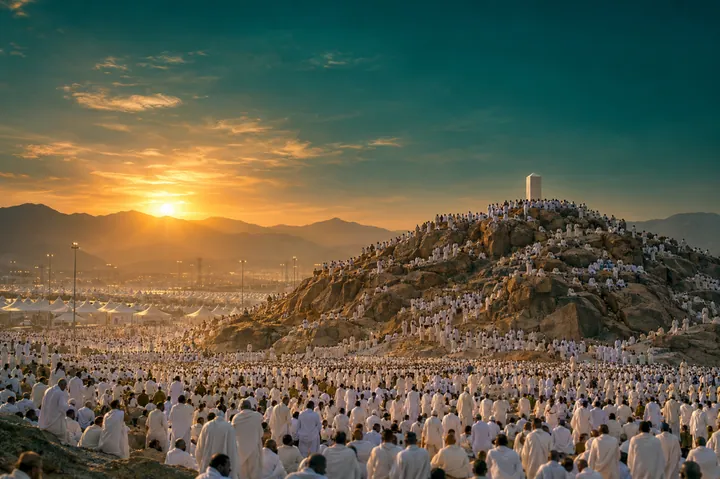
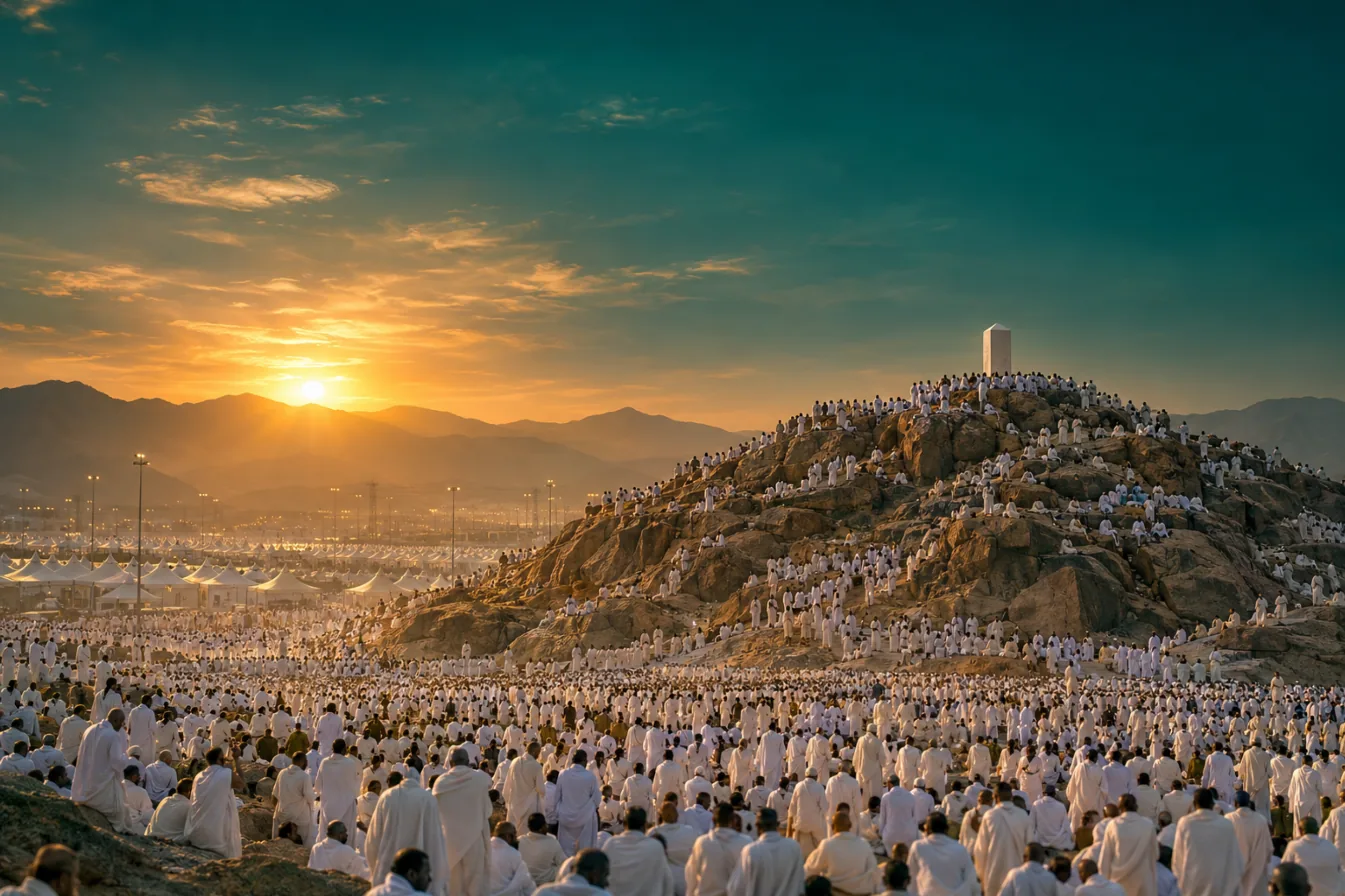
After sunrise he set off. Quraysh expected him to stop at al-Mash‘ar al-Haram as they used to, but he went on to Namirah, where a tent had been set up. After midday he rode to the valley of ‘Uranah and delivered the Farewell Sermon. Then Dhuhr and ‘Asr were prayed together, shortened, with one adhan and two iqamahs. He stood at Arafah near the rocks, facing the qiblah, in dua until sunset.
- 9 Dhul HijjahArafah
“Today I have perfected your religion”
‘Umar reported that the verse “Today I have perfected your religion for you, completed My favour upon you and chosen Islam as your religion” (5:3) was revealed while the Prophet ﷺ was standing at Arafah on a Friday (al-Bukhari and Muslim).
- Night of 10 Dhul HijjahMuzdalifah
Calm departure and the night at Muzdalifah
After sunset he left with Usamah riding behind him, pulling al-Qaswa’s rein tight and saying, “O people, calmly, calmly.” At Muzdalifah he prayed Maghrib and ‘Isha’ with one adhan and two iqamahs, with nothing in between, then lay down until dawn. He allowed weaker people, such as Sawdah, to leave earlier in the night (al-Bukhari and Muslim).
- 10 Dhul Hijjah — Day of Nahral-Mash‘ar al-Haram → Wadi Muhassir
Dawn at al-Mash‘ar al-Haram
He prayed Fajr as soon as dawn was clear, then went to al-Mash‘ar al-Haram, faced the qiblah and made dua, takbir and tahlil until the sky was very bright. He left before sunrise with al-Fadl ibn ‘Abbas behind him, and moved a little faster through the valley of Muhassir.
- 10 Dhul HijjahMina
Stoning, sacrifice and shaving
He stoned Jamrat al-‘Aqabah with seven small pebbles, saying takbir with each. He then sacrificed sixty-three camels with his own hand and gave the rest to ‘Ali, who sacrificed them — one hundred in all. A piece of each was cooked, and they ate from the meat and drank from the broth. He had his head shaved, starting with the right side, and gave his hair to the people (Muslim, from Anas).
- 10 Dhul HijjahMakkah → Mina
Tawaf al-Ifadah and Zamzam
He rode to the House and performed Tawaf al-Ifadah. He came to Banu ‘Abd al-Muttalib, who were giving out Zamzam, and said that if people would not crowd them out of their role he would draw water with them; they handed him a bucket and he drank. That day he addressed the people at Mina, and when asked about doing the rites out of order he said, “Do it, there is no harm” (al-Bukhari and Muslim).
- 11–13 Dhul Hijjah — Days of TashriqMina
The three Jamarat
Each day after midday he stoned the three Jamarat, seven pebbles each, standing long in dua after the first and second but not after Jamrat al-‘Aqabah (al-Bukhari, from Ibn ‘Umar). He did not hasten, completing the Farewell Hajj days in Mina on the 13th.
- 13–14 Dhul Hijjahal-Muhassab → al-Masjid al-Haram
Farewell tawaf
He went to al-Muhassab and prayed Dhuhr, ‘Asr, Maghrib and ‘Isha’ there, slept briefly, then rode to the House and performed the farewell tawaf (al-Bukhari, from Anas). ‘A’ishah performed an Umrah from al-Tan‘im with her brother ‘Abd al-Rahman before departure.
- 18 Dhul Hijjah (commonly dated)Ghadir Khumm → Madinah
Return to Madinah
On the way back he stopped at a watering place called Khumm. Zayd ibn Arqam reports that he addressed the people, urging them to hold to the Book of Allah and reminding them of Allah regarding his family (Sahih Muslim). He then continued to Madinah.
The Farewell Hajj route at a glance
The rites the Prophet ﷺ performed in the Farewell Hajj are the same sequence pilgrims follow today. Compare them with the modern steps:
The Farewell Sermon of the Farewell Hajj
The sermon at ‘Uranah on the Day of Arafah is the best-known moment of the Farewell Hajj. Jabir’s narration in Sahih Muslim preserves its key points:
- Sanctity of life and property: “Your blood and your property are sacred to you, like the sanctity of this day of yours, in this month of yours, in this land of yours.”
- The end of the days of ignorance: every practice of ignorance was placed under his feet. Blood-revenge claims were abolished, starting with that of his own relative Ibn Rabi‘ah ibn al-Harith.
- Abolition of riba: the usury of ignorance was cancelled, starting with that owed to his uncle al-‘Abbas ibn ‘Abd al-Muttalib.
- Rights of women: “Fear Allah regarding women.” Husbands took them by Allah’s trust, and wives have the right to provision and clothing in a fair manner.
- The Book of Allah: he left among them that which, if they held to it, they would never go astray — the Book of Allah.
- “Have I conveyed?”: he asked what they would say when asked about him. They said he had conveyed, fulfilled and given sincere counsel. He raised his finger to the sky, pointed to the people and said three times, “O Allah, bear witness.”
On the Day of Nahr he gave a further sermon at Mina, reported by Abu Bakrah in al-Bukhari and Muslim: time had come full circle, the year is twelve months with four sacred, blood, wealth and honour are sacred, “let those present convey to those absent”, and “do not turn, after me, into disbelievers striking one another’s necks”.
Where the Farewell Hajj narrations differ
Each Companion described the Farewell Hajj from where he or she stood, so some details differ. The scholars have discussed these openly:
- Type of Hajj: some reports describe Ifrad, others Tamattu‘ or Qiran. Many scholars, including Ibn al-Qayyim, conclude that he performed Qiran, based on Anas hearing him say “Labbayka ‘umratan wa hajjan” (Muslim), and reconcile the other reports with it.
- Where he began the Talbiyah: in the mosque at Dhul Hulayfah, when his camel stood up, or at al-Bayda’. Ibn ‘Abbas explained that different people heard him at different points (Abu Dawud).
- Dhuhr on the 10th: Jabir says he prayed Dhuhr in Makkah after Tawaf al-Ifadah; Ibn ‘Umar says he returned and prayed it at Mina (both in Muslim). Scholars have reconciled the two in different ways.
- Exact dates: the dates for departure and arrival are reconstructions from the reports; the Day of Arafah being a Friday is firmly established.
Farewell Hajj lessons for your own Hajj
- Follow the Sunnah: “Take your rites from me.” Learn each step before you travel with our Hajj step-by-step guide.
- Calmness: “O people, calmly, calmly” — the Farewell Hajj model for crowds and buses.
- Ease: “Do it, there is no harm,” and permission for the weak to leave Muzdalifah early.
- Women’s rites: Asma’ and ‘A’ishah show that menses never cancels a pilgrimage.
- Dua at Arafah: the Prophet ﷺ spent the afternoon facing the qiblah in dua.
- The Qur’an’s context: read the tafsir of the Hajj verses alongside this Farewell Hajj timeline.
Farewell Hajj: frequently asked questions
When was the Farewell Hajj?
The Farewell Hajj took place in Dhul Hijjah of 10 AH (early 632 CE). The Prophet ﷺ passed away in Rabi‘ al-Awwal of 11 AH, about three months later.
How many times did the Prophet ﷺ perform Hajj?
After the migration he performed Hajj once — the Farewell Hajj. He performed four Umrahs, the last together with this Hajj (al-Bukhari and Muslim, from Anas).
What type of Hajj did the Prophet ﷺ perform?
Many scholars hold he performed Qiran with hady. He told those without hady to make their ihram an Umrah, which is Tamattu‘.
Where is the full description of the Farewell Hajj?
The hadith of Jabir ibn ‘Abdullah in Sahih Muslim (1218) is the most complete account; read it on Sunnah.com.
Which verse was revealed during the Farewell Hajj?
Qur’an 5:3, “Today I have perfected your religion for you…”, was revealed on the Day of Arafah, a Friday, as ‘Umar reported in al-Bukhari and Muslim.
Follow the Farewell Hajj route yourself
Tell us your country of residence and preferred season, and our team will guide you through the official Hajj route and your options.